


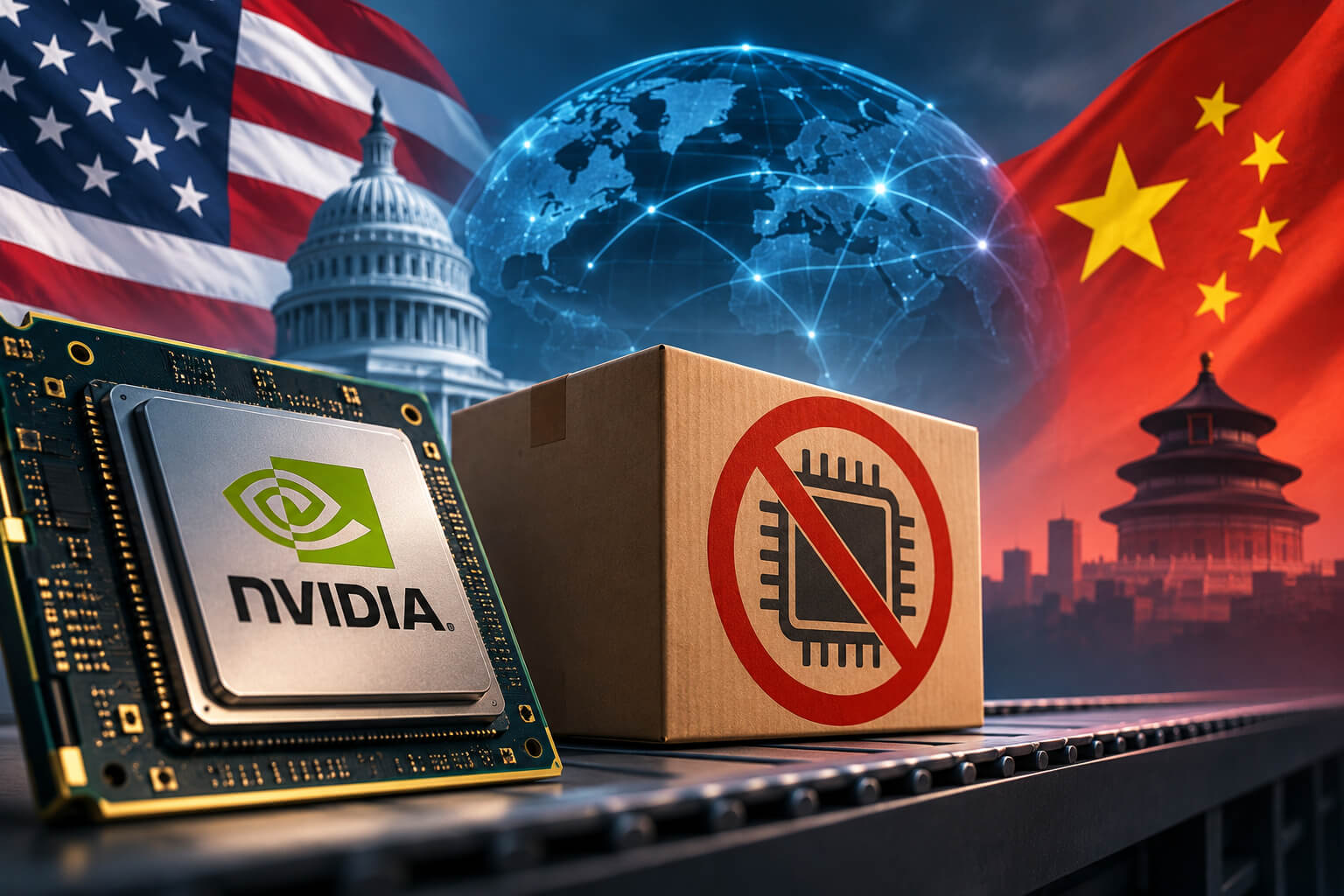
Nvidia has stopped shipping certain artificial intelligence chips to China despite receiving approval from the United States government, adding another complication to the already tense semiconductor relationship between the world’s two largest economies. The situation highlights ongoing concerns around Nvidia AI chip shipments to China as both governments tighten regulations and oversight on critical technology exports.
The decision highlights how unpredictable the global AI hardware market has become. Even when Washington allows advanced processors to reach Chinese customers, regulatory uncertainty and restrictions on the Chinese side can still disrupt shipments.
For Nvidia, the development creates fresh questions about its ability to serve one of the world’s largest technology markets. Chinese companies continue investing heavily in artificial intelligence, but securing the computing hardware needed to support those ambitions is becoming increasingly difficult.
Nvidia Suspends Shipments of Advanced AI Chips to China
Nvidia’s decision involves its Hopper-generation data center processors, including the H200, which companies use to train artificial intelligence models and handle demanding computing workloads. These chips are particularly valuable to technology businesses developing generative AI platforms, large language models, and advanced cloud services.
The suspension is notable because the processors had already received conditional approval for export under US licensing arrangements. Nvidia had been able to supply certain Chinese customers despite broader restrictions on advanced semiconductor technology.
The company has not publicly established a clear timeline for restarting shipments. That uncertainty leaves Chinese customers facing questions about future hardware availability, particularly as demand for high-performance AI computing continues to grow.
US Export Approval Has Not Eliminated Trade Barriers
The United States has spent several years tightening controls on advanced semiconductor exports to China, largely because of concerns that powerful AI processors could support military and national security applications. These restrictions have affected Nvidia and other American chipmakers seeking to maintain business relationships with Chinese technology companies.
Washington later introduced a licensing pathway that allowed certain advanced processors, including Nvidia’s H200, to be exported under specific conditions. The arrangement was intended to permit limited commercial sales while preserving government oversight of sensitive technologies.
However, receiving an American export license does not automatically guarantee that a shipment will reach its destination. Companies must also navigate Chinese import requirements, regulatory approvals, and broader political considerations that can change with little warning.
China Pushes for Greater Semiconductor Independence
China has been accelerating efforts to develop its own semiconductor industry as restrictions on American technology continue to reshape its AI ambitions. Domestic chipmakers are receiving increasing attention from technology companies looking for alternatives to imported processors.
That shift creates a difficult balancing act for Chinese authorities. Local AI developers still need access to powerful computing hardware, particularly for training sophisticated models, while Beijing wants to reduce dependence on foreign semiconductor suppliers.
Nvidia’s shipment suspension could reinforce the importance of domestic alternatives. Chinese technology companies may have to reconsider procurement plans, diversify hardware suppliers, or invest more heavily in locally developed AI computing infrastructure.
Nvidia Faces Growing Uncertainty in the Chinese Market
China has long represented an important commercial opportunity for Nvidia, with major technology companies investing in data centers, cloud computing, and artificial intelligence services. Demand for high-performance processors remains substantial, even as government restrictions complicate access.
The latest shipment halt adds another challenge to Nvidia’s international business. Export licensing requirements, changing trade policies, and China’s semiconductor development strategy make it increasingly difficult to predict how much hardware the company can sell in the market.
Nvidia also faces the possibility that prolonged restrictions will encourage Chinese customers to establish stronger relationships with domestic chipmakers. Once companies invest in alternative hardware systems and software ecosystems, returning to imported processors may become less straightforward.
Global AI Competition Becomes Increasingly Political
The dispute surrounding Nvidia’s chips reflects a broader transformation in the artificial intelligence industry. Advanced semiconductors are no longer viewed simply as commercial products. Governments increasingly treat them as strategic assets connected to economic competitiveness, national security, and technological influence.
American export controls are designed to limit access to sensitive computing capabilities, while China’s semiconductor policies aim to strengthen domestic production and reduce exposure to foreign restrictions. Technology companies operating between these competing priorities face considerable uncertainty.
The consequences extend beyond Nvidia and its Chinese customers. Cloud providers, AI startups, research institutions, and semiconductor manufacturers all depend on supply chains that can be affected by government decisions. A disruption involving one major chip supplier can influence hardware planning, investment decisions, and the pace of AI development.
What Happens Next for Nvidia AI Chip Shipments to China?
The immediate question is whether Nvidia will resume shipments under the existing licensing framework or wait for greater regulatory clarity. Without a confirmed timetable, Chinese customers may need to prepare for continued uncertainty surrounding access to American AI processors.
Future developments will depend partly on how Washington and Beijing approach semiconductor trade. Changes to export licensing rules, import approvals, or diplomatic negotiations could alter the commercial outlook for Nvidia and other technology suppliers.
For the wider AI industry, the situation illustrates a problem that is becoming harder to ignore. Companies are racing to develop more powerful artificial intelligence systems, yet access to the hardware behind those systems increasingly depends on political decisions.
Nvidia’s processors remain valuable to AI developers worldwide. Whether those chips can reach Chinese customers is now a question that goes well beyond technology.
Sources
1. Reuters — November 18, 2026: Nvidia Stops Shipping US-Approved AI Chips to China — Original reporting on Nvidia’s shipment suspension and its Chinese business. Investing.com
2. US Department of Commerce — January 13, 2026: Department of Commerce Revises License Review Policy for Semiconductors Exported to China — Official explanation of the revised export licensing framework. Bureau of Industry and Security
3. Federal Register — January 15, 2026: Export Licensing Regulations for Advanced Semiconductors — Regulatory requirements covering Nvidia H200 exports. GovInfo
