


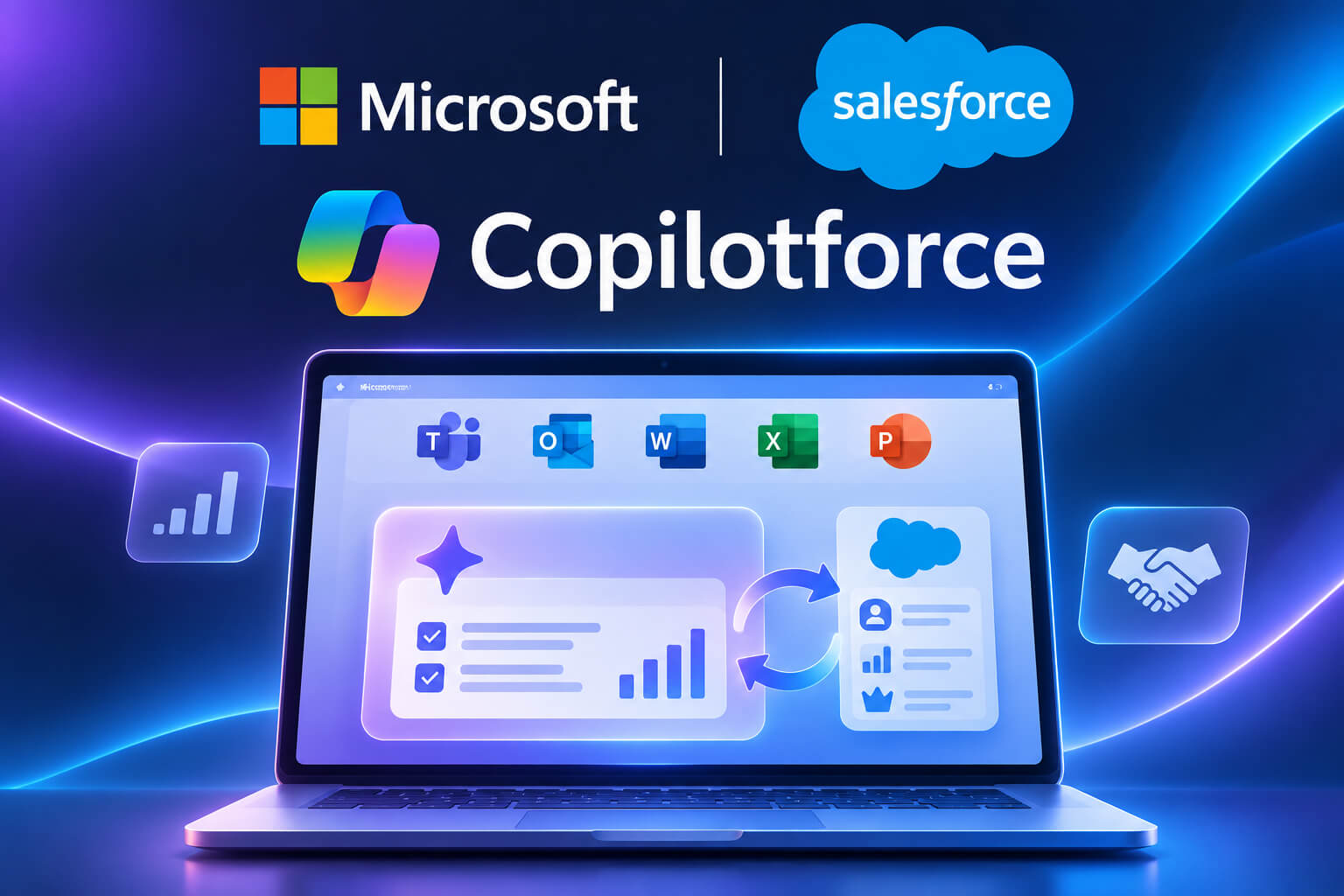
Microsoft and Salesforce have announced Copilotforce, a new enterprise AI collaboration designed to connect customer data, sales workflows and business intelligence directly with Microsoft Copilot, Teams and Fabric.
Announced on November 17, 2026, the partnership aims to make artificial intelligence more practical for sales teams by bringing Salesforce’s customer relationship management (CRM) capabilities into Microsoft’s everyday productivity applications.
The integration introduces Salesforce in Copilot, featuring more than 38 prebuilt sales skills that help employees manage opportunities, prepare for customer meetings, review sales pipelines and handle follow-up activities.
Rather than switching between multiple applications to find customer information, employees can use AI to access relevant business context and complete supported tasks within familiar Microsoft tools.
Copilotforce Brings Salesforce Customer Data Into Microsoft Copilot
Sales teams often work with information scattered across several platforms. Customer records live in Salesforce, important conversations happen in Outlook, and internal discussions take place in Microsoft Teams. Finding the complete picture of a customer relationship can take longer than the actual task.
Copilotforce is designed to address that problem by connecting Salesforce customer information with Microsoft’s AI experiences. Through Microsoft’s Work IQ intelligence layer, Copilot can use relevant context from Teams meetings, Outlook emails, SharePoint documents and OneDrive files alongside authorized Salesforce data.
For example, a sales representative preparing for an important client meeting could ask Copilot to summarize recent customer interactions, highlight unresolved concerns and identify potential opportunities. Instead of manually searching through CRM records and email conversations, the employee receives a more connected view of the account.
The integration also uses Salesforce’s Model Context Protocol (MCP) connection to support authenticated access to customer information and permitted CRM actions.
More Than 38 AI Sales Skills Aim to Reduce Administrative Work
Microsoft and Salesforce are focusing on practical sales activities rather than simply introducing another conversational AI assistant. Salesforce in Copilot includes more than 38 prebuilt skills designed to help employees manage customer relationships, monitor opportunities and complete routine tasks.
Among the capabilities are Pipeline Review and Close Planning, which help sales teams evaluate opportunities and determine what needs attention before a deal closes. Customer Health and Renewal Radar can also identify potential concerns by connecting CRM records with relevant conversations and business information.
Another feature, Call Follow-Up, helps prepare customer follow-up drafts, summarize discussions and suggest activities that employees can review before updating Salesforce.
These tools could be particularly valuable for sales professionals who spend a considerable amount of time maintaining records, preparing reports and coordinating customer communications. Whether they produce measurable productivity gains will depend on how businesses integrate them into existing workflows.
Microsoft Teams Gains Deeper Salesforce Integration
Microsoft Teams is becoming another place where Salesforce customers can access and manage sales information. Through Sales Cloud in Teams, employees can review CRM data, monitor pipeline performance and receive updates about customer opportunities without constantly moving between applications.
The integration is currently being tested with enterprise customers and is intended to make collaboration more closely connected to sales activity. Account managers could discuss a potential deal in Teams while reviewing relevant Salesforce information, helping colleagues work from the same customer context.
Sales representatives will also be able to access customer briefings, monitor quotas and receive notifications related to deals. Supported changes to CRM records will still require user confirmation and remain subject to Salesforce validation rules.
For organizations with large sales departments, bringing CRM functionality into Teams could simplify how employees coordinate customer activities and make decisions.
Salesforce Data 360 and Microsoft Fabric Introduce Zero Copy Data Sharing
The collaboration extends beyond sales tools into enterprise data management. Microsoft and Salesforce are introducing two-way Zero Copy integrations between Salesforce Data 360 and Microsoft Fabric, allowing organizations to work with information across both platforms without repeatedly copying entire datasets.
The Data Federation connection is already generally available, enabling Salesforce Data 360 users to query supported data stored in Microsoft Fabric OneLake while keeping that information in its original environment. The reverse integration, which allows curated Salesforce Data 360 information to be shared into OneLake, is currently available in public preview.
This matters for businesses that rely on customer information from multiple systems. Sales data alone rarely tells the whole story. Financial records, purchasing behavior, operational performance and customer service information can provide additional context.
By connecting these sources, organizations could build more comprehensive analytics and give AI applications access to broader business information. The goal is to reduce unnecessary data movement while making information more useful across enterprise applications.
Accenture Will Help Test and Implement Copilotforce
Accenture is joining the initiative as a design and implementation partner as well as an early pilot customer. The consulting company plans to test Copilotforce integrations within its global sales organization, giving Microsoft and Salesforce an opportunity to evaluate the technology in a large enterprise environment.
According to the announcement, Accenture has already expanded Microsoft Copilot access to more than 740,000 people and has approximately 55,000 Salesforce users. That scale makes the company a significant testing environment for AI-powered sales workflows.
Its involvement will help the companies examine how customer information, employee communications and automated sales activities work together across different systems. The pilot could also provide insights into implementation challenges, user adoption and the practical value of AI assistance.
Security and Customer Data Permissions Remain a Priority
Giving AI systems access to customer information creates obvious concerns about privacy, permissions and data governance. Microsoft and Salesforce say Copilotforce is designed to respect existing enterprise security controls rather than bypass them.
Salesforce will continue enforcing permissions governing customer records and CRM activities, while Microsoft’s compliance and security systems will apply to relevant workplace information. Employees will only be able to access data they are authorized to use.
The companies are also keeping human confirmation in the process for supported actions that write information back to Salesforce. This is important because Copilotforce goes beyond answering questions. It is intended to help employees take actions within business systems.
For enterprises handling sensitive customer relationships and commercial information, these safeguards will be an important consideration when deciding how widely to deploy the technology.
When Will Microsoft Copilotforce Become Available?
Copilotforce is being introduced through several releases rather than one immediate rollout. As of November 17, 2026, Salesforce in Copilot is available in public preview, giving eligible organizations an opportunity to explore the new AI sales capabilities.
The Microsoft OneLake-to-Salesforce Data 360 federation connection is generally available, while the reverse Data 360-to-OneLake integration remains in public preview.
Sales Cloud in Teams is undergoing enterprise pilot testing, with an open beta planned for later in 2026. Availability may vary depending on region, customer agreements and specific product requirements.
Businesses interested in adopting Copilotforce will need to review which integrations are currently accessible and whether additional configuration or licensing requirements apply.
What Copilotforce Means for the Future of Enterprise AI
Copilotforce reflects a growing shift in enterprise AI. Businesses are looking beyond standalone chatbots and toward systems that can understand work context, connect information across applications and assist with actual business processes.
Microsoft already has a strong presence in workplace productivity, while Salesforce remains a major platform for customer relationship management. Bringing those environments closer together could make AI more useful for employees who depend on both systems.
The challenge will be proving that these capabilities deliver meaningful results. Faster access to information is helpful, but organizations will ultimately want to see improvements in sales efficiency, customer engagement and operational performance.
Copilotforce is another sign that enterprise AI is moving deeper into the applications employees already use. The technology’s long-term value will depend less on how many AI features it offers and more on how effectively those features support everyday work.
