


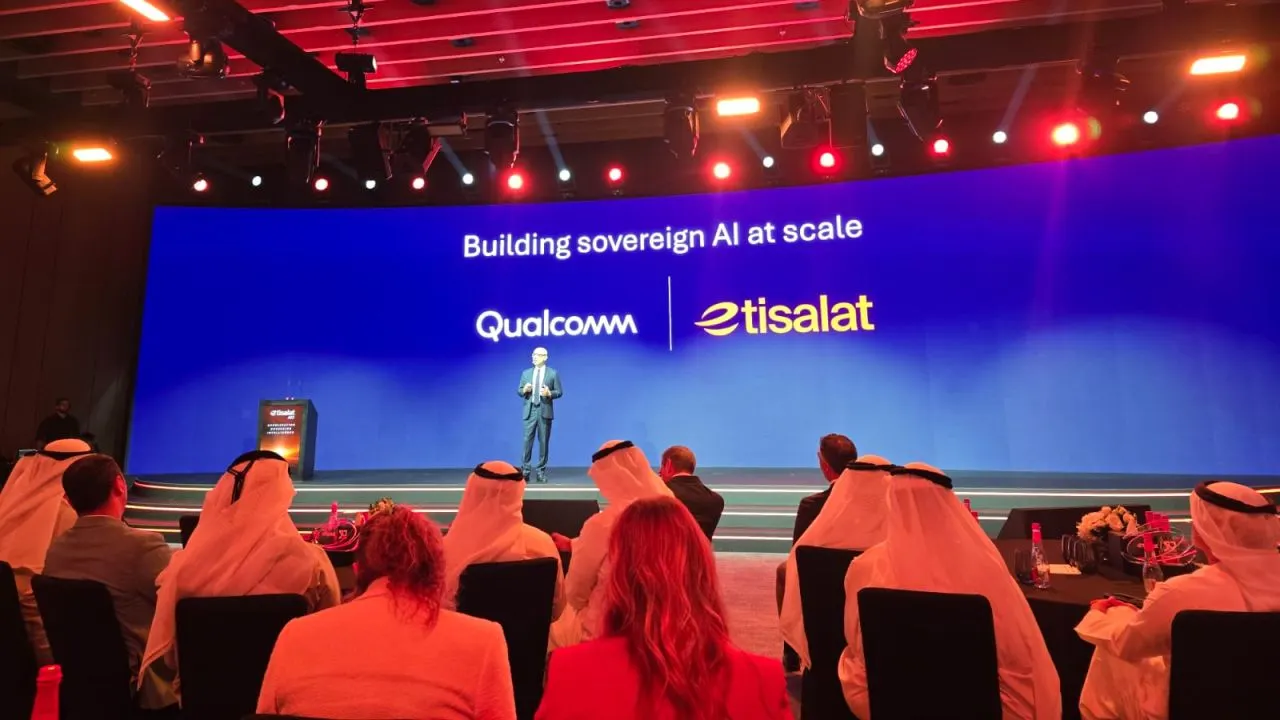
UAE telecommunications provider etisalat has launched its AIO platform, combining artificial intelligence infrastructure, advanced connectivity, cybersecurity and business automation into a unified ecosystem designed for enterprises and government organisations.
Unveiled during etisalat AI Innovation Day in Dubai on November 16, 2026, the platform brings together ten technology capabilities that could make it easier for organisations to adopt AI without developing their own infrastructure from the ground up.
The Etisalat AIO platform also reflects the company’s wider ambition to move beyond traditional telecommunications services and become a major provider of sovereign AI technology across the UAE and international markets.
Etisalat AIO Platform Brings Ten AI Technologies Together
Building an AI system involves more than choosing the right software. Companies need powerful computing infrastructure, secure data environments, reliable networks and applications capable of handling everyday operations. Managing these requirements separately can become expensive and difficult, particularly for smaller businesses.
Etisalat is addressing that challenge through AIO, which combines ten technology capabilities across three main areas: intelligence foundations, industry-specific solutions and business applications.
The platform includes AI data centres, AI Connect, AI Compute and Token Factory, Edge AI, mission-critical systems, industrial AI solutions, AI Security and Quantum, agentic AI, drones and robotics.
These capabilities are designed to work together, allowing organisations to access computing resources, process information, automate workflows and deploy intelligent applications through a more integrated technology environment.
Rather than offering AI as another standalone business tool, etisalat wants to provide the infrastructure and services required to support AI throughout an organisation.
Sovereign AI Infrastructure Becomes a Priority for UAE Businesses
Data sovereignty sits at the centre of etisalat’s new AI strategy. As more businesses adopt AI, questions about where sensitive information is stored, how it is processed and who controls the underlying infrastructure have become increasingly important.
The AIO platform includes UAE-based AI computing and data centre capabilities designed to support local data residency requirements and secure deployment environments.
This could appeal to government agencies, financial institutions and healthcare organisations that need tighter control over confidential information.
Etisalat is also offering private computing environments and managed AI infrastructure, allowing businesses to run AI applications without necessarily investing in their own specialised hardware.
The company views sovereignty as more than keeping information inside national borders. Its approach also focuses on maintaining control over AI deployment, operations and governance.
For UAE organisations looking to expand AI adoption while meeting security and regulatory requirements, that combination could become an important consideration.
Edge AI and Qualcomm Technology Support Faster Business Operations
Another major component of the Etisalat AIO platform is edge AI, which allows information to be processed closer to the devices and systems generating it.
Traditional cloud-based AI applications often send information to remote data centres before returning a result. Edge AI can reduce that delay by performing certain tasks locally, making it useful for operations that require quick responses.
Etisalat has previously collaborated with Qualcomm on edge AI technologies, including industrial connectivity, smart mobility and enterprise applications.
These capabilities could support manufacturing facilities that need to detect equipment problems, logistics companies monitoring shipments or industrial operators using intelligent cameras to identify potential safety hazards.
Edge computing can also help maintain selected AI functions during connectivity disruptions.
For businesses operating in remote locations or managing critical infrastructure, the ability to process information locally could improve reliability and reduce dependence on distant computing facilities.
Agentic AI Could Change How UAE Companies Manage Workflows
Etisalat is also bringing agentic AI into its enterprise technology portfolio, offering businesses systems that can carry out connected tasks rather than simply generate responses.
Unlike conventional AI chatbots, agentic systems can work across different applications, retrieve information and initiate actions within predefined permissions.
A logistics company, for example, could use an AI agent to identify a shipment delay, review delivery information and recommend an appropriate response. Customer service teams could use similar technology to manage enquiries, retrieve account details and support order processing.
Etisalat has been developing these capabilities as part of its broader enterprise automation strategy, including collaboration with AI technology partners.
The company says human approval and governance controls remain important, particularly when automated systems handle sensitive operations.
For businesses already experimenting with AI assistants, agentic AI represents a potential next step toward more automated daily operations.
Healthcare, Energy and Logistics Could Benefit From Industrial AI
The Etisalat AIO platform is designed for industries where AI could improve efficiency, monitoring and decision-making.
Healthcare organisations could use AI computing resources to support medical image analysis and other data-intensive applications. Energy companies may benefit from predictive maintenance systems that identify potential equipment failures before they disrupt operations.
In manufacturing, AI-powered cameras and digital twins could help operators monitor production facilities, detect defects and simulate changes to industrial processes.
Etisalat has also highlighted Smart Wadi, an AI-supported system designed to provide early flood warnings.
For logistics operators, the platform could support intelligent shipment monitoring, warehouse automation and improved coordination between connected systems.
These applications illustrate how the company intends to bring AI into physical operations rather than limiting its services to office productivity software.
Drones and Robotics Expand Etisalat’s AI Ambitions
Etisalat’s AI strategy also extends into drones and robotics, two areas attracting growing attention as businesses explore ways to automate physical tasks.
The company’s platform includes capabilities for AI-supported drones that could inspect power lines, monitor infrastructure and assist with emergency assessments, subject to applicable aviation regulations.
Robotics solutions are also part of the ecosystem, including autonomous mobile robots and collaborative machines designed to operate alongside human workers.
Warehouses could use these systems to move materials, while industrial facilities may deploy robots for repetitive or potentially hazardous tasks.
Healthcare environments could eventually benefit from robotic systems that assist with internal logistics and routine operations.
These technologies will require reliable connectivity, computing resources and secure coordination between machines. Etisalat is positioning its existing telecommunications infrastructure as a foundation for supporting those requirements.
Etisalat Targets Growth in Enterprise and Government AI Services
The launch of AIO comes as etisalat looks to expand its business beyond conventional telecommunications.
The company has outlined plans to increase its international connectivity capacity to 500 terabits per second while pursuing growth in enterprise and government technology services.
It is also targeting a doubling of revenue from those business segments.
AI infrastructure could play a significant role in that strategy as more organisations look for providers capable of supplying computing resources, connectivity, cybersecurity and automation through integrated services.
Etisalat’s existing telecommunications networks and enterprise relationships give it a starting point in this market.
Still, turning those advantages into widespread AI adoption will depend on affordability, reliability and the ability to deliver measurable business improvements.
UAE Strengthens Its Position in Sovereign AI Development
Etisalat’s AIO launch reflects the UAE’s wider investment in artificial intelligence infrastructure and locally controlled digital services.
The country has been expanding its AI capabilities through investments in data centres, cloud computing, advanced networks and partnerships with international technology companies.
For businesses, access to sovereign AI infrastructure could reduce some of the technical and operational barriers associated with deploying advanced applications.
It could also create opportunities for smaller organisations that cannot afford to build dedicated AI computing facilities.
The challenge will be ensuring that these services remain accessible while meeting security, regulatory and operational requirements.
Etisalat’s platform is an ambitious attempt to bring several parts of the AI technology stack under one ecosystem. Its commercial success, however, will depend on how effectively those capabilities translate into useful services for customers.
As AI becomes more closely integrated with business operations, the demand for secure computing, dependable connectivity and practical automation is likely to grow.
The Etisalat AIO platform puts the company in a position to compete for that demand, while supporting the UAE’s broader push toward sovereign AI infrastructure and enterprise digital transformation.
Sources
- Middle East AI News – UAE Telecom Etisalat Bundles AI Stack
- Emirates News Agency (WAM) – Etisalat UAE Launches Sovereign AI Platform AIO
- Etisalat UAE – Official AIO Platform
- Campaign Middle East – Etisalat AIO Launch Accelerates Sovereign Intelligence
- Intelligent CIO Middle East – Etisalat Builds a Sovereign AI Ecosystem
