


Meta is not treating AI infrastructure like a side project anymore.
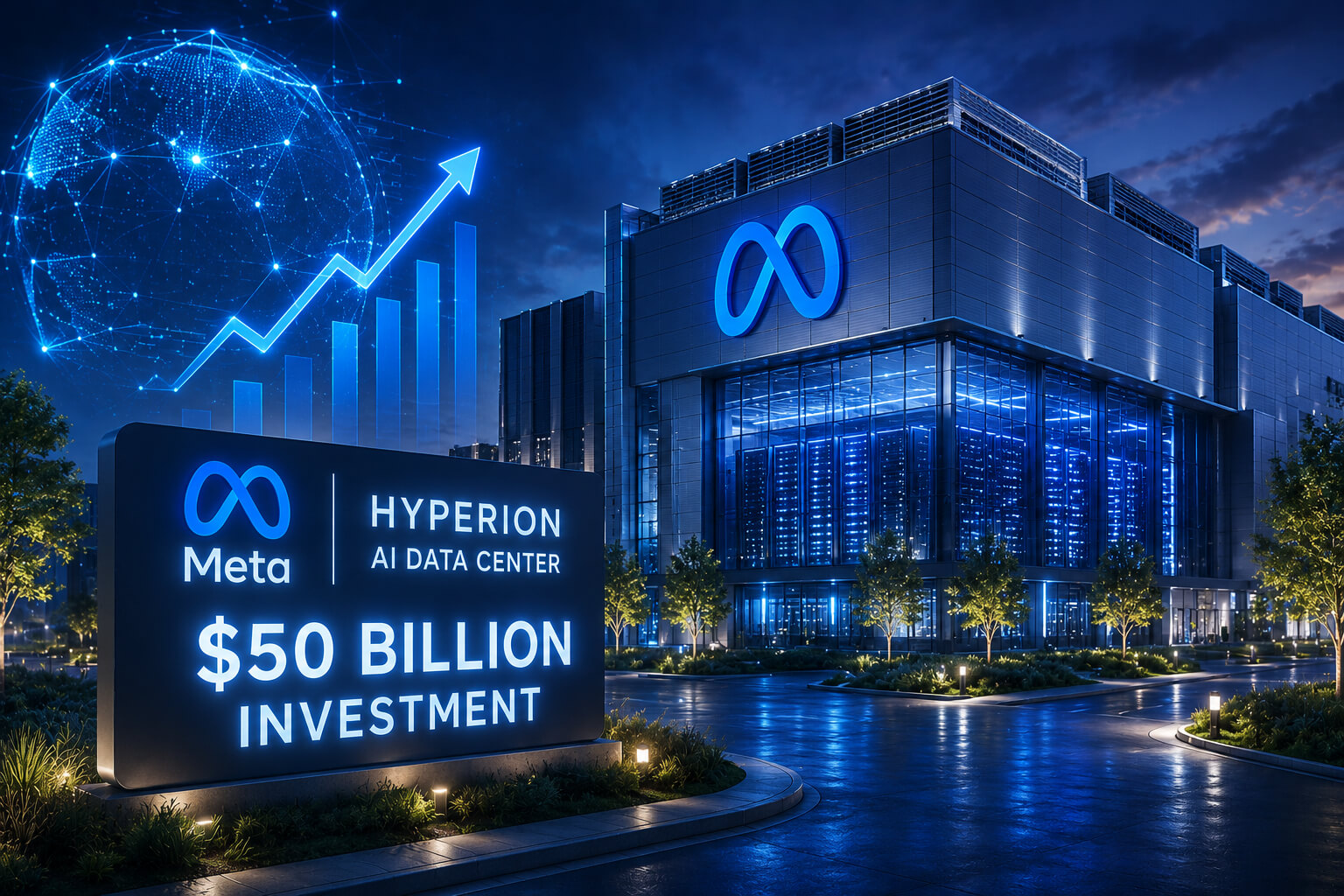
The company’s Hyperion AI data center project in Richland Parish, Louisiana, is now expected to cost more than $50 billion, a sharp jump from earlier estimates. The expansion also lifts the planned compute capacity to 5 gigawatts, making it one of the biggest AI infrastructure bets currently underway.
That number is hard to ignore. Fifty billion dollars for one AI data center project. Not a model launch. Far from a new app. And not a flashy chatbot feature. Just the physical backbone Meta believes it needs for the next stage of AI.
Meta’s Hyperion Project Is Getting Much Bigger
Hyperion was already large. Now it looks massive.
The project was previously estimated at around $27 billion with 2 gigawatts of compute capacity. With the expansion, Meta is pushing the planned capacity to 5 gigawatts and raising the total projected cost above $50 billion.
That puts Hyperion in a different category from ordinary data center projects. This is not about storing photos or running basic cloud services. The site is being built for AI workloads, the kind that demand enormous power, advanced chips, cooling systems, grid planning, and long-term capital.
Meta wants more compute. A lot more.
And that says something about where Mark Zuckerberg’s AI strategy is heading. The company is not only competing through models, assistants, smart glasses, social platforms, and AI tools. It is also trying to secure the infrastructure underneath all of it.
The AI Race Is Becoming a Power Race
AI used to be discussed mostly in terms of software.
Better models. Faster answers. Smarter assistants. More realistic images. Longer videos. Better coding tools.
Now the conversation is shifting. Compute is becoming the real battleground.
For companies like Meta, OpenAI, Google, Microsoft, Amazon, and xAI, the next jump in AI capability depends heavily on access to chips, energy, land, cooling, and large-scale data center construction. The companies that can build faster may have a serious advantage.
Hyperion shows that Meta understands this clearly.
A 5-gigawatt data center is not just a tech investment. It is an energy project, a construction project, a regional economic project, and an AI strategy all rolled into one. That makes it powerful. It also makes it controversial.
Louisiana Is Already Feeling the Impact
The Hyperion project is already changing parts of Richland Parish.
Reports say Louisiana businesses have received more than $1.6 billion in contracts tied to the project. Local tax revenue has also increased, with teacher bonuses in Richland Parish reportedly rising from $10,000 last year to more than $50,000 this year.
That is the kind of local impact politicians and business leaders like to highlight. Jobs, contracts, tax revenue, school funding, infrastructure spending. For a rural area, a project of this size can change the financial picture very quickly.
Meta has also said it plans to spend more than $1 billion on local infrastructure improvements without passing those costs to consumers, according to reports. Once operational, the data center is expected to create more than 1,000 jobs.
Still, big promises do not erase the harder questions.
Energy and Water Questions Are Not Going Away
AI data centers need serious power.
That is where the debate gets uncomfortable. As Big Tech expands AI infrastructure, communities and regulators are asking who pays for the power upgrades, how water demand will be handled, and whether local residents could face higher utility pressure over time.
Meta has partnered with Entergy Louisiana to support the energy needs of the project, while also committing to cover related infrastructure costs, according to reports.
But the larger issue remains bigger than one project.
AI companies keep saying they need more compute. That compute needs electricity. Electricity needs generation, transmission, land, and planning. At some point, the AI boom stops being just a Silicon Valley story and becomes a public infrastructure story.
Hyperion is a clear example of that shift.
Meta Is Spending Like AI Is the Future of the Company
The scale of the Hyperion investment also reflects Meta’s bigger AI push.
Zuckerberg has been trying to position Meta as a serious player in frontier AI, open-source models, AI assistants, smart glasses, creator tools, advertising automation, and eventually more advanced AI systems. None of that works at scale without massive compute.
So Meta is spending.
Not quietly either.
The company is part of a wider Big Tech capital spending wave, with major firms pouring hundreds of billions into AI infrastructure. Analysts have projected huge increases in hyperscale compute capacity over the next few years as demand for AI training and inference keeps rising.
That is why Hyperion matters. It is not just one Louisiana data center. It is a signal.
Meta wants enough infrastructure to compete at the top level of AI. And it seems willing to pay the price.
Hyperion Shows the Real Cost of AI Ambition
The public usually sees AI as a product.
A chatbot. A search tool. A video generator. A voice assistant. A pair of AI glasses.
Behind that is the expensive part. The land. The chips. The power lines. The cooling. The permits. The financing. The construction crews. The local political negotiations. The grid stress. The environmental pushback.
That physical buildout also reaches companies supplying fiber-optic connectivity for AI data centers, firms providing AI chip testing and semiconductor services, and technology companies trying to make AI models cheaper to operate.
Meta’s Hyperion project puts all of that into view.
A $50 billion AI data center is not just a business headline. It is a reminder that the AI race is moving into the physical world in a very big way.
And Meta is betting that whoever controls enough compute will have a stronger shot at controlling the next phase of artificial intelligence.
Source: Times of AI
