

Close Menu
    What's Hot
    Business & Marketing

    OpenAI Delays 2026 IPO as Altman Raises AI Safety Concerns

    By Art RyanSeptember 14, 20260

    OpenAI will not make its stock market debut in 2026. CEO Sam Altman has ruled…

    Xi Jinping Pushes BRICS AI Alliance as China Seeks Bigger Role in Global Tech

    September 14, 2026

    Ireland Takes Europe’s AI Lead as Business Adoption Jumps to 65%

    September 14, 2026

    Manufacturing AI Moves Beyond Pilots as Industrial Adoption Enters New Phase

    September 14, 2026
    Facebook X (Twitter) Instagram
    Facebook X (Twitter) Instagram
    Breaking AI News
    Monday, September 14
    • Home
    • Events
    • Videos
      • Machine Can Think Summit 2026
      • Step Dubai Conference 2026
    • Technology & Innovation

      OpenAI Delays 2026 IPO as Altman Raises AI Safety Concerns

      September 14, 2026

      Xi Jinping Pushes BRICS AI Alliance as China Seeks Bigger Role in Global Tech

      September 14, 2026

      Ireland Takes Europe’s AI Lead as Business Adoption Jumps to 65%

      September 14, 2026

      Manufacturing AI Moves Beyond Pilots as Industrial Adoption Enters New Phase

      September 14, 2026

      Weekly AI News: OpenAI Astra, Mistral Funding and Enterprise AI Lead

      September 13, 2026
    • Business & Marketing

      OpenAI Delays 2026 IPO as Altman Raises AI Safety Concerns

      September 14, 2026

      Ireland Takes Europe’s AI Lead as Business Adoption Jumps to 65%

      September 14, 2026

      UK Economy Grows 0.4% as AI and Cloud Computing Help Power July Expansion

      September 12, 2026

      Mistral Raises €3 Billion to Push Sovereign, Open-Weight AI Toward the Frontier

      September 12, 2026

      UAE Plans €40 Billion Germany Investment With AI and Data Centres at the Core

      September 12, 2026
    • Industry Applications

      Manufacturing AI Moves Beyond Pilots as Industrial Adoption Enters New Phase

      September 14, 2026

      Ghana Expands AI and Digital Skills Training Across Technical Education

      September 12, 2026

      Samsung and Mistral AI Bring On-Premises AI Into Semiconductor Manufacturing

      September 11, 2026

      JD.com Bets on Physical AI With Plan for 3 Million Robots Across Logistics Network

      September 11, 2026

      Snapchat CEO Bets on AI-Powered Advertising to Predict What Users Want Next

      September 11, 2026
    • Trends & Insights

      Ireland Takes Europe’s AI Lead as Business Adoption Jumps to 65%

      September 14, 2026

      Manufacturing AI Moves Beyond Pilots as Industrial Adoption Enters New Phase

      September 14, 2026

      Anthropic CEO Calls on AI Industry to Slow Model Development as Safety Fears Grow

      September 13, 2026

      UAE Rethinks 5GW AI Data Center Campus After Iranian Attacks Raise Security Concerns

      September 12, 2026

      UK Economy Grows 0.4% as AI and Cloud Computing Help Power July Expansion

      September 12, 2026
    • AI in Travel

      Travelxp Launches Marco, an Agentic AI Travel Concierge That Can Book and Pay for Trips

      September 12, 2026

      Mindtrip Brings AI-Powered Trip Planning to South Dakota Tourism Websites

      September 11, 2026

      HBX Group and Vorsee Bring Predictive and Agentic AI to Hotel Operations

      September 8, 2026

      Vintavia Launches AI Travel App Built Around Where Travellers Actually Are

      September 5, 2026

      AI Commerce Is Growing Fast, but Trust and Payment Gaps Could Slow Adoption

      September 5, 2026
    Breaking AI News
    Home » How AI Could Improve Economic Policymaking and Interest-Rate
    Business & Marketing

    How AI Could Improve Economic Policymaking and Interest-Rate

    Art RyanBy Art RyanJune 3, 2026No Comments5 Mins Read
    Facebook Twitter Pinterest LinkedIn Tumblr Email
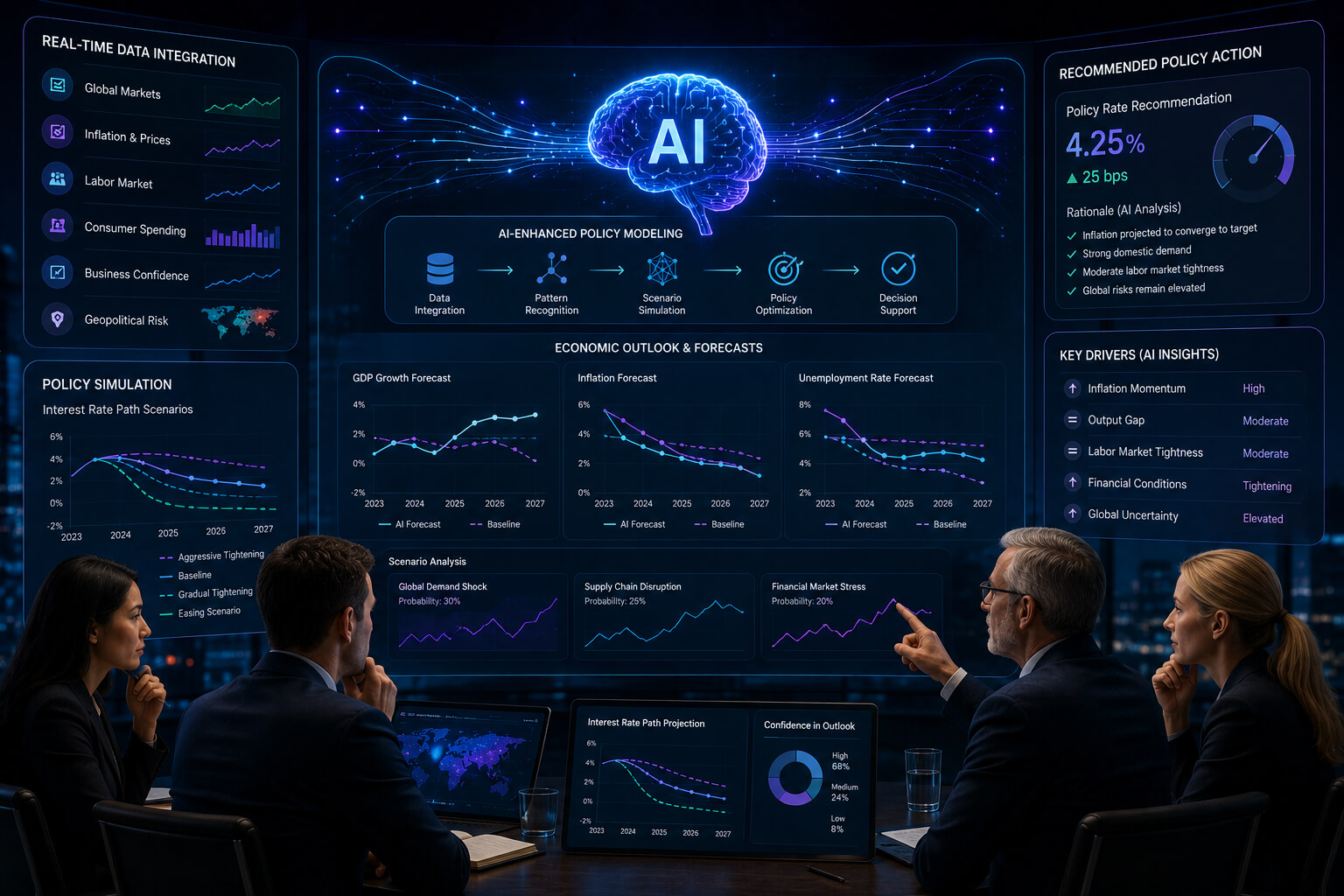
    AI in economic policymaking
    Share
    Facebook Twitter LinkedIn Pinterest Email

    Artificial intelligence is rapidly advancing beyond chatbots, image generators and productivity-boosting tools on the job. Its next big act may be in one of the most consequential areas of public life: economic policy.

    Central banks, finance ministries and government agencies use vast amounts of data to make decisions about inflation, interest rates, employment, financial stability and economic growth. But the traditional models of economics can struggle to keep up with the rapid changes in the real world.

    AI might change that.

    AI can assist policy makers in observing what is happening in the economy earlier than traditional reports by examining large amounts of data in real time, identifying economic trends and making forecasts more accurate.

    AI Can Make Economic Policymakers Better

    Economic policymakers tend to rely on lagging indicators. Inflation reports, labor data, consumer spending figures and GDP numbers take weeks or months to fully reflect what is happening.

    AI systems can process more and faster data including signals from financial markets, business activity, supply chain data, consumer behavior and public sentiment. This could help policy-makers spot economic risks earlier and take more accurate action.

    This matters to central banks because their interest rate policy decisions are heavily influenced by an understanding of trends in inflation, growth and employment. If AI can help improve economic forecasting, it could help inform better decisions on whether to raise, lower or hold interest rates steady.

    AI and Central Banks A new tool for forecasting

    Central banks are already exploring how AI can assist them in their work. AI can assist with “nowcasting,” a technique for evaluating current economic conditions before official data is published.

    Policymakers could track shifts in inflation pressure, business activity, credit conditions and labor-market weakness in near real time, rather than on a quarterly basis. AI-powered systems could help.

    That is not to say that AI will replace economists or central bankers. Rather, AI may be employed as a decision-support tool to assist specialists in assessing different scenarios, comparing policy outcomes, and gaining a better grasp of uncertainty.

    Better economic modeling with AI

    Traditional economic models are useful, but they often rely on simplified assumptions about how people, companies and markets behave. AI can help create more dynamic models by learning from large datasets and finding connections that might be difficult for people to spot.

    For example, AI could model what a tax change could mean for households, a rate hike could mean for borrowing or supply-chain disruptions could mean for pushing inflation higher.

    It could make economic policymaking more responsive. Instead of relying on past trends, governments could use AI to stress test policy options across a range of economic scenarios.

    The Risks of Applying AI in Economic Policy

    AI might enhance policy, but it also poses grave risks.

    Economic decisions impact millions of people, so AI models need to be transparent, reliable and carefully supervised. A flawed model could misinterpret economic signals, reinforce bias or give policymakers a false sense of confidence.

    There is also the risk of overreliance. AI can spot patterns, but it does not have an understanding of society, politics or human behaviour like experienced policymakers do. Economic policy involves judgment, trade-offs and values – not just data.

    AI should be an aid to human decision-making and not a substitute for it.

    AI could revolutionise the way government makes decisions

    The emergence of AI in economic policymaking is part of a wider change in how governments use technology. Public institutions are under pressure to make decisions faster and with greater precision in an increasingly complex global economy.

    AI can help governments respond better to inflation, recessions, financial shocks, labor-market changes, and productivity trends. It can also help improve public services by helping agencies allocate resources better.

    But trust will be the key to successful adoption. Policymakers will need clear rules around how AI tools are tested, audited, explained and used in high-stakes decisions.

    What’s Next

    AI is not going to take over economic policymaking anytime soon. But it is becoming an increasingly powerful tool for economists, central banks and governments.

    The most probable future is one in which AI helps policymakers better understand the economy, test more scenarios, and make smarter decisions using better data.

    Well managed, AI could be one of the most important upgrades to economic policy in decades.

    Why It Matters

    Economic policymaking with AI matters because decisions on interest rates, inflation, jobs and public spending affect us all.

    Better forecasting could help central banks avoid policy mistakes. Faster data analysis could help governments respond earlier to economic slowdowns. More advanced modelling could lead to smarter decisions on taxes, spending and regulation.

    But the risks are high. If AI tools are inaccurate, biased, or not well understood, they could make economic policy more fragile, not more reliable.

    The future of AI in policy-making will be decided by whether governments can combine machine intelligence with human judgment, transparency and accountability.

    For more Breaking AI news, visit: https://breakingai.news

    Share. Facebook Twitter Pinterest LinkedIn Tumblr Email
    Art Ryan

    Related Posts

    OpenAI Delays 2026 IPO as Altman Raises AI Safety Concerns

    September 14, 2026

    Xi Jinping Pushes BRICS AI Alliance as China Seeks Bigger Role in Global Tech

    September 14, 2026

    Ireland Takes Europe’s AI Lead as Business Adoption Jumps to 65%

    September 14, 2026

    Comments are closed.

    Latest News

    OpenAI Delays 2026 IPO as Altman Raises AI Safety Concerns

    September 14, 2026

    Xi Jinping Pushes BRICS AI Alliance as China Seeks Bigger Role in Global Tech

    September 14, 2026

    Ireland Takes Europe’s AI Lead as Business Adoption Jumps to 65%

    September 14, 2026

    Manufacturing AI Moves Beyond Pilots as Industrial Adoption Enters New Phase

    September 14, 2026
    Facebook X (Twitter) Pinterest Vimeo WhatsApp TikTok Instagram LinkedIn YouTube Spotify Reddit Snapchat Threads

    AI University

    • Global Universities
    • Universities in Africa
    • Universities in Asia
    • Universities in Europe
    • Universities in Latin America
    • Universities in Middle East
    • Universities in North America
    • Universities in Oceania

    AI Tools & Apps Directory

    • AI Productivity Tools
    • AI Coding Tools
    • AI Voice Tools
    • AI Video Tools
    • AI Image Generators
    • AI Writing Tools

    Info

    • Home
    • About Us
    • AI Organizations & Associations
    • Contact Us
    • Cookie Policy
    • Copyright Policy
    • Disclaimer
    • Editorial Policy
    • Terms and Conditions

    Subscribe to Updates

    Get the latest creative news from FooBar about art, design and business.

    © 2026 Breaking AI News.
    • Privacy Policy

    Type above and press Enter to search. Press Esc to cancel.

    Sign Up

    Want to stay ahead In Artificial Intelligence?

     Sign up now and get exclusive breaking AI news and special updates—FREE!