


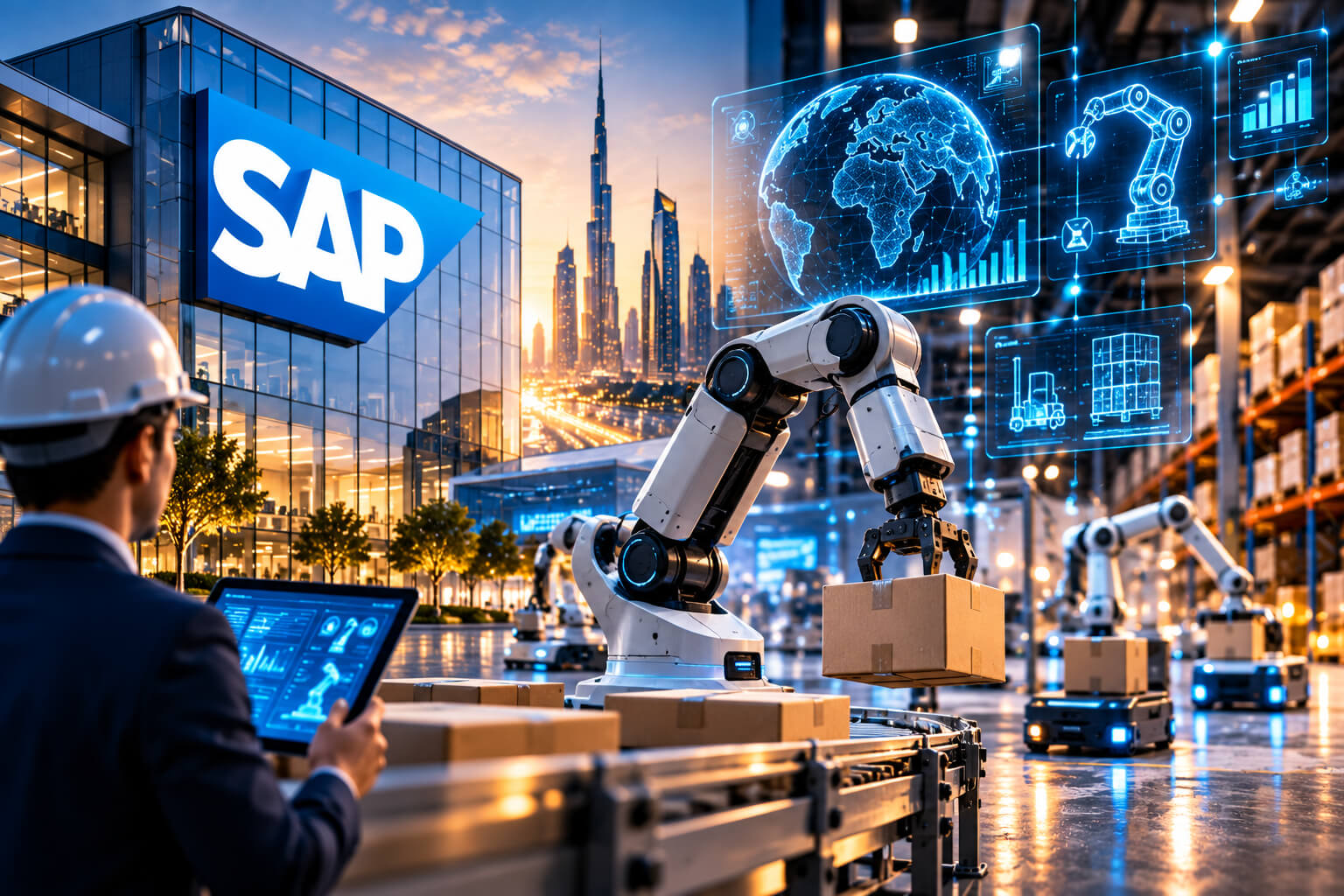
SAP is pushing artificial intelligence beyond traditional business software with the introduction of SAP Physical AI, a new approach designed to connect enterprise systems with robots, drones and autonomous industrial equipment.
Unveiled at SAP TechEd 2026, the technology aims to help businesses translate digital instructions into real-world actions. Instead of simply analysing operational data or recommending decisions, AI-powered systems could coordinate physical tasks across warehouses, manufacturing facilities and industrial sites.
The announcement marks another step in SAP’s vision for the Autonomous Enterprise. In this vision, artificial intelligence plays a more active role in managing daily business operations.
For companies already investing in automation, the development raises an interesting possibility. Machines could respond directly to business priorities without requiring separate systems to manage every task.
SAP Physical AI Connects Enterprise Software with Robotic Systems
Industrial robots have been part of manufacturing for decades, but many still operate through specialised control systems that remain separate from broader enterprise software. SAP Physical AI aims to close that gap by connecting robotic equipment with the business applications companies already use to manage inventory, logistics and maintenance.
Through SAP’s enterprise technology, organisations could initiate physical tasks based on operational requirements. For example, a warehouse management system could assign an autonomous robot to move materials between storage areas. It could then automatically update inventory records once the task is complete. Similarly, maintenance systems could schedule robotic inspections and collect findings without requiring employees to transfer information manually.
The technology also supports different robotics platforms and AI models. As a result, businesses have more flexibility when integrating automation into existing facilities. SAP’s objective is to make physical machines part of coordinated enterprise workflows rather than isolated pieces of equipment.
Intel and SAP Demonstrate Autonomous Warehouse Operations
SAP’s collaboration with Intel provides an early example of how Physical AI could operate in a manufacturing environment. At Intel’s Chengdu facility in China, the companies demonstrated a proof of concept connecting SAP Extended Warehouse Management with Intel-powered edge AI and autonomous robotics technologies.
The demonstration showed how warehouse transport requests generated through SAP software could be converted into assignments for autonomous machines. Once a robot completed its movement, the system could receive updated information about the task. This allowed warehouse operations to remain connected with enterprise records.
For large facilities handling thousands of materials and components, this level of coordination could reduce unnecessary movement and repetitive manual handling. It could also help warehouse managers respond more quickly when inventory priorities change. However, the demonstration remains an early example rather than proof that the same results can be achieved across every industrial environment.
Foxconn and Arçelik-LG Explore Humanoid Robots in Manufacturing
Manufacturing companies are also examining how humanoid robots and autonomous transport systems could fit into existing enterprise workflows. SAP highlighted collaborations involving Foxconn and Arçelik-LG, where robotic technologies are being connected with warehouse management and industrial operations.
At Foxconn, the focus includes linking SAP warehouse processes with humanoid robots and autonomous transport equipment. The aim is to allow robotic systems to respond to operational instructions while keeping their activities connected to business software. Equipment inspections initiated through enterprise maintenance schedules are another area being explored.
Arçelik-LG, meanwhile, is using a humanoid robot to support inbound storage activities and document warehouse operations. Accurate material placement is particularly important in manufacturing, where misplaced components can interrupt production schedules and create additional handling costs. SAP has indicated that the application could generate substantial financial savings, although those potential benefits should not be confused with independently verified operational results.
Holcim Uses Robotic Dogs and Drones for Industrial Inspections
Physical AI could also change how companies inspect equipment in industrial environments where access is difficult or potentially dangerous. Building materials company Holcim has introduced robotic inspection capabilities involving drones and four-legged robots, demonstrating how autonomous machines can support maintenance activities.
These devices can inspect conveyor belts in dusty environments, examine machinery exposed to high temperatures and reach elevated locations that would otherwise require additional safety precautions for human workers. By connecting inspection activities with SAP maintenance systems, companies can initiate assignments according to established schedules. They can then receive operational findings after each task.
The approach could help maintenance teams identify equipment problems earlier while reducing the need for employees to enter hazardous areas. Furthermore, it allows inspection results to become part of existing maintenance records. This makes the information easier to access when planning repairs or evaluating equipment performance.
SAP Emphasises Human Oversight and AI Governance
Connecting enterprise software directly with physical machines creates new responsibilities for businesses, particularly when automated decisions can affect workers, equipment and production schedules. SAP says its Physical AI approach incorporates business rules, operational context and governance mechanisms to help organisations maintain control over automated activities.
Before initiating a task, connected systems can consider factors such as inventory availability, order priorities, safety requirements and compliance restrictions. Activities can also be recorded within enterprise systems. This gives organisations a clearer picture of what machines have been instructed to do and whether those assignments were completed.
Human oversight remains important, especially in industrial environments where unexpected conditions may require immediate intervention. While AI can coordinate repetitive activities and process operational information, businesses still need appropriate safeguards, monitoring procedures and accountability. This is especially crucial when deploying autonomous equipment.
Physical AI Signals a New Direction for Enterprise Automation
SAP’s introduction of Physical AI reflects a broader shift in enterprise technology, with artificial intelligence moving beyond digital analysis and into the coordination of physical operations. The ability to connect business decisions with robots, drones and industrial equipment could reshape how companies approach logistics, manufacturing and maintenance.
The technology is still developing, and some of the applications presented at SAP TechEd remain proof-of-concept demonstrations. Businesses considering adoption will need to assess implementation costs, equipment compatibility, operational reliability and the safety requirements associated with autonomous machines.
For SAP customers, the attraction lies in bringing physical automation into software environments they already use. Rather than managing robots through entirely separate systems, organisations could eventually coordinate more of their physical operations through connected enterprise workflows.
Whether Physical AI becomes a standard feature of industrial operations will depend on measurable results. Productivity improvements, reduced downtime and safer working conditions will matter far more than the novelty of machines carrying out instructions generated by business software.
SAP’s latest announcement suggests that the next phase of enterprise AI may not be confined to screens and dashboards. Increasingly, it could be found moving materials across warehouses, inspecting industrial machinery and carrying out tasks that begin with a decision inside enterprise software.
