


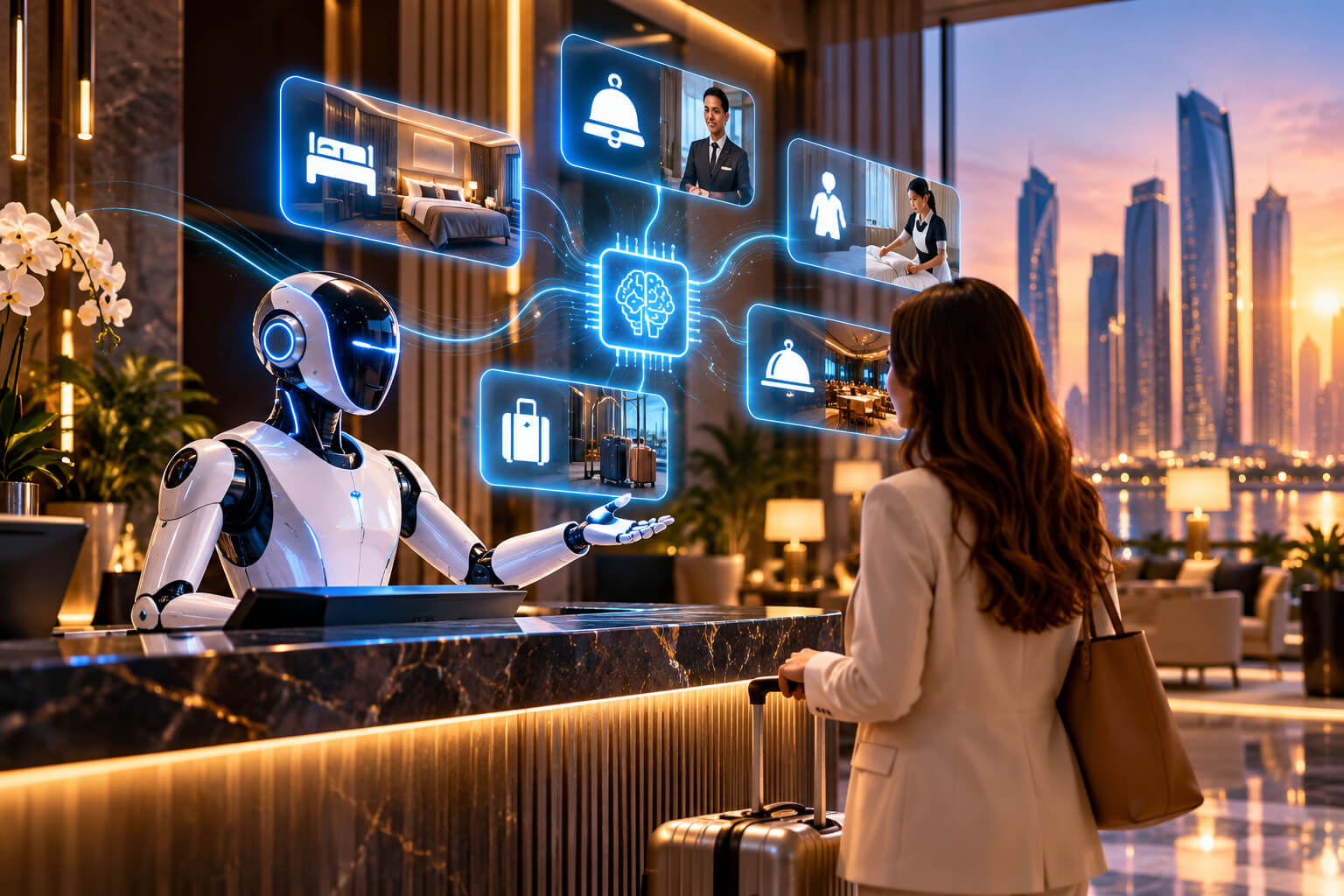
Artificial intelligence is no longer just answering guest questions or helping hotels write marketing emails. It’s starting to handle actual operational work, from updating reservations and analyzing room rates to preparing financial forecasts that previously required hours of manual effort.
Hospitality technology provider Apaleo reported a 70% increase in usage of its Model Context Protocol (MCP) server between July and September 2026, reflecting growing interest in connecting AI agents directly to hotel management systems.
The company recorded a 23% increase in usage between July and August, followed by another 38% rise from August to September.
What’s particularly interesting is that this isn’t happening exclusively at major international hotel chains. Independent properties, smaller hotel groups and serviced apartment operators are also exploring how AI agents can reduce administrative workloads without requiring extensive technology investments.
Hotels Are Moving AI Agents From Experiments Into Daily Operations
Hotels have experimented with artificial intelligence for years, particularly through customer service chatbots, automated messaging and recommendation tools. Those applications helped introduce AI into hospitality, but they rarely changed how core hotel operations were managed. Now, AI agents are beginning to interact directly with property management systems, allowing authorized users to retrieve information, update records and automate tasks that previously required employees to navigate multiple software platforms.
Apaleo introduced its hospitality-focused MCP server in September 2025, creating a way for compatible AI applications to connect with its property management platform. Rather than developing separate integrations for every assistant, hotel operators can use the connection to access supported functions through AI-powered interfaces. This allows employees to request operational information or initiate routine tasks using natural language. For smaller hospitality businesses, the appeal is straightforward: less time moving between dashboards and more time managing guests, revenue and day-to-day operations.
How Model Context Protocol Makes Hotel AI Agents More Useful
The technology behind this shift is Model Context Protocol (MCP), an open standard designed to help AI applications communicate with external tools and information sources. In hospitality, MCP can connect an AI assistant to authorized reservation records, room availability, pricing information and other operational data. Instead of producing answers based only on general knowledge, the assistant can work with information from the hotel’s existing systems and, where permitted, carry out specific actions.
Apaleo’s MCP server provides a standardized connection to its platform, reducing the technical work required to link compatible AI applications with hotel operations. The system also incorporates permission controls and records actions performed through the connection. These safeguards are important because allowing an AI agent to modify a reservation or access sensitive guest information involves greater responsibility than generating a simple response. Hotels must still determine which tasks can be automated, who can authorize them and when human review is necessary.
AI Adoption Is Growing Faster Than Hotel System Integration
Artificial intelligence is already widely used across the hospitality industry, but many hotels still lack the technical connections required to take full advantage of more advanced AI applications. According to the h2c Hotel Chain Tech Report 2026, 91% of surveyed hotel chains were using AI, up from 78% in the previous year. However, only 15% had implemented a standardized AI data access layer such as MCP, while 38% identified integration with existing systems as a challenge.
The research also found that external AI applications, including ChatGPT, accounted for 60% of daily AI usage among hotel chains, compared with 27% for AI capabilities embedded within vendor platforms. This suggests that hotel operators are increasingly interested in choosing their own AI tools rather than depending entirely on software providers. The challenge is making those tools useful beyond isolated tasks. Without reliable connections to reservation systems, financial information and operational platforms, even sophisticated AI models have limited ability to support daily hotel management.
Swiss Hotel Group Uses AI to Improve Revenue Management
At Appenzeller Hotels, a three-property hospitality group in Switzerland, AI is already helping employees identify opportunities to improve room revenue. The company uses Claude in a daily workflow that analyzes reservations and identifies bookings suitable for room upgrades. By moving eligible guests into higher room categories, the hotel can potentially make lower-priced rooms available for resale, creating additional opportunities to manage inventory and revenue more effectively.
According to Apaleo, the workflow saves approximately two hours each week while supporting booking reconciliation and operational reporting. Although the time savings may appear modest compared with large-scale automation projects, they can make a meaningful difference for smaller hotel teams responsible for multiple administrative duties. The example demonstrates how AI agents can deliver practical improvements without requiring hotels to completely redesign their operations. Instead of replacing existing revenue management processes, the technology helps employees identify opportunities and complete repetitive work more efficiently.
AI Agents Are Reducing Hotel Financial Forecasting Work
Financial forecasting can be a demanding process for hospitality operators, particularly when revenue and expense information is spread across different systems. Brera Serviced Apartments addressed this challenge by developing its own MCP integration alongside Apaleo’s platform and creating a data lake that combines financial and operational information. The company then used historical data to generate a forecast covering both halves of 2026, providing its controller with information to support budgeting decisions.
According to the reported case study, similar forecasting work previously required three employees working over approximately two weeks. By connecting relevant information and using AI-assisted analysis, the company significantly reduced the manual effort involved in preparing its forecast. This approach could allow hotel finance teams to update projections more frequently, evaluate changing market conditions and spend less time collecting information from separate platforms. Financial professionals still need to validate assumptions and review results, but AI agents can help accelerate the preparation work that often consumes substantial staff resources.
German Hotels Are Using AI to Automate Repetitive Tasks
German hotel group McDreams Hotels is exploring how AI agents can simplify routine operational processes and make business information easier for employees to access. Instead of relying on manually prepared reports or searching through different software interfaces, staff can interact with connected AI applications to retrieve relevant operational data. The approach helps reduce repetitive administrative work while making existing information more accessible to employees responsible for daily decisions.
The company’s experience reflects a wider interest in conversational access to hotel management systems. Hospitality operators increasingly want employees to obtain information without requiring specialized technical knowledge or extensive training in individual software platforms. Other businesses are experimenting with similar capabilities. LikeStay, for example, uses MCP-connected AI to convert price lists into rate plans, examine reservation patterns and support property management system migrations. These applications show how AI agents can assist with operational tasks that are often time-consuming but essential to running a hospitality business.
Smartments Uses AI to Modify 2,000 Hotel Reservations
Reservation management is another area where AI agents are beginning to demonstrate measurable operational benefits. Smartments, a serviced apartment operator, used Apaleo’s MCP server to modify approximately 2,000 reservations through a single operation. Apaleo estimated that completing the same changes manually would have required around 50 hours of employee work, illustrating the potential efficiency gains when repetitive booking tasks can be handled through connected systems.
For businesses managing large accommodation portfolios, reservation updates can involve substantial administrative effort, particularly when changes affect numerous bookings at once. AI-assisted automation can help reduce that workload, but it also introduces additional responsibilities. An incorrect bulk update could affect hundreds or thousands of reservations, making permission management, verification and audit records essential. The Smartments example highlights both the operational potential of AI agents and the importance of maintaining appropriate human oversight when automated systems interact with live hotel records.
Hotels Want Greater Flexibility in Choosing Their AI Technology
As AI capabilities develop, hospitality businesses are becoming more interested in maintaining control over which models and applications they use. Traditional hotel software often comes with fixed integrations or proprietary AI features, limiting operators to tools selected by their technology providers. Apaleo’s MCP-based approach allows compatible external AI applications to connect with its property management platform, giving hotels greater flexibility to experiment with different assistants and adopt new capabilities as they become available.
This flexibility could become increasingly valuable as AI technology evolves and businesses identify different tools for specific operational needs. A hotel might prefer one assistant for financial analysis and another for reservation management, provided both can securely access the necessary information. Apaleo founder Philip von Ditfurth has emphasized the importance of connecting AI applications to operational systems, rather than treating artificial intelligence as an isolated software feature. For hotels, the practical value comes from combining capable AI models with reliable access to the systems employees already depend on.
AI Agents Could Change How Hotels Manage Everyday Operations
The growing use of AI agents suggests that hospitality businesses are moving toward a more connected approach to automation. Rather than using artificial intelligence only for content generation or customer inquiries, hotels are beginning to apply it to reservations, revenue management, financial planning and internal reporting. These applications may not attract the same attention as futuristic robotic hotel services, but they address problems that employees encounter every day.
Trust remains an important consideration. The h2c research cited by Apaleo found that reliance on AI increased from 4.7 to 5.4 on a ten-point scale over the previous year, while trust remained unchanged at 6.5. Hotels may be using artificial intelligence more frequently without becoming significantly more confident in its reliability. That distinction will matter as businesses give AI agents greater access to operational systems and increasingly sensitive information.
Apaleo’s reported 70% increase in MCP server usage indicates growing activity around connected AI workflows, although it does not necessarily mean the number of hotels using AI increased by the same percentage. The industry’s next challenge will be demonstrating that these systems can deliver consistent results while maintaining security, accuracy and accountability. For hotel operators, the goal is not simply to introduce more artificial intelligence. It’s to make everyday operations easier to manage without compromising the guest experience.
Sources
- Breaking Travel News — Hotels Are Putting AI Agents to Work in Live Operations
- Apaleo — Official Hospitality Technology Platform
- h2c — Hospitality Technology Research and Consulting
- Model Context Protocol — Official MCP Documentation
