


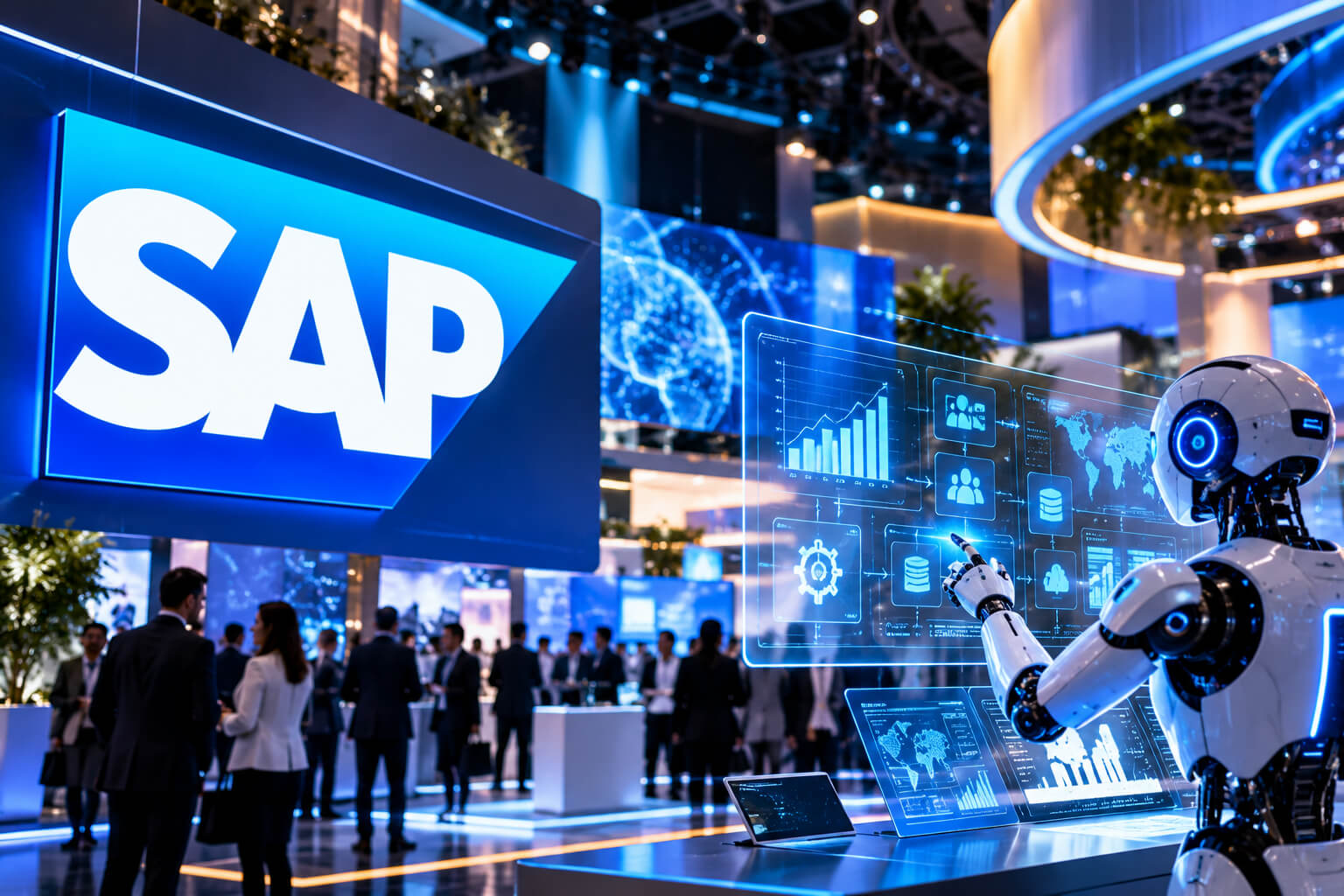
SAP is taking another step toward making artificial intelligence an active part of everyday business operations. At SAP TechEd 2026, the enterprise software company introduced new AI development capabilities, autonomous agents and data technologies designed to help organizations move beyond basic automation. This year, SAP TechEd 2026 AI innovations are set to redefine how businesses approach intelligent automation and data-driven processes.
The announcements focus on SAP Joule Work, Joule Studio and SAP Business AI Platform, giving developers more ways to build AI-powered applications that can understand business information and execute tasks across connected systems.
SAP’s broader ambition is to make AI useful beyond generating responses. It wants intelligent systems that can coordinate workflows, identify problems and take action while remaining under enterprise oversight.
SAP Joule Work Brings AI Agents Closer to Everyday Business Tasks
SAP is expanding the capabilities of Joule Work to help employees manage complicated business processes without manually navigating multiple applications. Instead of relying on separate tools for individual tasks, users can describe what they want to accomplish and allow AI agents to coordinate the necessary steps.
The updated platform supports communication between AI systems through technologies such as Model Context Protocol (MCP) and Agent2Agent (A2A). These standards make it easier for different agents and enterprise applications to exchange information and work together. SAP is also strengthening security and governance through its Enterprise AI Gateway, allowing organizations to monitor AI activity, manage permissions and maintain control over sensitive operations.
Joule Studio Gives Developers More Freedom to Build AI Agents
Developers will have greater flexibility to create customized AI agents through SAP Joule Studio, the company’s development environment for enterprise artificial intelligence. The platform combines no-code development capabilities with professional programming tools, making it accessible to both technical teams and business users.
With access to more than 70 AI models, developers can select technologies that match their organization’s requirements. SAP is also incorporating n8n workflow capabilities into Joule Studio, allowing users to connect different applications and automate business processes. New monitoring features will provide better visibility into agent performance, model usage and operational costs. These improvements could make it easier for businesses to experiment with autonomous workflows before expanding them across departments.
SAP Business Data Cloud Connects AI to Real Business Information
AI systems depend heavily on the quality and accessibility of the information they receive. SAP is addressing this challenge through improvements to SAP Business Data Cloud, which helps organizations connect business information from different systems and make it available for analytics and AI applications.
A new Ontology Manager will help AI understand relationships between business data, giving agents more context when analyzing transactions, operational records and company processes. SAP is also expanding its partnerships with Databricks and Dremio to improve data integration and accessibility. Support for technologies such as Apache Iceberg and Apache Polaris will allow organizations to work with information across different environments without constantly transferring or duplicating large datasets. The company is also integrating Reltio’s master data management capabilities to improve the consistency of customer, supplier and product records.
SAP’s New AI Models Could Improve Forecasting and Anomaly Detection
SAP is introducing additional capabilities for its tabular foundation models, which specialize in analyzing structured business information rather than generating conversational responses. Its updated SAP-RPT-2.0 model is designed to identify unusual patterns, detect anomalies and examine relationships across datasets.
The company is also developing SAP-RPT-TS, a model focused on time-series forecasting. These technologies could help businesses anticipate demand changes, identify operational irregularities and improve planning decisions using historical information. Unlike traditional machine learning projects that often require separate models for individual use cases, SAP’s approach aims to make advanced predictive capabilities more accessible across enterprise applications.
SAP and HPE Take Enterprise AI to the International Space Station
One of SAP’s more unusual announcements involves a collaboration with Hewlett Packard Enterprise to bring enterprise AI technology into space. The companies plan to run SAP’s tabular AI technology on HPE Spaceborne Computer-2 aboard the International Space Station, where it will support the analysis of spacecraft sensor information.
The system is intended to identify potential equipment anomalies, predict technical problems and reconstruct missing sensor readings using historical information. Processing data directly aboard the space station could reduce reliance on communication with ground-based systems and allow technical teams to respond more efficiently. Although the project operates far outside a typical enterprise environment, it demonstrates how specialized AI models could support operations where connectivity and computing resources are limited.
SAP Expands AI Partnerships Across Software and Robotics
SAP is extending its autonomous enterprise strategy through partnerships with technology companies working in software automation, digital workflows and robotics. Its collaboration with Intel focuses on connecting enterprise business processes with autonomous robotic systems, potentially allowing organizations to coordinate physical operations through AI-driven software.
The company is also working with Docusign, Parloa and Redwood to improve automation across business applications. These collaborations aim to reduce the manual effort involved in moving information between systems and coordinating processes across departments. For organizations managing large numbers of applications, the ability to connect AI agents with existing software could help simplify operations without requiring a complete replacement of their technology infrastructure.
What SAP TechEd 2026 Means for Enterprise AI
The announcements at SAP TechEd 2026 highlight how enterprise AI is gradually moving from experimentation toward practical execution. Companies are no longer looking only for assistants that summarize documents or answer questions. They increasingly want systems capable of completing meaningful tasks across finance, procurement, supply chains and other business functions.
SAP is positioning Joule Work, Joule Studio and its broader AI platform as tools for that transition. However, giving AI systems greater responsibility also creates challenges involving data reliability, security, accountability and human oversight. Businesses will need to determine which processes can operate autonomously and where employees should remain directly involved.
For developers, the latest SAP updates provide more opportunities to build applications that interact with real business systems. For enterprise customers, the bigger opportunity lies in connecting those capabilities to measurable operational improvements. SAP’s vision of autonomous execution is becoming clearer, but its long-term success will depend on how effectively organizations put these technologies to work.
Sources
- SAP News Center: SAP Empowers AI Developers to Build What Matters and Turn Intent into Autonomous Execution — October 2026.
- SAP News Center: SAP Official News and Announcements
- SAP: SAP Business AI — Official Product Information
