


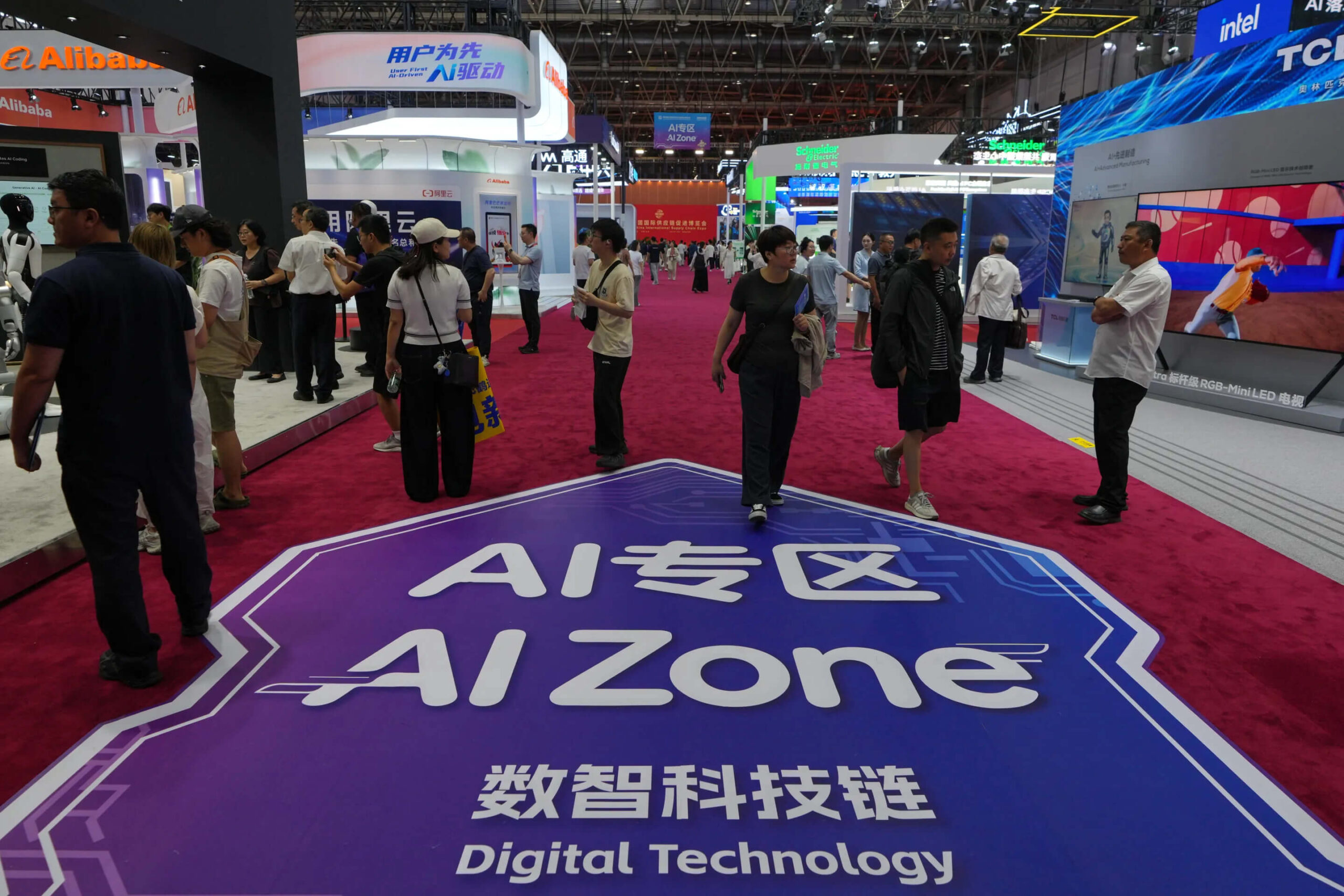
The US-China AI rivalry is creating a new divide in global technology, leaving governments with an increasingly difficult decision: align with Washington’s advanced artificial intelligence ecosystem, embrace China’s more affordable alternatives, or find a way to work with both.
For many countries, choosing just one side is hardly an attractive option.
The United States is strengthening partnerships around advanced semiconductors, trusted technology networks and secure supply chains. China, meanwhile, is promoting open-source AI models, lower-cost infrastructure and broader international cooperation.
According to an October 25 report by the Associated Press, countries across Asia, Europe and the Middle East are trying to benefit from both powers, even as geopolitical pressure threatens to limit their options.
Washington and Beijing Build Competing AI Alliances
The competition between the United States and China is no longer simply about developing the most powerful artificial intelligence models. Both countries are building international technology alliances that could determine how governments access AI infrastructure, secure advanced computing resources and participate in future technology markets.
Washington is advancing Pax Silica, an initiative focused on trusted semiconductor supply chains, high-tech manufacturing and strategic technology partnerships. China has introduced the World AI Cooperation Organization, presenting it as an international platform that encourages cooperation and broader access to artificial intelligence.
The two initiatives reflect different approaches to global AI development. American technology companies retain important advantages in advanced semiconductor hardware and frontier AI systems, while Chinese developers are attracting attention through affordable and openly available models.
Washington has also signalled that countries participating in competing technology initiatives may face difficulties maintaining trusted partnerships with the United States. Beijing, on the other hand, argues that artificial intelligence should remain accessible rather than controlled by a handful of powerful countries.
Kazakhstan Pursues AI Partnerships With Both Superpowers
Kazakhstan has emerged as an example of a country attempting to benefit from both sides of the US-China AI rivalry. The Central Asian nation is pursuing investment, infrastructure development and technology partnerships without committing exclusively to either Washington or Beijing.
In June 2026, Kazakhstan’s AI minister, Zhaslan Madiyev, visited Washington to join the US-led initiative focused on strengthening technology supply chains. Three weeks later, he travelled to Shanghai, where Kazakhstan became a founding member of China’s World AI Cooperation Organization.
The country’s economic resources make it particularly attractive to technology investors. Kazakhstan possesses critical minerals important to advanced manufacturing and relatively inexpensive electricity that could support energy-intensive AI data centres.
Its government has signed an investment agreement involving Nvidia worth up to $10 billion to support the development of a major data centre hub. Chinese investment is also expanding, with local officials reporting that Chinese foreign direct investment reached a record $2.8 billion in 2025.
Maintaining these relationships could help Kazakhstan develop its technology sector. However, growing competition between Washington and Beijing may eventually make such a balanced approach harder to sustain.
Indonesia and Singapore Seek Flexibility in AI Development
Indonesia is following a similar path as it attempts to strengthen its position in the international AI economy. The Southeast Asian country has joined China’s World AI Cooperation Organization while continuing to pursue technology partnerships and investment opportunities involving American companies.
Indonesia’s substantial nickel and copper resources also give it strategic importance in global technology supply chains. These materials are essential to several industries connected to electronics, energy infrastructure and advanced manufacturing.
Mari Pangestu, vice chair of Indonesia’s National Economic Council, has indicated that the country wants the flexibility to participate in both technology ecosystems and select systems that best serve its interests.
Singapore is navigating the same competition from a different position. The city-state already attracts major American technology companies, including Anthropic, which is expanding its regional presence. Singapore has also indicated that it is considering joining China’s AI cooperation initiative.
For both countries, maintaining access to competing AI technologies offers economic and strategic advantages. Restricting themselves to one supplier could limit investment opportunities and reduce the range of technologies available to businesses and government agencies.
Saudi Arabia Combines Chinese AI Models With American Technology
Saudi Arabia’s artificial intelligence strategy demonstrates how American and Chinese technologies can operate within the same national AI ecosystem.
In September, Saudi AI company Humain introduced a platform built on an open model developed by a Chinese AI company. The kingdom also has an agreement with Nvidia to expand its AI computing capabilities using advanced American semiconductor technology.
The arrangement reflects Saudi Arabia’s broader ambition to establish itself as a major centre for artificial intelligence development. Access to powerful computing hardware is essential for that goal, but affordable AI models can also help organisations develop and deploy applications more efficiently.
Riyadh’s approach shows that governments do not necessarily view American and Chinese technologies as mutually exclusive. An AI system can rely on computing infrastructure from one country while incorporating software developed in another.
Whether such combinations remain practical will depend partly on future export controls, security requirements and the willingness of technology suppliers to maintain international partnerships.
France and Japan Take Different Approaches to AI Independence
European and Asian economies are also exploring ways to reduce their exposure to the growing US-China AI divide.
France is investing in domestic AI development, with companies such as Mistral AI helping strengthen Europe’s position in the international market. The French startup released a model in October that reportedly outperformed certain advanced Chinese models in selected performance comparisons.
Japan, meanwhile, maintains close technology and security relationships with the United States. American semiconductor technology and trusted AI infrastructure remain important to its strategic priorities, particularly in sensitive applications.
That does not mean Japanese organisations will necessarily reject Chinese AI models. Researchers have suggested that affordable Chinese systems could remain suitable for lower-risk applications where security requirements are less demanding.
Countries such as Germany and the United Kingdom face another challenge. Despite their substantial economic resources and research capabilities, they remain dependent on foreign technology companies for access to some of the most advanced AI models and computing infrastructure.
Developing independent capabilities requires considerable investment, and national AI strategies alone cannot eliminate reliance on international technology providers.
China Expands AI Cooperation Across Developing Economies
China is extending its AI influence into developing markets by supporting technology infrastructure, financing projects and promoting access to affordable artificial intelligence systems.
Research from AidData at William & Mary indicates that China has provided official grants and loans for projects involving AI technologies or supporting infrastructure in at least 77 low- and middle-income countries.
Among the countries receiving support are Nigeria, Ghana, Zambia, Bangladesh, Senegal, Cameroon and Kenya.
For developing economies, China’s approach offers opportunities to adopt artificial intelligence without necessarily relying on expensive proprietary systems. Open-source models can provide local developers with greater flexibility to customise applications for domestic languages, public services and business requirements.
Financial assistance and infrastructure investment can also help countries establish the technical foundations needed to support AI adoption.
However, access to affordable models does not automatically guarantee technological independence. Governments still need computing resources, reliable electricity, skilled professionals and sustainable infrastructure to operate AI systems over the long term.
AI Sovereignty Becomes a Major Concern for Governments
The growing competition between Washington and Beijing is placing greater attention on AI sovereignty, particularly among countries that depend on foreign technology companies for advanced computing capabilities.
Governments increasingly want greater control over the AI systems used in public administration, national security, healthcare, education and economic development. Yet developing frontier AI models independently remains extraordinarily expensive.
Training advanced systems requires substantial computing power, specialised semiconductor hardware, extensive datasets and highly skilled researchers. Only a small number of countries and technology companies possess the resources necessary to compete at that level.
This creates a difficult situation for governments seeking independence from both American and Chinese technology ecosystems.
Some countries are investing in domestic AI models and local data centres, while others are pursuing open-source systems or partnerships with multiple international suppliers. These strategies can reduce certain dependencies, although they do not eliminate the need for foreign hardware, software or expertise.
The concern is that increasingly restrictive technology policies could leave smaller countries with fewer choices about which AI systems they can access.
The Global AI Race Is Becoming a Competition for Influence
The US-China AI rivalry is developing into a contest over much more than model performance. Semiconductor access, infrastructure investment, technical standards and international partnerships are becoming central to both countries’ efforts to shape the future of artificial intelligence.
Washington continues to promote trusted technology relationships while tightening restrictions on sensitive technologies. Beijing is positioning its AI ecosystem as a more accessible alternative, particularly for countries looking to reduce their reliance on expensive Western systems.
Many governments would prefer to avoid becoming dependent on either side.
Kazakhstan, Indonesia, Singapore and Saudi Arabia illustrate how countries are attempting to preserve that flexibility through different combinations of investment, infrastructure development and international cooperation.
For now, both American and Chinese technologies remain attractive for different reasons. The challenge is determining whether countries will continue to have the freedom to choose between them.
As the competition intensifies, the decisions made in Washington and Beijing could increasingly influence which nations gain access to advanced artificial intelligence and which are left struggling to keep pace.
Sources
- Associated Press — October 25, 2026: As the US and China Form AI Blocs, Countries Are Increasingly Torn Between Them
- Associated Press — October 22, 2026: US Treasury Proposes Rule to Crack Down on High-Tech Investments in China
- Associated Press — October 20, 2026: China Defends DeepSeek After US Ban of Its AI From Government Systems
