


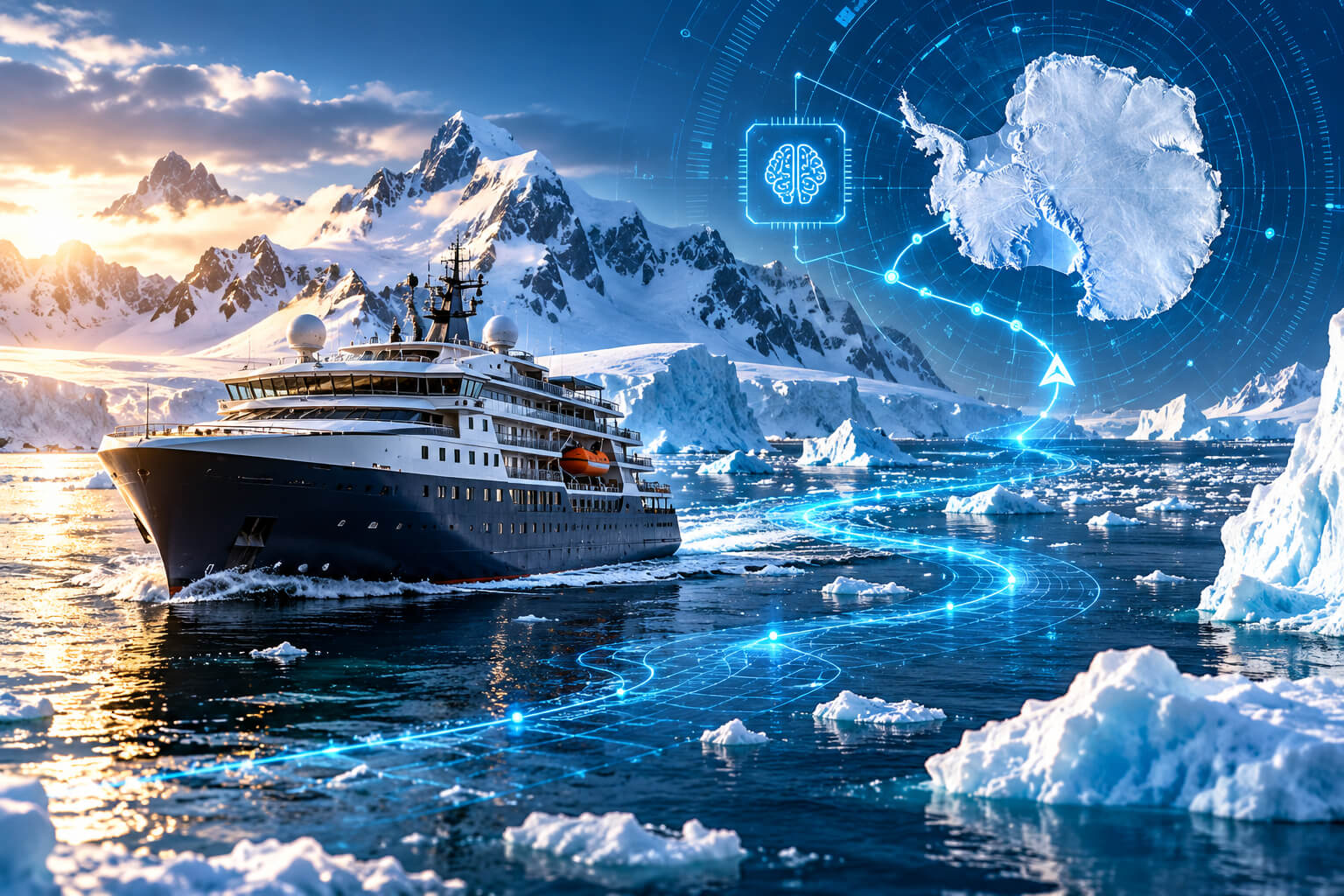
Artificial intelligence is making its way into one of the world’s most challenging maritime environments, with AE Expeditions testing AI-powered ocean navigation technology to reduce fuel consumption during Antarctic voyages.
The expedition cruise operator partnered with ocean technology company CounterCurrent to explore how artificial intelligence and ocean forecasting could help ships navigate more efficiently. Early results suggest that analyzing ocean currents and environmental conditions could reduce fuel consumption without requiring major changes to vessel operations.
The trial aboard the expedition vessel Douglas Mawson recorded fuel savings of approximately 2% to 5% over certain 24-hour periods, while preliminary modelling suggested potential savings of between 5% and 15% under favorable conditions. These findings have encouraged AE Expeditions to expand the technology across its three-ship fleet, marking another step toward using AI to improve maritime efficiency.
AI-Powered Ocean Navigation Delivers Promising Results in Antarctica
Navigating Antarctic waters presents considerable challenges for expedition vessels, particularly when unpredictable ocean currents, extreme weather and changing sea conditions affect fuel consumption and voyage planning. AE Expeditions worked with CounterCurrent to determine whether artificial intelligence could identify more efficient routes by analyzing environmental conditions and recommending adjustments that allow vessels to take advantage of favorable ocean currents.
The trial was conducted aboard Douglas Mawson between December 2025 and March 2026, covering five Antarctic voyages and 126 days of operation. During this period, the system generated 39 route recommendations and collected more than 5,600 environmental observations. Early findings indicated fuel savings of approximately 2% to 5% over 24-hour periods, with preliminary modelling suggesting that larger reductions could be possible in suitable operating conditions. Although the results remain subject to further testing, they demonstrate how AI-powered forecasting could help expedition operators manage fuel consumption in demanding maritime environments.
How CounterCurrent Uses Artificial Intelligence to Improve Ocean Navigation
CounterCurrent’s technology analyzes ocean conditions to identify routes that could allow ships to travel more efficiently. Rather than simply calculating the shortest distance between destinations, the platform examines ocean currents and environmental observations to determine whether small navigation adjustments could reduce the amount of fuel required to complete a voyage.
The system combines information from vessel-mounted sensors with ocean forecasting models, allowing it to generate recommendations based on changing marine conditions. CounterCurrent founder Professor Shane Keating has described the technology as a form of “Google Maps for the Sea,” reflecting its ability to provide route guidance using environmental data. By identifying favorable currents and helping vessels avoid conditions that increase resistance, the platform aims to improve operational efficiency while supporting lower fuel consumption. Importantly, the technology does not replace ship captains or navigation teams, who remain responsible for evaluating recommendations and making final operational decisions.
Antarctic Conditions Challenge AI Sensors and Ocean Forecasting Technology
Testing advanced maritime technology in Antarctica requires equipment capable of operating in extreme conditions. During the trial, CounterCurrent’s sensors encountered temperatures reaching minus 30 degrees Celsius and winds of approximately 120 kilometers per hour. These conditions provided an opportunity to evaluate whether the system could continue collecting useful environmental information in remote waters where reliable connectivity and consistent weather observations can be difficult to maintain.
AE Expeditions’ navigation teams also contributed feedback throughout the testing period, helping refine the technology’s recommendations to reflect real-world operational requirements. Factors such as sea ice, ocean swell, passenger comfort and expedition schedules were considered alongside fuel efficiency. This was particularly important because the most economical route may not always be the safest or most suitable option for a passenger vessel operating in Antarctic waters. The trial therefore focused on using artificial intelligence to support experienced crews rather than allowing automated systems to determine navigation decisions independently.
AE Expeditions Expands AI Ocean Technology Across Its Expedition Fleet
Following the initial results, AE Expeditions expanded its partnership with CounterCurrent by introducing upgraded Mark 3 Triton sensor technology across its three expedition vessels, Douglas Mawson, Sylvia Earle and Greg Mortimer. The wider deployment allows the company to collect environmental information from multiple ships while continuing to evaluate how AI-powered forecasting performs across different routes and operating conditions.
The upgraded sensors incorporate several improvements developed from lessons learned during the Antarctic trial, including enhanced solar energy generation, eight times greater battery capacity and increased onboard processing and storage capabilities. These features are intended to improve reliability during operations in remote environments, particularly when sunlight is limited or satellite connectivity becomes unavailable. By expanding the technology across its fleet, AE Expeditions can also gather a broader dataset that may help CounterCurrent refine its forecasting models and improve future navigation recommendations.
AI-Powered Navigation Could Help Reduce Maritime Fuel Consumption and Emissions
Fuel consumption remains a major operational consideration for maritime companies, especially those operating vessels across long distances or in difficult environmental conditions. Expedition ships must balance navigation efficiency with passenger safety, scheduled activities and the unpredictable nature of remote destinations. CounterCurrent’s AI-powered system addresses this challenge by examining how natural ocean currents could be used to reduce energy demand during voyages.
Even modest improvements in fuel efficiency could become meaningful when applied across multiple journeys. Lower fuel consumption can also reduce fuel-related greenhouse gas emissions, supporting maritime operators seeking practical ways to improve environmental performance. For AE Expeditions, the partnership represents an opportunity to explore technology that could contribute to more efficient operations while maintaining the expedition experience. The long-term environmental benefits will depend on whether the savings observed during the trial can be consistently achieved across different vessels, seasons and ocean conditions.
CounterCurrent Explores Fleet-Wide Forecasting and Onboard AI Processing
CounterCurrent is looking beyond individual vessel performance by exploring how environmental observations collected across multiple ships could contribute to more accurate ocean forecasts. Information gathered by one vessel may eventually help improve navigation recommendations for other ships traveling through nearby waters, creating a broader network of maritime observations that can support more responsive forecasting.
The company is also examining onboard processing capabilities that would allow vessels to generate useful forecasts without depending entirely on cloud-based systems. This could be particularly valuable for ships operating in polar regions and other remote maritime environments where satellite communications may be unreliable. Processing more information directly onboard could help navigation teams maintain access to relevant environmental guidance while reducing their dependence on external connectivity. Such developments would strengthen the practical application of artificial intelligence in maritime operations, especially for vessels traveling beyond established shipping routes.
What AE Expeditions’ Antarctic AI Trial Means for the Future of Maritime Technology
The Antarctic trial highlights how artificial intelligence can be applied to maritime challenges that have traditionally depended on human experience, weather observations and established navigation practices. By combining environmental data with predictive forecasting, CounterCurrent’s technology offers a way for vessels to make more informed decisions about their routes while potentially reducing unnecessary fuel consumption.
The early findings are encouraging, although the projected savings of up to 15% should not be interpreted as a guaranteed outcome for every voyage. Actual performance will depend on ocean conditions, vessel characteristics, navigation requirements and the ability to consistently identify favorable currents. With AE Expeditions expanding the technology across its fleet, further operational data should provide a clearer picture of its long-term effectiveness. For the wider maritime industry, the project illustrates how AI could support more efficient and environmentally responsible shipping without removing experienced crews from critical decision-making processes.
Sources
- Breaking Travel News — AE Expeditions Antarctic Trial Reveals Promising Fuel Savings Using AI-Powered Ocean Technology
- Cruise & Ferry — AE Expeditions to Reduce Fuel Consumption by Deploying CounterCurrent AI Technology
- Travel Weekly Australia — Aurora Expeditions Expands Partnership With CounterCurrent After Tech Trial
- Aurora Expeditions — Official Website
