


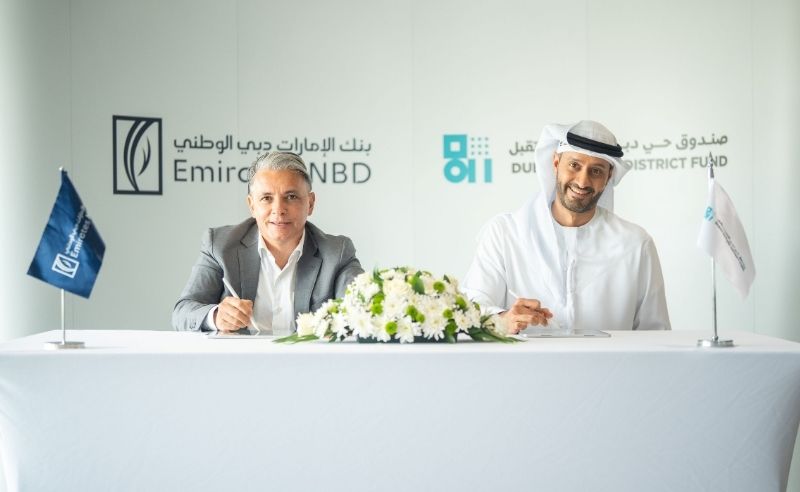
Dubai’s push to turn artificial intelligence investment into actual commercial deployment is getting another boost. The Emirates NBD Dubai Future District Fund AI partnership marks a new chapter, as Emirates NBD has partnered with the Dubai Future District Fund (DFDF), opening a more direct route for AI and fintech startups to test their technology inside one of the region’s biggest banking groups.
This isn’t being framed as another startup accelerator where companies pitch, collect mentorship and disappear six months later. The idea is more practical: find technologies the bank can use, test them against real banking problems and, when something works, give it a shot at becoming a commercial deployment.
AI Startups Get a Route Into Emirates NBD
Under the partnership, Emirates NBD and DFDF will jointly source, assess and pilot technology developed by startups.
For Emirates NBD, that means access to a curated group of companies already considered capable of working with larger enterprises. For startups, the interesting part is obvious. Getting through the door of a major financial institution is often harder than developing the product in the first place.
DFDF brings some serious financial weight to that process. The organisation operates as a AED 1 billion evergreen venture capital fund of funds backed by the Dubai International Financial Centre and Dubai Future Foundation.
The partnership is expected to explore AI-powered banking alongside embedded finance, digital assets, WealthTech, SME technology, compliance tools and next-generation banking infrastructure.
That’s a fairly wide net. AI, though, sits right in the middle of it.
The Important Part Is What Happens After the Pilot
Banks have been running innovation programs for years. Proof-of-concept projects are easy to announce. Getting those projects into production is where things usually become less glamorous.
This partnership is explicitly creating a path beyond experimentation.
Selected startups will be able to run structured pilots with Emirates NBD. Technologies that survive that stage could eventually move into larger commercial deployments across the bank’s operations.
That could involve customer-facing AI systems, internal automation, compliance technology, smarter financial products or infrastructure that customers never directly see.
And that last category may ultimately matter just as much as the flashy AI assistants.
Emirates NBD Has Been Building Its AI and Fintech Pipeline
The DFDF agreement isn’t happening in isolation.
Emirates NBD already operates an Innovation Fund established in 2023 to invest in companies considered strategically relevant to the group. Its investment strategy targets companies that could shape how the bank works and how it serves customers rather than treating venture investment as a completely separate financial activity.
In July 2026, the bank also announced a partnership with Techstars built around what the companies called an “Acceleration-to-Enterprise” approach for AI and fintech startups. The program is designed to move promising technologies toward actual integration inside Emirates NBD’s banking ecosystem.
There’s a pattern forming here.
Instead of waiting for enterprise AI products to mature elsewhere and buying them later, Emirates NBD is increasingly putting itself closer to the companies building them.
Dubai Wants AI Startups to Find Customers, Not Just Capital
There’s another side to the deal.
Dubai has spent heavily on positioning itself as a place where AI companies can raise capital, establish operations and connect with government and enterprise customers. Venture funding matters, but access to large buyers can be even more valuable for an early-stage company trying to prove that its technology works outside a demo.
Connecting DFDF-backed companies directly with Emirates NBD addresses that problem.
Dubai’s broader AI strategy also points in this direction. Its Universal Blueprint for Artificial Intelligence was created around accelerating AI adoption across the city and expanding the economic impact of the technology, rather than treating AI purely as a research project.
Banking is a pretty obvious place to test whether that strategy works.
Fintech Growth Gives the Partnership Room to Expand
The numbers being cited by the partners make the timing easier to understand.
The UAE fintech market is projected to grow from roughly $3.16 billion in 2024 to $5.71 billion by 2029 as demand grows for digital financial services and AI-powered products.
Not every part of that growth will come from generative AI. Some of the more meaningful changes could happen quietly through fraud detection, compliance automation, lending infrastructure, wealth management systems and back-office processes.
The Emirates NBD–DFDF partnership gives startups working on those problems something they badly need: somewhere large enough to prove the technology works.
For Dubai, that may be the bigger story. The city already has money flowing into AI. Now more of the attention is moving toward what gets deployed after the funding announcement.
