


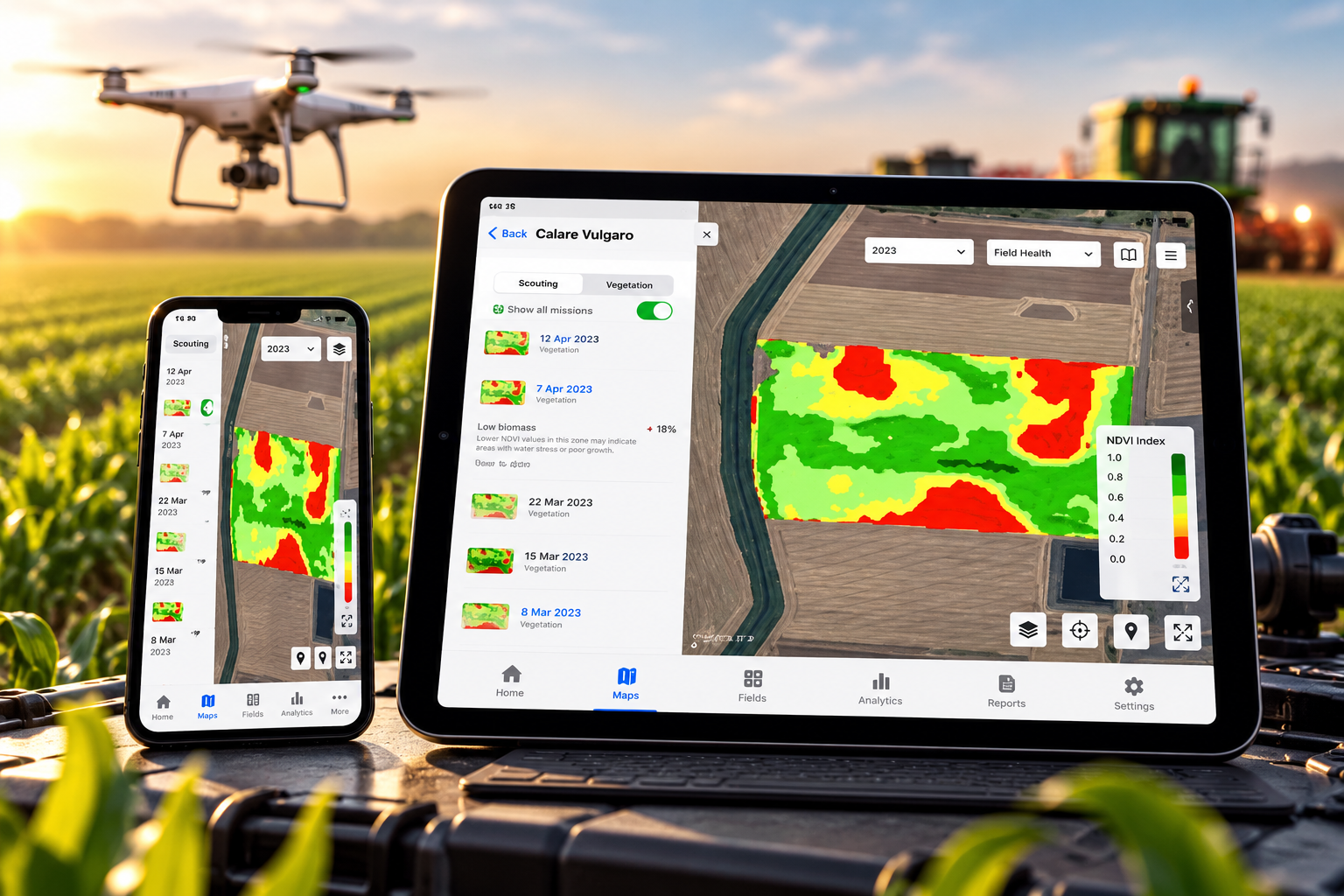
Climate Corporation has been nominated for the 2026 World AI Awards in the Agricultural Tech category, recognising its work in digital agriculture and the use of data science to help farmers make decisions at field and even individual-acre level.
At the centre of that work is Climate FieldView, Bayer’s digital farming platform. FieldView brings planting, spraying, harvest and other agronomic data into one system, giving farmers tools to examine crop performance, monitor fields and build prescriptions for seed, fertility and crop protection.
This is AI operating far away from the usual chatbot conversation. The problem is physical and messy: soil changes across a field, weather shifts, seed performance varies, and decisions made during planting can show up months later at harvest.
The World AI Awards recognises organisations, individuals, products and technologies contributing to the development and real-world application of artificial intelligence across industries.
Turning farm machinery into a stream of usable data
A large part of FieldView’s value starts with collecting information that might otherwise remain scattered across machinery, files and different agricultural systems.
The platform records field activity during planting, spraying and harvest. Farmers can transfer historical records into FieldView as well, while the FieldView Drive 2.0 connects compatible agricultural equipment with an iPad via Bluetooth to capture information during field operations.
Once those records are together, farmers can compare fields, hybrids, inputs and farming practices using maps and reports. Yield Analysis, for example, lets growers examine harvest performance by factors including field, hybrid and soil.
The system is designed to keep the farmer involved rather than turning agronomic decisions over to an opaque algorithm. FieldView says growers retain control of their farm data and can choose whether to share anything from an individual field to an entire operation with agronomists and other partners.
Machine learning gets involved before the seed enters the ground
Climate Corporation has also used machine learning for one of farming’s deceptively difficult questions: what should be planted, and where?
Its earlier Seed Advisor work applied machine-learning techniques to Bayer seed genetics and field-performance data to develop recommendations based on the characteristics of individual fields.
Climate Corporation documented models that considered more than 150 features when developing field-level product recommendations. These included environmental conditions such as soil characteristics alongside management factors including crop rotation and tillage.
The company reported that its placement model had demonstrated an average statistically significant yield lift of 7.8 bushels per acre across more than 9,600 research fields during historical cross-validation. That figure came from Climate Corporation’s own model-validation work and should not be read as a guaranteed yield increase for every farm.
Current FieldView tools continue that data-driven approach. FieldView says its seed scripts use information from more than one million test plots to help determine planting rates for individual fields.
Every acre becomes something farmers can interrogate
The more practical side of agricultural AI appears after the machinery has done its work.
FieldView allows farmers to put planting and application records beside harvest results and ask a straightforward question: what actually worked?
Its Field Region Reports can isolate sections of a field and compare factors such as seed product, soil type, elevation, population and application rate. Yield Analysis can then examine how crop-protection or fertility applications corresponded with harvested area, moisture and yield.
That changes the scale of farm analysis. Instead of treating a field as one uniform block, growers can investigate differences inside it and use those observations when planning another season.
FieldView also provides high-definition imagery for scouting and tools for generating prescriptions covering seed, nitrogen, phosphorus, potassium, lime and crop-protection applications.
The platform currently connects with more than 60 partners, according to FieldView, reflecting another practical challenge in digital agriculture: farmers rarely operate machinery and software from a single technology supplier.
Agricultural AI has to prove itself in the dirt
That may be what makes Climate Corporation’s approach particularly relevant to Agricultural Tech.
A recommendation made on a computer eventually has to survive weather, soil variability, equipment limitations and the biological uncertainty of a growing season.
FieldView currently says farmers using its seed scripts recorded an average increase of five bushels per acre compared with users who wrote their own scripts. It is a company-reported comparison rather than a universal prediction of what an individual farmer will achieve.
Still, it illustrates where agricultural data science is heading. The goal is not simply to collect more farm data. It is to turn that information into decisions farmers can test against actual harvest results, then carry what they learn into the next season.
Graham Cooke, President of the World AI Awards, said:
“Climate Corporation’s nomination highlights a side of artificial intelligence that is already closely connected to the physical world. Farming produces enormous amounts of information, but the real opportunity comes from turning that data into decisions farmers can actually use in the field.
“Through Climate FieldView and its work in data science, field analysis and precision agriculture, Climate Corporation demonstrates how digital technology can help growers understand variability across their operations and make more informed choices about seed, inputs and crop management. We congratulate the team on its 2026 World AI Awards nomination in Agricultural Tech and look forward to following the continued development of these technologies.”
Climate Corporation joins organisations, researchers, entrepreneurs and technology developers being recognised through the 2026 World AI Awards.
The programme recognises organisations, individuals and technologies contributing to the development and application of artificial intelligence across industries. Agricultural technology is a particularly tangible part of that story. Algorithms may process the data, but their usefulness is ultimately tested in fields, against real crops and at harvest.
Climate Corporation’s work through FieldView sits directly at that intersection. Data collected from farm equipment can be analysed alongside imagery, agronomic records and yield information, giving growers another layer of evidence for decisions that once relied much more heavily on broad averages and experience alone.
The farmer still makes the call. The difference is the amount of field-level evidence available when that call has to be made.
Learn more about Climate Corporation and Climate FieldView at https://climate.com/en-us.html.
Discover the World AI Awards 2026, explore the nominees and learn more about the awards at https://www.worldawards.ai.
