


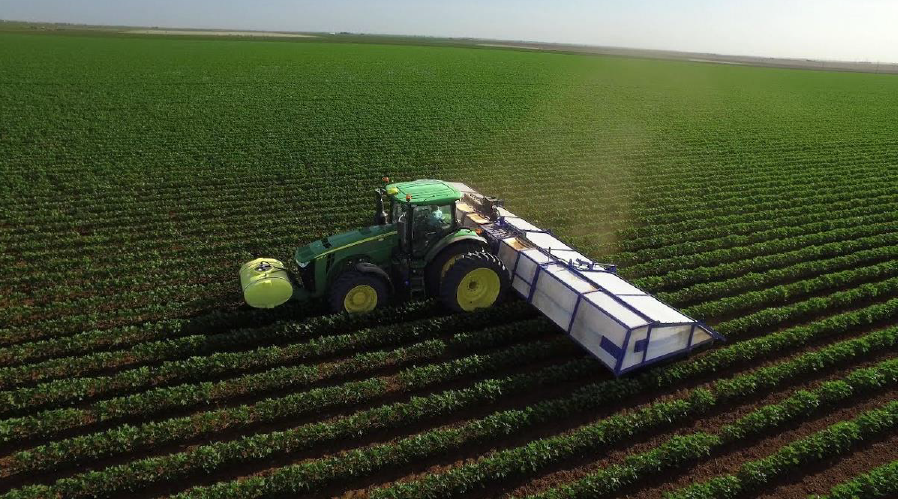
Blue River Technology has been nominated for the 2026 World AI Awards in the Agricultural Tech category, recognising its work in applying artificial intelligence, computer vision and robotics to precision agriculture.
The John Deere subsidiary is best known for See & Spray, a technology that identifies individual plants while agricultural machinery moves through a field and determines where herbicide should — and should not — be applied.
It sounds straightforward. In practice, the machine has milliseconds to distinguish a crop from a weed while dealing with dust, changing light, plant variation and equipment moving at agricultural working speeds.
That is where Blue River’s approach to agricultural AI becomes interesting.
The World AI Awards recognises organisations, individuals, products and technologies contributing to the development and real-world application of artificial intelligence across industries. Blue River Technology’s nomination puts the focus on AI that has left the lab and is working directly in fields.
See & Spray gives farm machinery a set of digital eyes
Traditional broadcast spraying can apply herbicide across an entire section of a field, including areas where weeds are absent.
See & Spray takes a different approach.
Blue River combines high-resolution cameras, computer vision, deep-learning models and precision spray controls to analyse plants as machinery travels through the field. Its models classify crops and weeds in real time, then the system activates individual spray nozzles where treatment is required.
The latest system uses 36 cameras and, according to Blue River, scans more than 2,500 square feet every second while operating at speeds of up to 16 mph.
That means the AI is not analysing carefully prepared photographs in a controlled environment. It has to make plant-level decisions continuously while a large agricultural machine moves through an unpredictable field.
Blue River says See & Spray now supports crops including corn, soybeans, wheat, canola and sugarbeets.
Less herbicide is the metric that matters
The practical case for computer vision becomes clearer when chemical use enters the picture.
Blue River reports that customers using See & Spray in 2025 reduced non-residual herbicide use by nearly 50%, collectively saving approximately 31 million gallons. Some trials achieved reductions of 59%.
Those figures are reported by Blue River rather than independent industry-wide measurements, and results can vary according to crop, weed pressure, field conditions and application strategy.
Still, the scale is notable.
The company says See & Spray operated across more than 5 million acres of farmland in 2025. Adoption has grown substantially since 2022 as the technology has been incorporated into John Deere agricultural equipment.
This is an important distinction for agricultural AI. See & Spray is not simply a research demonstration. The technology has moved into commercial machinery and is being used by farmers in working fields.
AI has to survive outside the laboratory
Agriculture creates a particularly awkward computer-vision problem.
Plants overlap. Dust covers cameras. Shadows move. Crops change appearance throughout the growing season. A model that performs well on a clean dataset still has to work while attached to heavy machinery travelling across uneven ground.
Blue River builds its deep-learning models to operate at the edge, processing high-resolution visual information directly as machinery moves through the field.
Classification, decision-making and spray actuation happen in milliseconds.
The company has also introduced central-frame cameras designed to reduce interference from dust, while optional full-boom lighting can extend See & Spray operations into nighttime conditions.
Blue River’s work reaches beyond spraying as well. Its engineering teams are developing machine-learning and robotics technologies around autonomy, perception and intelligent machinery across agriculture and other John Deere industries.
From Lettuce Bot to John Deere scale
Blue River’s agricultural AI work predates the current wave of generative artificial intelligence.
The company began after its founders experimented with robotics and computer vision in California agriculture. One of its earliest machines, Lettuce Bot, used computer vision to identify plants and automate lettuce thinning.
See & Spray took the same basic idea much further: recognise what the machine is looking at, make a decision and act on that decision immediately.
John Deere acquired Blue River Technology in 2017. Blue River continues to operate as a subsidiary while gaining access to Deere’s machinery, engineering resources and distribution network.
That relationship has given the technology something agricultural robotics companies often struggle to achieve — a route from experimental computer vision to machines operating at commercial farming scale.
Graham Cooke, President of the World AI Awards, said:
“Blue River Technology’s nomination highlights one of the most practical opportunities for artificial intelligence in agriculture: giving machinery the ability to understand what it sees and act with much greater precision.
“See & Spray brings computer vision, machine learning and robotics together around a very tangible agricultural problem — identifying weeds while helping farmers target inputs more precisely. We congratulate the Blue River Technology team on its 2026 World AI Awards nomination in Agricultural Tech and look forward to following the continued development of intelligent machinery in farming.”
Blue River Technology joins organisations, researchers, entrepreneurs and technology developers being recognised through the 2026 World AI Awards.
The programme recognises organisations, individuals and technologies contributing to the development and application of artificial intelligence across industries.
Agriculture offers a particularly useful test of what applied AI actually means. Models cannot simply produce an answer on a screen. They have to perceive crops and weeds, work through changing environmental conditions and trigger physical machinery accurately enough to make the technology useful to a farmer.
Blue River Technology has spent years working on that problem. With See & Spray now operating across millions of acres, its work provides a practical example of computer vision moving from research into everyday agricultural machinery.
Learn more about Blue River Technology and See & Spray at bluerivertechnology.com.
Discover the World AI Awards 2026, explore the nominees and learn more about the awards at worldawards.ai.
