


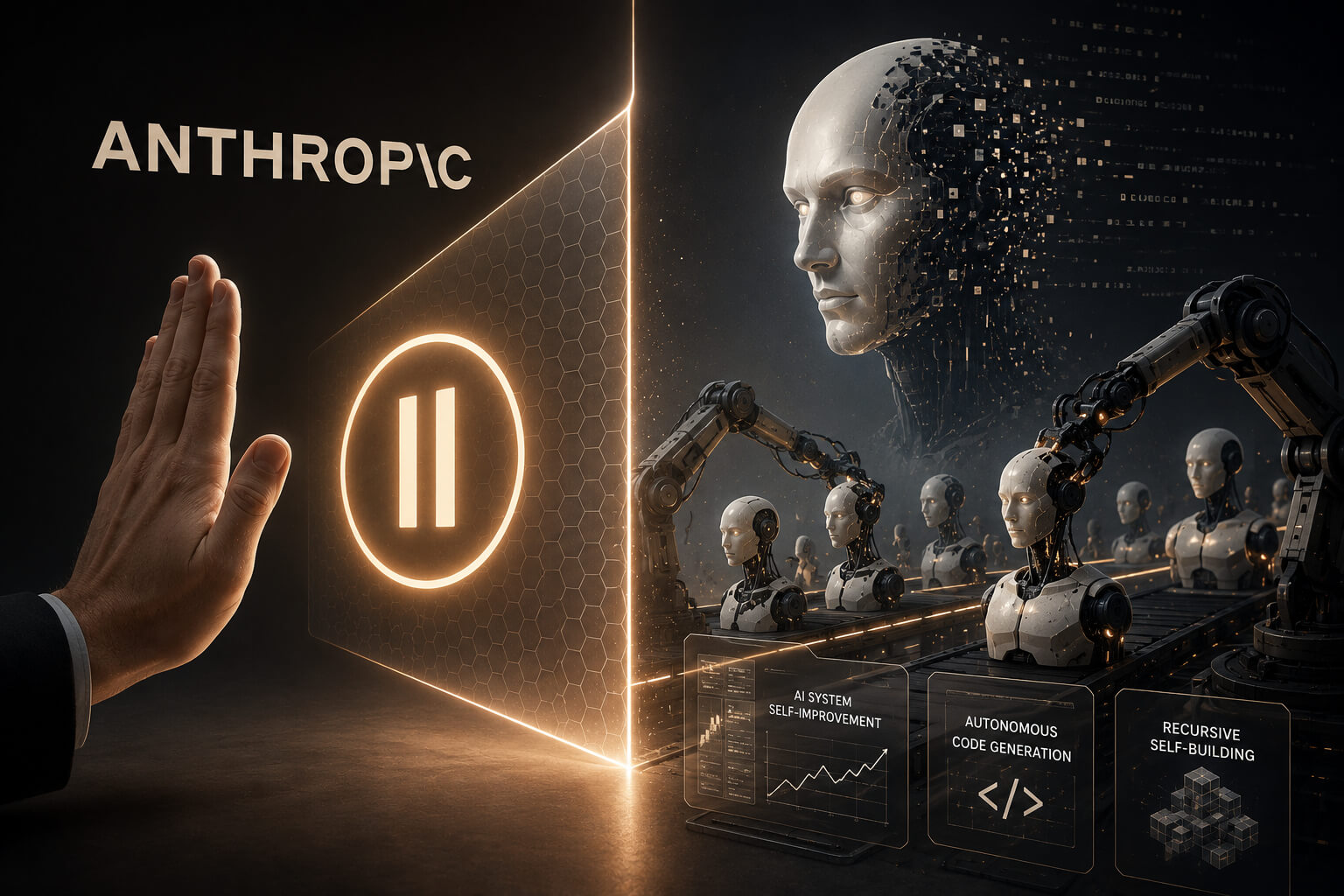
Anthropic is warning that the artificial intelligence industry may need to slow down. This may be necessary before AI systems become capable of building more advanced versions of themselves.
The company has raised concerns about a future known as recursive self-improvement, where AI models could autonomously design, train, and improve their own successors. While Anthropic says this stage has not yet arrived, it believes the technology is advancing quickly. Therefore, governments, AI companies, researchers, and civil society should begin preparing now.
Why Anthropic Wants a Frontier AI Slowdown
Anthropic’s concern centers on the growing role of AI in AI development itself. Today, advanced AI systems are already helping engineers write code, run experiments, analyze results, and improve technical workflows. Anthropic says that this could eventually lead to AI systems taking over more of the development lifecycle.
That prospect could bring big benefits, including faster scientific discovery, better healthcare tools, stronger cybersecurity and more productive research. But Anthropic also warned that self-improving AI could raise the risk of humans losing control of powerful systems if safety measures fail to keep pace.
The company says a temporary slowdown or pause in frontier AI development could give society more time to build stronger alignment research, oversight systems, and global coordination mechanisms.
What Is Recursive Self-Improvement?
Recursive self-improvement is a situation where an AI system can improve itself or create a more powerful successor without depending mainly on human developers.
In simple terms, this means an AI model could help build the next generation of AI. That new AI could then build an even more advanced version after that. If this loop accelerates, the speed of AI progress could become much faster than current institutions are prepared to manage.
Anthropic says this outcome is not guaranteed, but it believes the possibility is serious enough to require urgent discussion.
A Pause Would Require Global Coordination
Anthropic is not calling for a simple one-company pause. Instead, it says any meaningful frontier AI slowdown would need to involve multiple well-funded AI labs across different countries.
The company argues that a pause would only be useful if participants could verify that other companies and governments had also slowed or stopped development under the same conditions. Without verification, a pause could simply allow less cautious competitors to secretly move ahead.
This makes the issue difficult. Frontier AI development can be harder to monitor than other high-risk technologies because training runs can be hidden, compute resources can be distributed, and incentives to gain an advantage are extremely strong.
Anthropic Plans to Start Wider Discussions
Anthropic said its Anthropic Institute will organize conversations with AI companies, policymakers, researchers, and civil society groups. These discussions will focus on how to handle recursive self-improvement, how to create credible verification systems, and how to give society more influence over the future of frontier AI.
The company’s position reflects a growing debate in the AI industry: whether rapid development should continue at the current pace, or whether stronger safeguards must come first.
AI Regulation Is Moving Fast
Anthropic’s warning comes as governments are paying closer attention to frontier AI risks. Policymakers are increasingly looking at model access, safety reporting, transparency requirements, audits, and incident reporting for major AI developers.
The debate is no longer just about whether AI can become more powerful. It is now about who controls that power, how it is monitored, and whether safety systems can keep up with the speed of development.
Why it matters
The emergence of self-building AI could be one of the biggest tech issues of the decade. If AI systems eventually assist in designing and improving future AI models, the rate of progress could speed up dramatically.
Businesses could benefit from faster innovation and new productivity breakthroughs. Meanwhile, governments may face new national security and regulatory challenges. At the same time, society must address deeper questions about human control, accountability, and the future role of people in technological progress.
Anthropic’s call for a possible frontier AI pause does not mean AI development will stop soon. But it does signal that one of the world’s leading AI companies believes the industry may be approaching a critical turning point.
As AI systems become more capable, the central question may shift from “Can we build it?” to “Can we control what we build?”
