


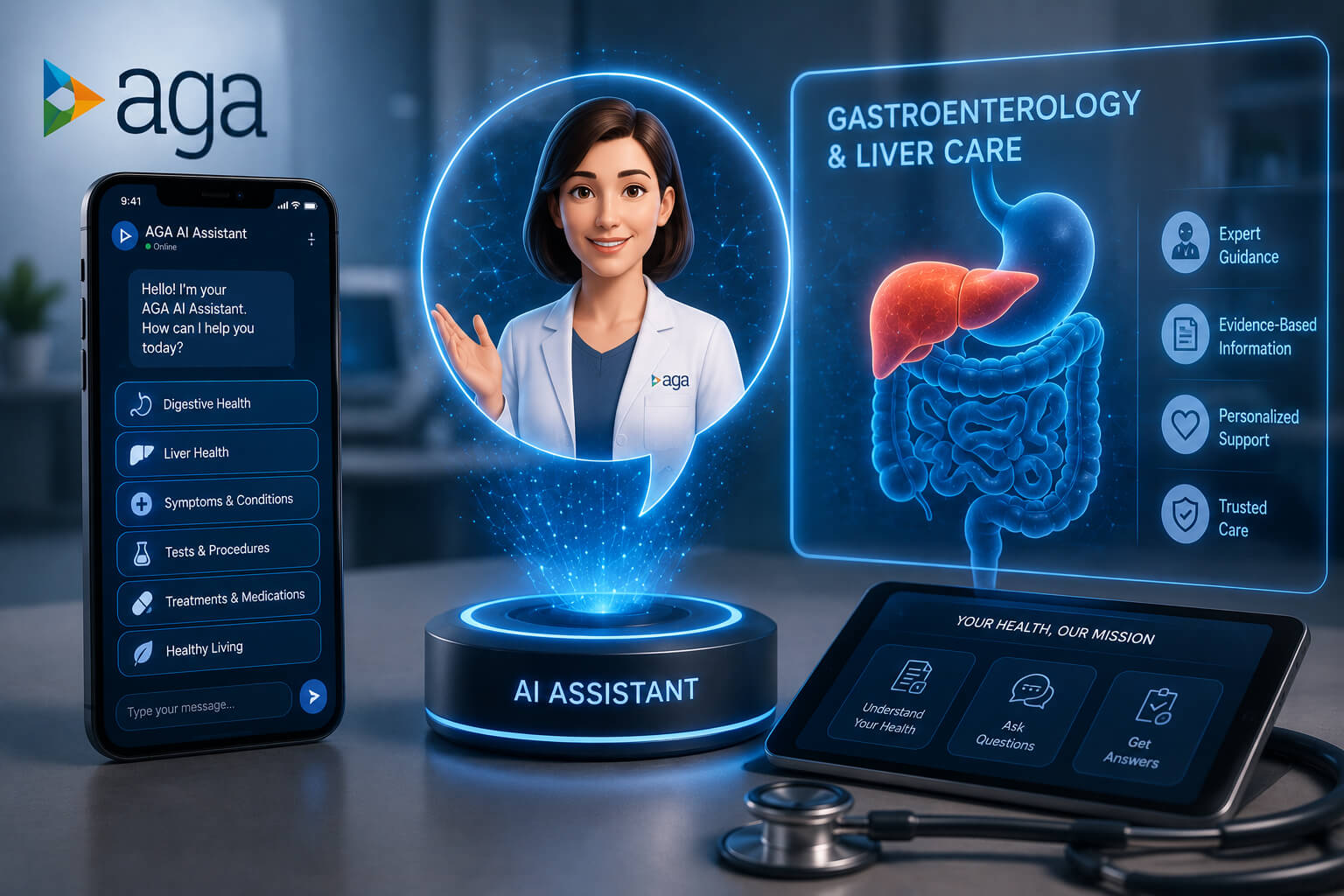
The American Gastroenterological Association has introduced Nigel, an AI-powered virtual assistant built specifically for gastroenterology and hepatology care. Not a general chatbot. Not another broad medical search tool pretending to know everything. This one is trained around AGA’s clinical guidance and designed for clinicians who need quick, evidence-based answers during patient care.
That detail matters. Digestive disease care can get complicated fast. Guidelines shift. New research arrives. Treatment decisions are rarely as simple as one symptom, one answer. AGA is positioning Nigel as a point-of-care support tool for doctors who need reliable information without digging through long documents in the middle of a busy clinical day.
Nigel Brings AI Into Gastroenterology Workflows
Nigel was developed exclusively for gastroenterology and hepatology. According to AGA, the tool was built using its trusted clinical guidance and developed with experts including Dennis L. Shung, MD, MHS, PhD, Bradly C. Stadie, PhD, and Aly T. Strauss, MD, MIE.
The goal is simple enough: give clinicians fast answers they can actually use.
That includes evidence-based responses, summaries of AGA guideline recommendations, supporting research, and help validating diagnostic or treatment decisions. The assistant is also designed to deliver answers within seconds, which is probably where the real value sits. In medicine, a tool that takes too long often becomes a tool nobody opens.
A Different Kind of Medical AI Tool
AGA is making a clear distinction between Nigel and general-purpose AI systems. The organization says Nigel is not trained on broad internet data in the usual way. It is built around AGA’s peer-reviewed clinical guidelines and structured through the GRADE evidence framework, which is used to assess the strength and certainty of clinical recommendations.
That is the important part.
Healthcare AI has a trust problem. Clinicians do not just need polished answers. They need to know where the answer came from, how strong the evidence is, and whether there is uncertainty around a recommendation. Nigel is meant to show that context instead of giving a confident-sounding response with no clinical grounding.
Faster Answers, Less Searching
AGA says Nigel can help clinicians access current evidence quickly, reduce time spent on literature searches, stay updated as guidelines change, and focus more attention on patients. It may also help reduce cognitive burden, especially in specialties where clinicians must constantly track evolving guidance.
That sounds small until you picture the day-to-day work.
A gastroenterologist may be moving between patients, lab results, medication questions, liver disease guidelines, inflammatory bowel disease decisions, screening recommendations, and insurance-related pressure. Even experienced clinicians still need to check guidance. The issue is not lack of knowledge. It is time, overload, and the risk of missing something current.
Nigel is trying to fit into that gap.
Why This Matters for AI in Healthcare
The launch also shows where medical AI may be heading next. Less hype around replacing doctors. More tools built for narrow, high-value clinical settings.
Gastroenterology and hepatology are good examples. These fields deal with complex chronic conditions, evolving treatment pathways, and large volumes of clinical research. A focused AI assistant, backed by a major professional association, may be easier for clinicians to trust than a generic chatbot dropped into a hospital workflow.
Still, this is not about letting AI make the final call. AGA presents Nigel as clinical support, not a substitute for medical judgment. That line needs to stay clear, especially as more AI tools move from demos into real care environments.
Updated as Guidance Changes
One of Nigel’s more practical features is its update model. AGA says the assistant’s knowledge base will be updated in real time as the association publishes new clinical guidance and as emerging evidence changes recommendations.
That could be useful if it works smoothly. Medical guidance does not stand still. A static AI tool becomes outdated quickly. A tool tied directly to guideline updates has a better chance of staying relevant, though clinicians will still need transparency around what changed and when.
A Small Launch With Bigger Signals
Nigel may not be the flashiest AI healthcare announcement this year. No dramatic claim about replacing clinical work. No promise to reinvent medicine overnight.
But that is exactly why it is worth watching.
The future of healthcare AI may look less like a giant all-purpose doctor bot and more like specialized assistants built for real clinical pressure points. Gastroenterology gets one now. Other specialties will likely follow.
For AGA, Nigel is a step toward faster, guideline-grounded decision support. For clinicians, it could become another tool on the desk, useful only if it saves time without adding doubt. And for healthcare AI, it is another sign that trust, evidence, and specialty focus are becoming the real battleground.
