


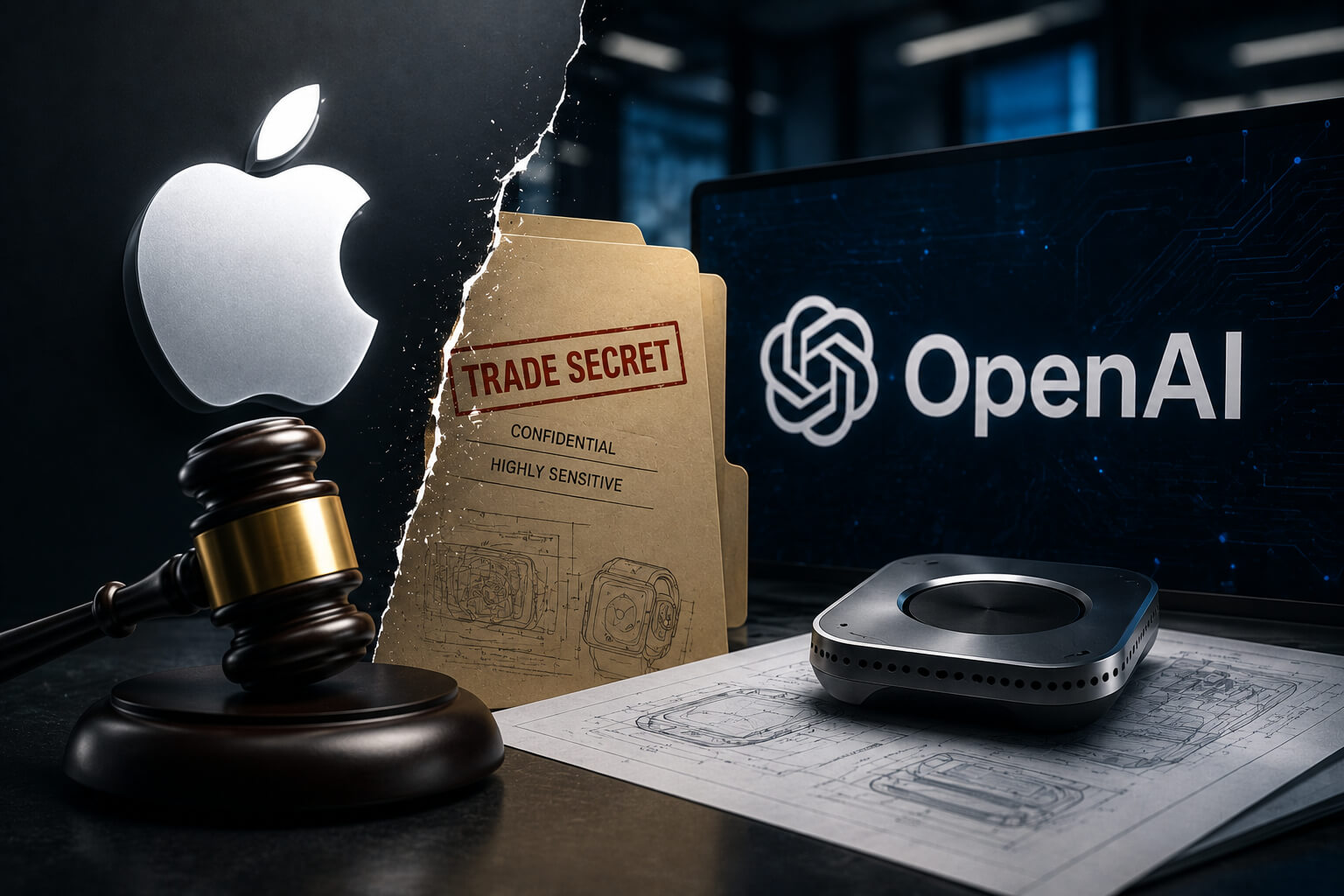
Apple has sued OpenAI, accusing the ChatGPT maker of stealing trade secrets tied to its hardware work. And yes, that sounds almost strange when you remember these two companies were supposed to be partners not that long ago.
The lawsuit, filed in California federal court, claims OpenAI used former Apple employees and confidential information to speed up its push into consumer AI hardware. Apple says the alleged misconduct involved sensitive product details, unreleased parts, supplier information, and internal documents connected to Apple’s device development. OpenAI has not publicly responded to the allegations at the time of reporting.
Apple’s Lawsuit Puts OpenAI’s Hardware Ambitions Under Pressure
The center of the dispute is not ChatGPT itself. It is hardware.
OpenAI has been moving beyond software, especially after its connection with Jony Ive and the acquisition of io Products, the AI hardware startup linked to Ive and former Apple design talent. Apple’s complaint names OpenAI, io Products, and former Apple employees including Tang Tan and Chang Liu, according to multiple reports.
That matters because OpenAI’s next big act may not be another chatbot window. It may be a physical AI device. Something people carry, wear, speak to, or use instead of a phone for certain tasks. Nobody outside the companies knows exactly what that device will look like, but Apple clearly sees enough risk to go to court.
What Apple Is Accusing OpenAI Of
Apple alleges that former employees improperly accessed or transferred confidential company information after leaving Apple. One report says the complaint includes claims that Chang Liu accessed internal systems after his departure and downloaded sensitive files related to unreleased products and technical documents.
Apple also claims Tang Tan, now OpenAI’s chief hardware officer, solicited confidential supplier and parts information through people still connected to Apple’s hardware ecosystem. The company argues that this was not just a small employee mistake, but part of a broader pattern that could benefit OpenAI’s device plans.
These are allegations for now. That distinction matters. Apple still has to prove its claims in court, and OpenAI will likely challenge the story hard if the case moves forward.
The Apple and OpenAI Partnership Looks Very Different Now
This lawsuit lands awkwardly because Apple and OpenAI were recently working together. Apple brought ChatGPT into the iPhone experience as part of its Apple Intelligence rollout, giving users access to OpenAI’s chatbot inside certain iOS features.
At the time, it looked like a practical partnership. Apple needed stronger generative AI features. OpenAI wanted deeper consumer reach. Simple enough.
Now the relationship looks much colder.
Reports earlier this year already suggested tension between the two companies over the ChatGPT integration and whether OpenAI received the value it expected from the partnership. This lawsuit turns that tension into something much more serious.
Why This Case Matters for the AI Industry
This is not just another tech lawsuit with big names attached.
AI companies are racing into hardware because the next interface for AI may not be a browser tab or phone app. It could be a dedicated device built around voice, camera input, personal context, and always-available assistance.
That is exactly where Apple has decades of experience. Supply chains. industrial design. miniaturization. sensors. privacy systems. manufacturing at scale. The hard, boring, expensive parts that software-first AI companies do not automatically understand.
So if Apple believes OpenAI gained access to that knowledge unfairly, it was never going to shrug it off.
OpenAI’s Consumer Device Dream Just Got Messier
OpenAI wants to become more than the company behind ChatGPT. That part is obvious now. It has enterprise tools, developer platforms, consumer subscriptions, media partnerships, and a growing interest in hardware.
But hardware is a different game. It brings factories, suppliers, prototypes, leaks, patents, trade secrets, and lawsuits that can drag for years.
Apple knows that world better than almost anyone.
If the court takes Apple’s claims seriously, OpenAI’s hardware plans could face delays, restrictions, or at least a heavy legal distraction. Apple is reportedly seeking damages and injunctions to stop the use of any allegedly stolen confidential information.
A Bigger Battle Over AI Devices Is Starting
The bigger picture is not hard to see.
Apple wants AI to strengthen the iPhone, Mac, iPad, and its broader ecosystem. OpenAI wants AI to become its own platform, possibly with hardware that does not depend on Apple’s devices forever.
That creates a natural collision.
For years, OpenAI lived mostly inside other people’s devices. Apple’s devices. Microsoft’s cloud. Browsers. Apps. APIs. Now OpenAI appears to be thinking about the physical layer too.
Apple does not usually welcome that kind of move, especially when former Apple hardware people are involved.
What Happens Next
The case will now move through the legal system, and OpenAI’s response will be important. The company may deny wrongdoing, challenge Apple’s evidence, or argue that employee knowledge and company secrets are being blurred together.
For now, Apple has made the message clear: it believes OpenAI’s hardware push crossed a line.
And that makes this one of the more important AI industry fights to watch. Not because it is dramatic, although it is. But because it shows where the next AI war may be heading.
Not just models.
Devices.
Source: https://www.bloomberg.com/
