


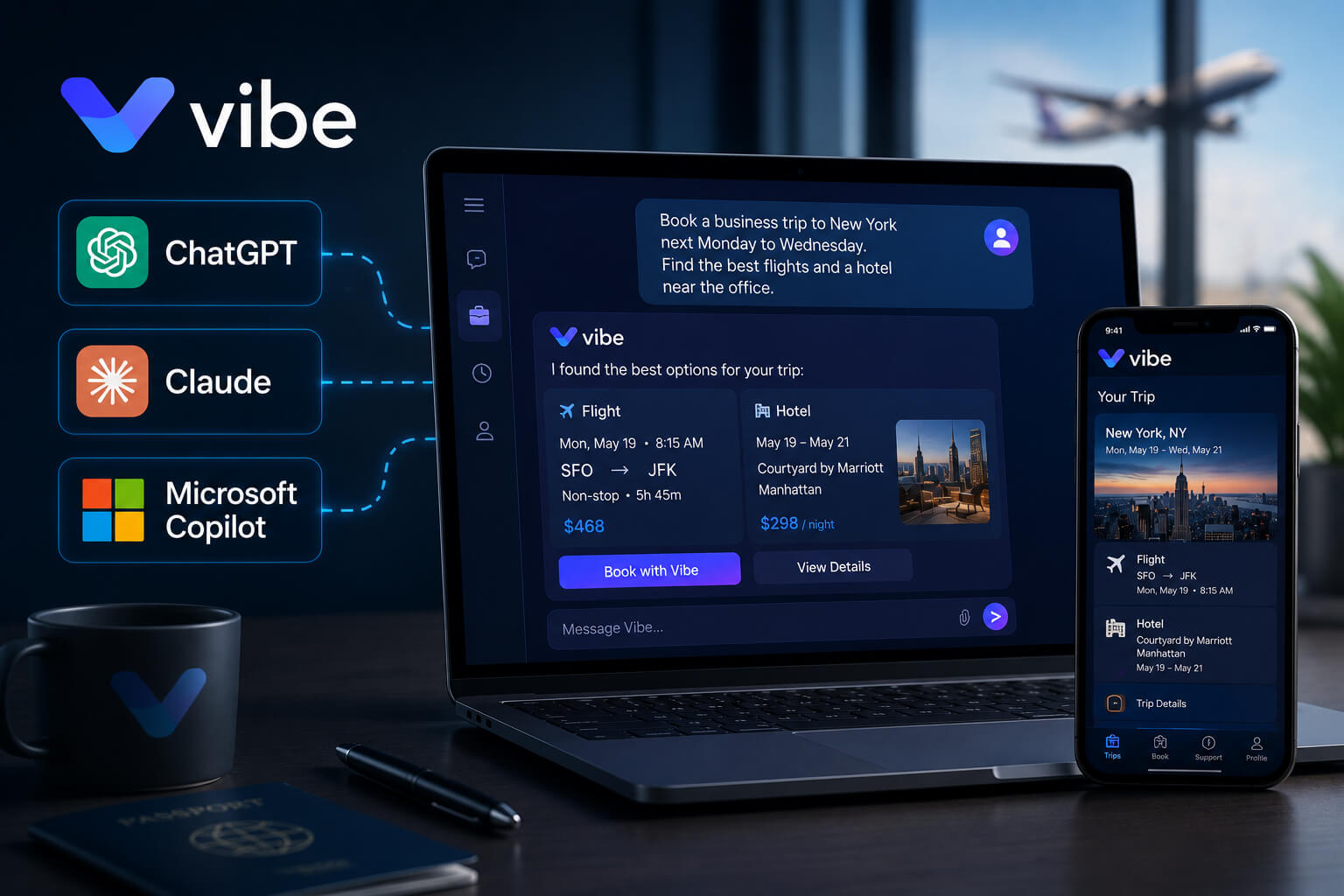
Corporate travel booking is starting to move into a new place. Not another travel app. Not another dashboard with too many tabs. This time, Vibe wants the booking process to happen inside the AI assistants people are already using.
Vibe has launched a new AI integration that allows corporate travellers to search, book, and manage travel through platforms including ChatGPT, Claude, and Microsoft Copilot. The company says the system keeps Travel Management Companies, or TMCs, in control of the booking process, which is the part that makes this more than just another AI travel experiment.
Vibe Uses MCP to Connect Travel Platforms With AI Assistants
The new integration runs through the Vibe MCP server, using Model Context Protocol to connect Vibe-powered travel management platforms directly with AI assistant environments.
That sounds technical, but the idea is fairly simple. A business traveller could use natural language to search for flights, hotels, or rail options without leaving the AI tool they already have open. Instead of clicking through a traditional booking interface, they can ask for what they need in plain language.
The important part is what happens behind the scenes. Vibe says bookings remain connected to approved corporate travel content, supplier relationships, payment systems, travel policies, and reporting structures. That matters because corporate travel is not the same as booking a weekend trip for yourself.
There are rules. Budgets. Preferred suppliers. Duty of care. Approval flows. Finance teams watching everything.
AI can make booking easier, yes. But if it pulls travellers outside the company’s managed travel programme, it creates a different problem.
Why This Matters for Travel Management Companies
This launch is aimed directly at TMCs that do not want to be pushed aside by AI assistants.
The risk is easy to see. Employees may start using ChatGPT, Claude, or Copilot to plan travel because it feels faster and more natural. If the final booking happens outside official channels, the company loses visibility. The TMC loses control. Travel policy becomes more of a suggestion than a system.
Vibe is trying to avoid that split.
Instead of asking TMCs to build their own AI infrastructure from scratch, Vibe gives them a way to bring AI-powered search, booking, and servicing into their existing travel programmes. It is not trying to replace the TMC. At least, that is the message. It wants the TMC to remain the layer that controls content, policy, payment, and commercial relationships while the user-facing experience becomes more conversational.
That is a smart position to take. Because AI travel booking will probably happen anyway. The real question is whether it happens inside managed systems or around them.
Travellers Can Book Flights, Hotels and Rail Through AI Chat
Through the integration, corporate travellers can use their chosen AI assistant to search and book flights, rail, and hotels. They can also view existing bookings, manage trips, make payments, amend itineraries, and access corporate travel policy information.
That last part is underrated.
A lot of business travel friction comes from small questions. Is this hotel allowed? Can I book premium economy? What happens if the meeting changes? Which airport should I use? Is this supplier approved?
In a normal system, those answers may be buried in policy documents or scattered across emails and booking tools. If AI can answer them inside the booking flow, the experience becomes less painful. Not magical. Just less annoying.
And in corporate travel, less annoying is already a big win.
ITG Business Travel Is Already Testing the Integration
ITG Business Travel is the first Vibe client live with the integration and is testing the technology with corporate clients in real booking environments.
That is useful because this kind of tool needs more than a polished demo. Corporate travel has too many edge cases. Delayed flights. Changing meetings. Approval problems. Travellers who ignore policy. Finance teams asking why a fare was chosen. A simple AI booking flow is not enough unless it survives the mess of real business travel.
ITG Business Travel said the integration gives it a way to compete in the AI booking space without making the heavy investment usually needed to build this kind of technology in-house.
That may be one of the bigger points here. AI adoption in travel is not only about giant companies with deep engineering teams. Smaller and mid-sized travel businesses also need a route into AI, or they risk watching user behaviour shift without them.
AI Is Becoming the New Front Door for Booking
Vibe’s move fits a wider change happening across digital commerce. AI assistants are starting to become entry points for search, shopping, support, and booking. People are getting used to asking instead of browsing.
Travel is an obvious target because travel planning is already conversational. People do not always think in filters. They think in messy requests.
“I need to be in Berlin by Tuesday morning, near the conference venue, but keep it within policy.”
That is exactly the kind of request AI assistants are built to handle.
The harder part is making sure the response is not just convenient, but compliant. For leisure travel, a slightly imperfect AI recommendation may just be annoying. For corporate travel, it can create cost, safety, and reporting problems.
This is why Vibe’s controlled approach matters. It does not treat AI as a separate booking world. It plugs AI into the managed travel system.
Vibe Is Not Building Another Standalone AI Travel Tool
Vibe says it is not building a separate AI travel assistant. Instead, it wants existing travel businesses to operate in an AI-first environment.
That distinction matters.
The travel industry already has enough standalone tools fighting for attention. Another AI travel chatbot would be easy to ignore. A system that lets TMCs extend their own services into ChatGPT, Claude, and Microsoft Copilot is different. It goes where users may already be moving.
It also gives TMCs a defensive strategy. Rather than waiting for AI assistants to capture the traveller relationship, they can use those same assistants as a new interface for their own managed travel content.
That does not mean the old booking interface disappears tomorrow. It probably will not. Corporate travel systems move slowly for a reason. But the front end may start changing faster than the back end.
Corporate Travel Booking Is Getting More Conversational
The big story here is not just Vibe. It is the direction of business software.
Workers are slowly being trained to expect AI interfaces inside daily tasks. Writing, searching, summarising, scheduling, researching. Booking travel is a natural next step.
For travel management companies, this creates pressure. They can either let travellers drift toward consumer-style AI tools, or they can bring AI into the managed travel environment before that behaviour becomes normal.
Vibe is choosing the second path.
And honestly, that is where the corporate travel market probably has to go. Not because every traveller wants another chatbot. But because the old booking experience often feels too slow for the way people now expect software to work.
AI will not remove the need for policy, control, supplier management, or reporting. Those pieces become even more important once booking starts happening through conversational tools.
The interface may look casual. The system behind it cannot be.
