


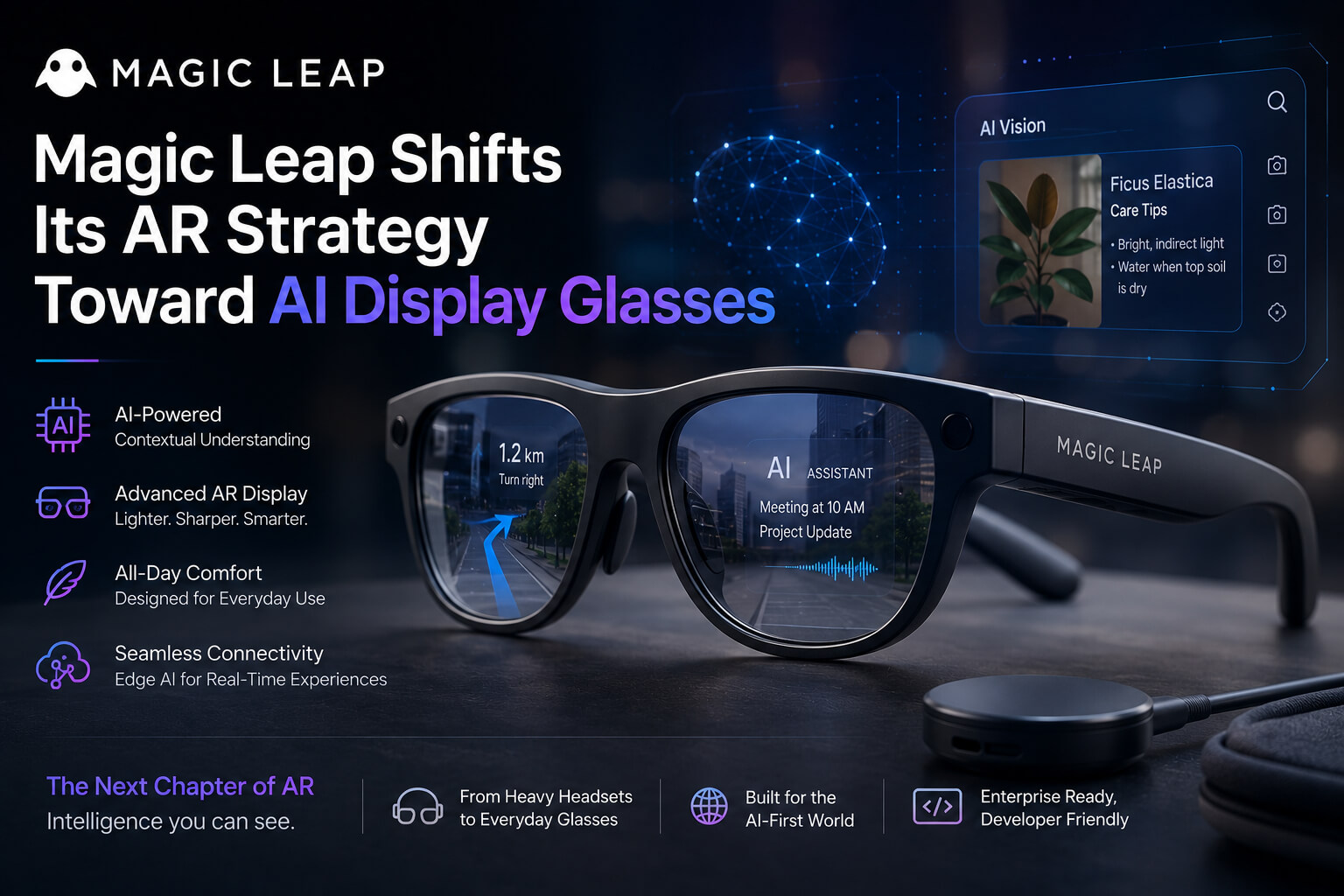
Magic Leap is changing direction again, but this time the move feels less like a consumer hardware gamble and more like a supplier play.
The company announced a strategic pivot on July 9, 2026, saying it will focus on helping the technology industry build AI display glasses through its waveguide expertise, AR optics, and device integration experience. Instead of trying to push its own first-party devices into the market, Magic Leap now wants to become a key partner for companies building the next wave of wearable AI hardware.
Magic Leap Wants to Be the Engine Behind AI Glasses
The new strategy puts Magic Leap in a different position. Not the brand trying to convince consumers to buy another headset. Not the company carrying the full burden of hardware design, software, retail, and adoption.
This time, Magic Leap is leaning into the part of the business where it already has deep technical history: near-eye display systems.
The company says it will serve as an AR ecosystem partner, waveguide supplier, and device integration expert for technology companies working on AI display glasses. That matters because the race around AI wearables is no longer only about microphones, speakers, and camera features. The harder step is visual AI: useful information shown in front of the user without turning the product into a bulky headset.
That is where waveguides come in.
Why Waveguides Matter for AI Display Glasses
Waveguides are one of the quiet but critical pieces of AR glasses. They help place digital visuals into the wearer’s field of view while keeping the glasses thin enough to actually wear.
Magic Leap says its diffractive waveguide technology is built for lightweight AI display glasses, with support for larger field-of-view ranges, higher resolution, stronger brightness and color quality, and integration with many commercially available light engine technologies. The company also points to a larger eyebox, which can help make the viewing experience work for a wider range of users.
That may sound technical, but the consumer version is simple. If AI glasses are going to move beyond voice prompts and tiny notifications, the display has to be comfortable, clear, and small enough to disappear into a normal-looking product.
Nobody wants smart glasses that feel like a science project strapped to their face.
Magic Leap Is Betting on Manufacturing, Not Just Ideas
The more interesting part of Magic Leap’s announcement is manufacturing.
The company says its waveguide production process is designed for repeatability and volume. It uses a proprietary Jet and Flash Imprint Lithography process, known as J-FIL, to improve consistency, increase yield, and reduce material waste. Magic Leap also says its surface-relief grating diffractive waveguide architecture requires fewer process steps than competing approaches, which could shorten manufacturing cycles and help partners move faster from prototype to volume production.
That is the real bottleneck for AI glasses. Plenty of companies can show a prototype. Scaling a display system that is bright, thin, durable, affordable, and manufacturable is a different problem entirely.
Magic Leap is basically saying: we already spent years learning the expensive lessons, so partners do not have to start from zero.
AI Wearables Are Moving Toward Visual AI
Magic Leap’s pivot comes as displayless AI glasses and audio-based wearables have already started pulling consumer attention. The company pointed to a 44.4% rise in total XR device shipments in 2025 as a sign that consumers are warming up to wearable AI when the product feels useful, stylish, and affordable.
But displayless glasses are only one phase. They can answer questions, capture media, translate speech, or provide audio help. Useful, yes. Still limited.
Visual AI is the more ambitious version. Directions shown in view. Real-time prompts. Contextual information. Translation overlays. Workplace instructions. Shopping details. Training support. Maybe even lightweight productivity tools that do not require pulling out a phone every few minutes.
That future depends on displays that do not ruin the glasses.
A Smarter Role for Magic Leap?
Magic Leap has been through several chapters already. Big ambition. Expensive hardware. Enterprise focus. Consumer curiosity. Market skepticism. Now, the company seems to be choosing a role that may fit better with where the industry is heading.
Instead of trying to own the whole AI glasses experience, Magic Leap wants to own a difficult layer inside it.
That could make the company more relevant as major tech players explore AI wearables, AR glasses, and spatial computing devices. If the next battle is about who can ship comfortable AI display glasses at scale, optics and waveguide manufacturing become far more important than flashy demos.
Magic Leap does not need to be the name on the frame to matter. It just needs to be inside the glasses.
