


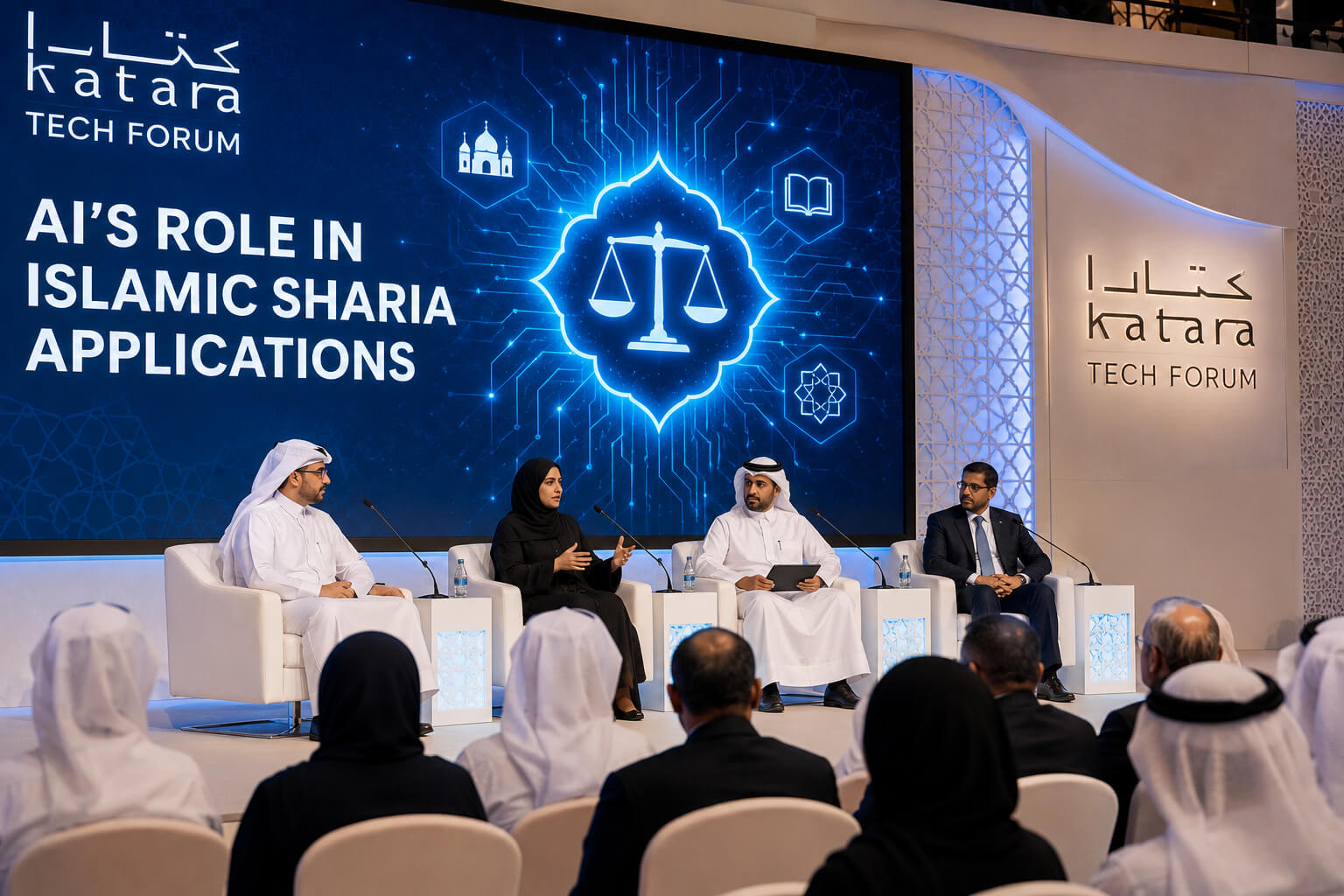
Artificial intelligence is moving into spaces that need more than speed. Accuracy matters. Context matters even more. That was the center of discussion at the 30th Katara Tech Forum in Doha, where experts examined how AI can support Islamic Sharia applications without replacing scholars, juristic reasoning, or human review.
The forum was organized by Katara Cultural Village in cooperation with the Ministry of Endowments and Islamic Affairs, also known as Awqaf, and IslamOnline. The session focused on a sensitive but increasingly relevant question: how far can AI go in helping religious research, Fatwa work, sermon analysis, and digital Islamic content?
Katara Tech Forum Puts AI and Sharia on the Same Table
The panel brought together specialists from Sharia sciences, technology, religious guidance, and media. It was moderated by Mu’adh Yusuf Al Qasimi, Head of the Religious Guidance Section at Awqaf.
This was not a conversation about handing religious judgment to machines. The tone was more careful than that. AI was framed as a tool that can organize information, speed up access to sources, and help researchers work through large volumes of religious content. Still, the final authority remains human.
That distinction matters. In Islamic law, a Fatwa is not just an answer generated from available text. It requires knowledge, context, interpretation, and responsibility. AI may assist the process, but it cannot carry that responsibility on its own.
How AI Could Support Fatwa Research
Dr. Idris Ahmed Tijani, a specialist in jurisprudence and its principles, presented examples of how AI could be used in Sharia-related work. One area he highlighted was Fatwa support.
AI can help researchers search through Sharia sources faster. It can surface relevant references, organize material, and make religious content easier to access. For scholars and legal researchers, that could reduce time spent searching and increase time spent analyzing.
But there is a line. The forum stressed that AI tools must operate under scientific and Sharia controls. Reliability is not optional here. A fast answer that is wrong, poorly sourced, or stripped of context can create real harm.
Friday Sermon Analysis Gets an AI Use Case
One of the more practical examples discussed was the use of AI in analyzing Friday sermons.
The idea is simple enough on the surface. Sermons can be converted into digital text. AI can then examine the content, identify themes, extract verses and Hadiths, and prepare evaluation reports based on set standards.
That could help institutions review sermon quality, track recurring themes, and improve religious communication. It could also make large-scale analysis possible without manually reviewing every sermon from start to finish.
Still, the forum made the human role clear. AI can prepare reports. Humans must validate the results. That is not a small detail. It is the safeguard.
IslamOnline Shows AI’s Role in Digital Religious Content
The discussion also touched on IslamOnline’s digital transformation efforts. The platform has been investing in AI-powered technologies to improve semantic search and make trusted religious content easier to find.
Search is a major part of this story. Many people now expect instant answers online. Religious platforms are under pressure to make credible content searchable, understandable, and accessible without losing scholarly discipline.
AI can help with that. It can improve how users find answers. It can connect related concepts. It can make archives easier to navigate. But again, the value depends on the quality of the source material and the review process behind it.
AI in Islamic Content Needs Rules, Not Hype
The panel also discussed the wider impact of AI on Islamic content and visual media. This is where the issue becomes more complicated.
AI can create, summarize, translate, classify, and recommend content at scale. That is useful for education, media, research, and public guidance. At the same time, religious content cannot be treated like ordinary online material. Precision matters. Attribution matters. The difference between a helpful explanation and a misleading one can be small, but serious.
Forum participants pointed to the need for Sharia and regulatory frameworks. In other words, AI adoption in religious fields cannot rely only on technical performance. It needs clear limits, responsible governance, and expert supervision.
AI Can Help Scholars, But It Cannot Replace Them
The strongest message from the Katara Tech Forum was not that AI should enter Islamic Sharia applications everywhere. It was that AI can support the work if used carefully.
It can speed up browsing. It can help control knowledge resources. It can improve access to information. It can support research, sermon analysis, and content organization.
But it cannot replace scholars. It cannot replace juristic reasoning. It cannot issue religious judgment without human authority.
That is probably the most important takeaway. AI may become part of the religious knowledge ecosystem, but only as an assistant. The scholar stays at the center.
