


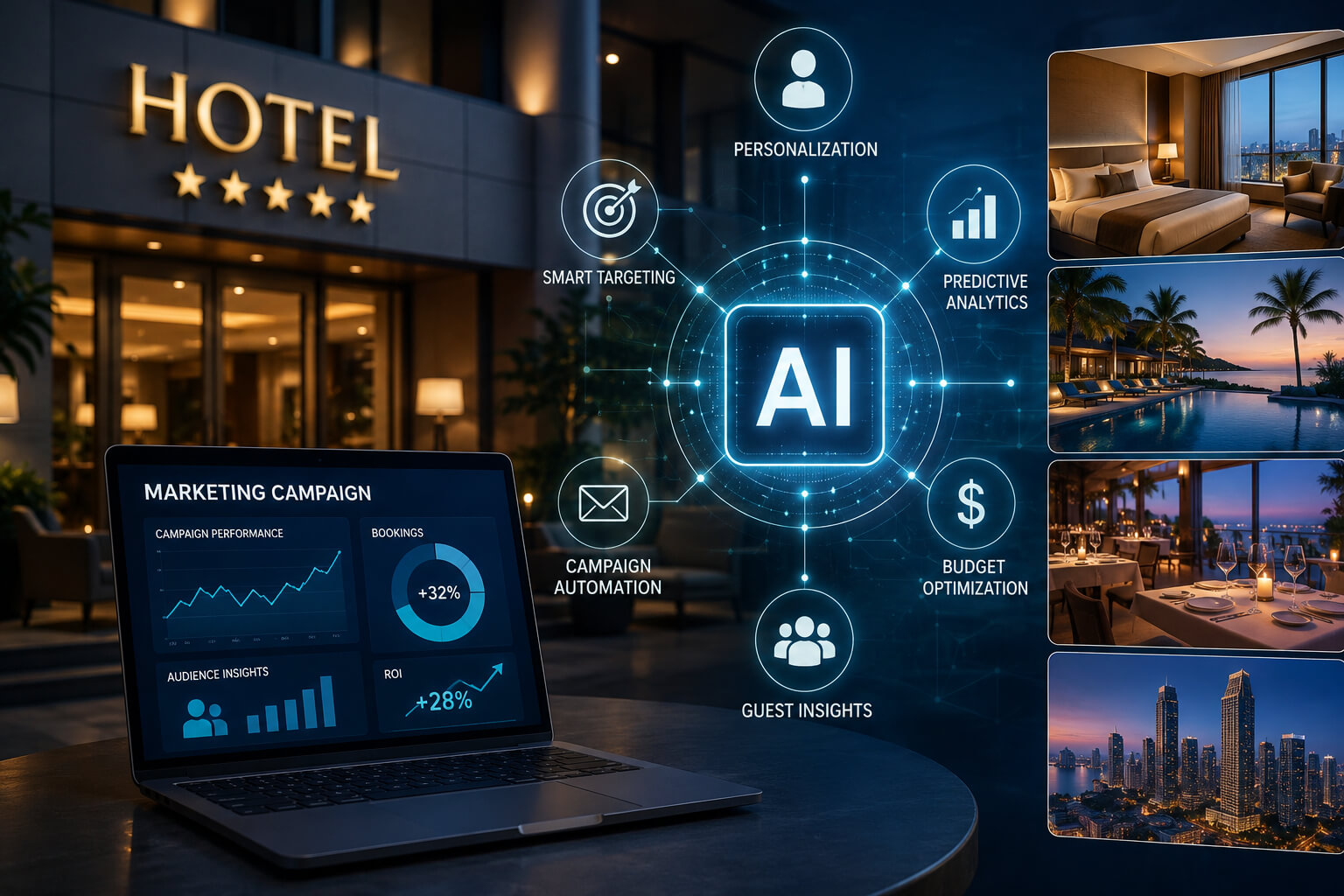
Hotel marketing has entered one of those strange phases where everyone knows something big is changing, but not everyone knows what to do with it yet. In particular, the rise of AI hotel marketing is shifting strategies and creating new opportunities for the industry.
Google Ads is changing. Bing Ads is changing. Meta, TikTok, metasearch engines, even ChatGPT-style discovery tools are starting to reshape how travelers find, compare, and book hotels. The funny thing is, AI did not suddenly appear in advertising last week. These platforms have been pushing marketers toward algorithms for years.
What is different now is the pressure.
Travelers are searching differently now. Longer questions are becoming normal. AI assistants are part of the process, too. People are not always typing clean keywords like “hotel in Madrid” anymore. Instead, they ask for a mood, a budget, a location, or a specific type of trip. Something like “a charming hotel in Barcelona for a couple with breakfast under €200.” That is not old-school search. That is intent. And the platforms are racing to understand it.
For hotels, this is not just a technology update. It changes campaign structure, budget decisions, creative work, search strategy, and the way direct bookings are won.
AI Is Already Inside the Major Ad Platforms
The biggest mistake would be treating AI as a separate tool that sits outside hotel marketing.
It is already inside the platforms hotels use every day. Google Ads uses it. Bing Ads uses it. Meta and TikTok use it. Metasearch engines are moving in the same direction. These systems are no longer waiting for marketers to manually define every keyword, every bid, every audience, and every creative variation.
They want signals. Good data. Enough volume. Clear conversion goals. Then they learn.
That makes the hotel marketer’s job different. Less button-pushing. More strategy. Less campaign clutter. More careful feeding of the algorithm.
The 5 Keys to Using AI in Hotel Marketing
The changes happening across ad platforms are connected. They are all moving toward efficiency: cleaner campaign structures, smarter budget management, better personalization, and more useful communication with travelers.
There are five areas hoteliers need to understand first.
1. Semantic and Contextual Search Changes Who Sees Your Hotel
Ads are no longer triggered only by exact keywords or narrow audiences. AI is learning to read the intent behind a trip.
A traveler might search for “a family getaway” and never mention the word hotel. In the old keyword world, that could be a missed opportunity. Now, AI can understand that a city hotel, family-friendly property, or nearby accommodation may be relevant depending on the search context.
It can also consider signals such as device, location, previous behavior, booking intent, and even cancellation likelihood.
The result is a wider qualified audience. Not random traffic. Better-matched traffic.
But this only works if the algorithm has quality data. Hotels need to feed it accurate booking information, strong website content, clear pricing, availability, and enough time to learn. AI does not perform well when it is starved of signals.
2. Dynamic Generative Creativity Makes Hotel Ads More Personal
Creative production has always been one of the slow parts of hotel advertising.
One image may be made for couples, another for families, and a different version for business guests. Luxury travelers might need their own visual too. Weekend offers and long-stay packages can require separate creatives as well. It adds up quickly.
Generative AI makes that process faster. Campaign managers can customize images, videos, headlines, and descriptions for different user profiles without building every variation from scratch.
That means more asset versions, more personalization, and more chances to match the traveler’s reason for booking.
Still, this is not permission to publish bland AI visuals everywhere. Hotel branding still matters. Real atmosphere matters. Trust matters. But AI gives marketers more room to test different creative angles without draining the entire budget.
3. Smart Bidding 2.0 Moves Away From Cheap Clicks
Hotel SEM used to care too much about cheap clicks.
That logic is getting old.
With AI-powered bidding, the more important question is not “How cheap is this click?” It is “How valuable is this guest likely to be?”
Smart Bidding now looks at conversion value. It studies thousands of variables to decide whether a user is worth bidding on. Intent, device, location, recurrence, booking behavior, and expected transaction value all matter.
If hotels provide gross and net booking data, the system can learn which guests bring real value. A one-night low-margin booking is not the same as a five-night direct reservation. AI can start to see that difference when the data is properly connected.
This is where the budget becomes smarter. Not necessarily smaller from day one, but better directed.
4. Single-Point Campaign Structures Reduce the Mess
A lot of hotel ad accounts are overbuilt.
Too many campaigns are running at once. Budgets get sliced too thin. Micro-strategies pile up, but most never collect enough data to learn properly.
AI does not like fragmentation. It performs better when campaign structures are simplified and the learning pool is stronger.
That is why platforms are moving toward “single-point” campaigns. One AI-powered campaign can manage discovery, consideration, and conversion across different placements. Social, video, search, and remarketing can work together instead of sitting in separate silos.
The benefit is practical: fewer human errors, less duplicated budget, less time wasted managing tiny campaigns, and better learning for the platform.
This does not mean marketers become lazy. It means the old campaign maze is becoming less useful.
5. Conversion Modeling Fills the Cookie Gap
Privacy rules have made tracking harder. Platforms cannot follow every user journey the way they once did. Cookies are weaker. Consent rules are stricter. Attribution is less direct.
AI fills part of that gap through predictive modeling.
When the platform loses track of a user, it uses patterns from millions of similar travelers to estimate what likely happened. It can fill missing attribution gaps and connect bookings back to campaigns with statistical accuracy.
That sounds slightly uncomfortable, and maybe it should. Modeled data is not perfect. But in a privacy-first world, it is becoming part of how performance is measured.
Hotels need to understand it rather than ignore it.
AI Does Not Mean Spending More Forever
One concern is obvious. Does using AI mean hotels need bigger advertising budgets?
At first, maybe. New AI campaign types often need a learning phase, and platforms usually recommend more budget to generate enough data. Google, for example, may suggest increasing budgets for AI-powered Search campaigns so the system has the volume it needs.
But the bigger point is not simply spending more. It is simplifying to optimize.
AI penalizes scattered accounts with too many small, weak campaigns. When campaign structures are cleaned up and products are merged, budget silos start to disappear. The possible future integration of Google Ads and Hotel Ads points in that direction.
Social platforms are doing the same thing. They are pushing advertisers away from micro-strategies and toward broader structures that let algorithms learn faster.
There is also a search opportunity hiding here. Many searches are new, longer, and less competitive. Travelers are typing or speaking more detailed queries. These longer searches can carry lower CPC because fewer advertisers are targeting them properly.
Traditional searches are crowded. AI-assisted long-tail discovery may be cheaper, at least for hotels that adapt early.
Cross-Platform AI Could Become the Hotel Brand Center
Another layer is starting to appear: cross-platform AI tools connected to booking data and campaign platforms.
A system like Claude, when connected properly, can act as a kind of digital brain for hotel marketing. It can help keep messages, offers, responses, and campaign content aligned across different channels.
That matters because AI marketing can get messy fast. If every platform generates its own copy, assets, and recommendations without brand control, the hotel voice can become inconsistent.
A central AI layer could help keep the brand sharp while still allowing personalization by customer, channel, and ad platform.
That is where the future becomes interesting. Not just AI inside Google or Bing, but AI sitting across the hotel’s entire marketing system.
Google Ads Is Becoming a Predictive Ecosystem
Google Ads is no longer just a keyword machine.
It is becoming a predictive ecosystem powered by AI. Hotels are not only buying keywords now. They are buying business outcomes through conversion goals.
Gemini acts as an intelligent layer that interprets traveler intent across different signals. Search behavior, website content, Maps, YouTube, Gmail, hotel feeds, pricing, availability, and user history all start to connect.
This changes the way hotels should think about Google Ads. The campaign is not only a text ad attached to a keyword. It is a system trying to predict which traveler should see which message at which moment.
1. Smart Bidding Should Already Be Part of the Strategy
Smart Bidding is no longer optional for serious hotel SEM.
It is not just optimizing for clicks. It looks at conversion value and booking likelihood. The system analyzes thousands of variables before deciding whether to bid for a user.
For hotels, this is important because guest value varies. Some bookings bring higher margins, longer stays, or better direct booking value. AI can prioritize these users when the right data is available.
Bad data leads to bad automation. Good data gives Smart Bidding something useful to work with.
2. Broad Match Is Becoming More Useful
Broad Match used to make marketers nervous. Sometimes with good reason.
But AI has changed its role. Broad Match now helps the algorithm move beyond exact keyword limitations. It can use audience signals, user history, and search context to decide when a hotel is relevant, even if the query does not match the hotel’s name or target keyword exactly.
That matters because travelers do not search in neat little boxes anymore.
They describe what they want. AI tries to connect that description to the right hotel.
3. Performance Max for Travel Goals Connects the Funnel
Performance Max for Travel Goals is one of Google’s key AI campaign types for hotels.
It can target generic searches such as “family-friendly hotel in Madrid” using audience signals and hotel feed data. AI manages creative and text assets across Search, Maps, YouTube, Gmail, and other placements.
The hotel feed is important here. It gives Google centralized data about the property, pricing, availability, images, and details.
That feed becomes a foundation for future campaigns. Without it, AI has less context. And context is becoming the whole game.
4. Demand Gen for Travel Pushes Hotels Earlier Into the Journey
Demand Gen for Travel focuses on static banners, video, YouTube, Discover, and audience-based reach. It also connects to the hotel feed.
The important part is how AI handles the funnel. One campaign can do prospecting and remarketing without splitting the budget into separate pieces. It can find new guests similar to existing customers and reconnect with people who have already visited the hotel website.
That makes the whole journey less fragmented.
Instead of treating upper-funnel and lower-funnel campaigns as completely separate worlds, AI can work across them.
AI Max Is the Big Shift in Google Search
AI Max may be one of the most important changes for hotels using Google Ads.
It is designed to capture conversational searches, voice searches, AI-assisted searches, and traditional searches at the same time. It also helps generate and personalize ad content based on the user’s query.
This matters because search is no longer always a list of blue links. AI Overviews and AI Mode are changing how results appear. With AI Max, hotels may be able to appear alongside Google’s generative responses, either as recommendations or native ads.
The ad itself can become more dynamic. AI scans the hotel website, drafts titles and descriptions, matches the user’s query, and can send the traveler to the most relevant page. The goal is to connect the search intent to the right offer faster.
If pricing and feed synchronization improve, real-time rates and availability become part of the ad experience too.
Search Campaign for Travel Could Merge Search, Maps, and Hotel Ads
Google’s more disruptive promise is the new Search Campaign for Travel.
The idea is to bring together Google Ads, Google Maps, and Google Hotel Ads into a more intelligent campaign structure. It would use AI Max, real-time metasearch data, prices, availability, and Maps location data.
For hotels, this could be a major shift.
Ads would not only be generated dynamically. They could include real-time pricing, availability, hotel photos, location context, and property information.
This also matters for agentic search through Gemini. Imagine a user asking, “Plan a trip to Barcelona with my partner. We want a charming central hotel with breakfast under €200 per night.”
That is not a keyword. That is a full travel brief.
A connected Search Campaign for Travel could read the request, check inventory, match the hotel feed, and serve structured information as an ad. That is where paid search starts to look more like AI-assisted travel planning.
Direct Offers Could Become Smarter Ad Extensions
The Direct Offer feature sounds like the next version of ad extensions, but more dynamic.
Instead of static text, offers can become personalized, native, and action-oriented. They can appear closer to the bottom of the funnel, where the traveler is ready to decide.
This is where organic content and paid content may start working from the same data layer. The hotel feed becomes the base. Google Ads pulls from it. AI systems interpret it. The traveler sees a message that feels closer to their actual need.
That is very different from writing one generic hotel ad and hoping it works.
Bing Ads Is Quietly Becoming More Important
Bing Ads does not always get the same attention as Google Ads in hotel marketing.
That may be a mistake.
Microsoft has a powerful ecosystem: Windows, Outlook, LinkedIn, Edge, and Copilot. This gives Bing a strong position with corporate travelers, business users, and higher-spending audiences.
As search becomes more conversational, Bing has a real chance to grow in travel discovery. Ads may no longer appear only as links. They could become recommendations inside productivity environments.
That is especially interesting for business travel, event planning, meetings, and corporate bookings.
Smart Import and Desktop Bidding Still Matter in Bing
Some Bing features are already useful for hotels.
Smart Import from Google can sync and adapt Google Ads campaigns into Microsoft Advertising. That makes it easier to keep campaigns active across both platforms without rebuilding everything manually.
Smart Bidding in Bing can also prioritize desktop and tablet users, who often show stronger conversion rates and longer sessions. This is particularly useful in travel, where users may research on mobile but complete serious booking decisions on desktop.
Bing may not always deliver the same volume as Google, but the audience can be valuable.
Copilot Conversational Ads Could Change Hotel Discovery
The most interesting Bing feature is Copilot Conversational Ads.
This is where Microsoft’s OpenAI partnership becomes very relevant. Instead of showing a hotel as a standard search ad, Copilot can integrate the hotel into a chat-style recommendation.
A traveler planning a trip could ask Copilot for hotel ideas, and the platform may present a hotel as a logical option inside the written answer.
There is also potential for AI-generated multimedia ads that adapt to the user’s environment, including dark or light mode. Less intrusive, more native.
LinkedIn data gives Microsoft another advantage. Hotels can target by company, industry, or job title, which is useful for reaching event planners, corporate clients, and business travelers.
That kind of targeting is not just broad travel intent. It is business context.
The New Hotel SEM Standard Is Data, Not Manual Control
AI is becoming the new standard in hotel SEM.
The old model was built around manual keyword adjustments, bid changes, and campaign splitting. That is not disappearing completely, but it is no longer the center of the strategy.
The new model is about feeding and guiding the algorithm.
That means first-party data. Clean hotel feeds. Real booking values. Strong creative assets. Accurate pricing. Updated availability. Clear conversion goals. Better landing pages. Less campaign clutter.
AI does not magically fix weak infrastructure. It exposes it.
What Hotels Should Take From This Shift
The first takeaway is real anticipation. Google and Bing can cross-reference signals from maps, emails, calendars, searches, and platform ecosystems to reach travelers earlier in the planning phase.
The second is native formats. Traditional ads are slowly giving way to recommendations inside smart chats, AI assistants, and dynamic creative environments.
The third is simplification. AI rewards clean structures and punishes fragmented accounts. Hotels need to centralize data and avoid spreading budgets across too many small campaigns.
The fourth is budget realism. AI campaigns may require more investment at the start because the system needs data to learn. But over time, smarter structures, lower CPC opportunities, and reduced overlap can improve CPA.
The fifth is planning. Hotels should prepare now for fully AI-powered campaign products. These tools are changing quickly, and the details matter. Having experts who understand Google, Bing, metasearch, and hotel data feeds will become more valuable, not less.
Fewer Campaigns, Better Signals, Smarter Results
The future of hotel digital marketing is not more chaos.
It is fewer campaigns. Smarter campaigns. Better-synchronized campaigns.
That may sound simple, but it requires work. Hotels need cleaner data, stronger feeds, better booking signals, sharper creative, and a willingness to trust automation without abandoning strategy.
AI will not replace hotel marketers. But it will punish slow, fragmented, outdated marketing structures.
The hotels that win will not be the ones launching the most campaigns. They will be the ones giving AI the best signals and using it to reach travelers in the moments that actually matter.
Source: Mirai
