


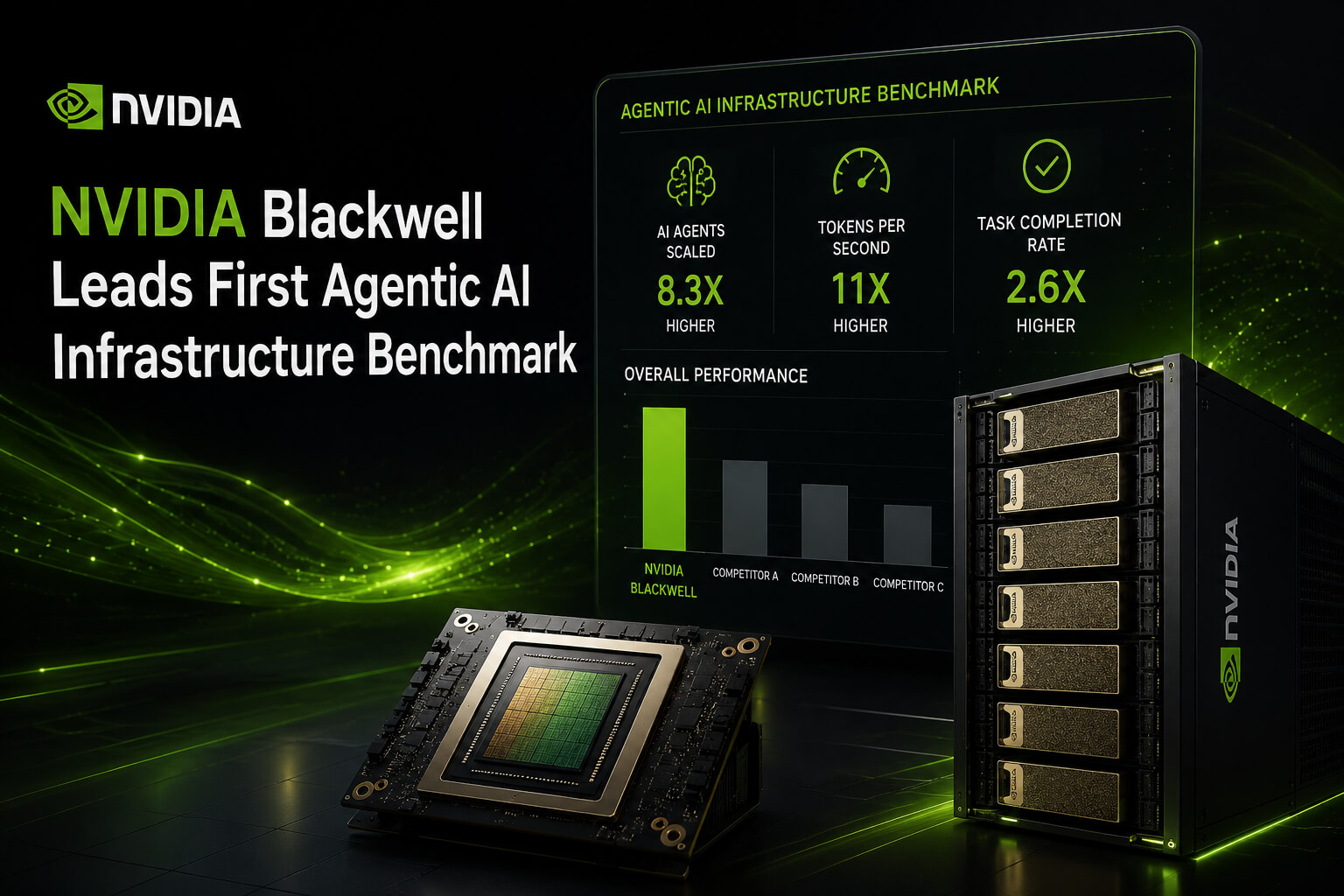
NVIDIA Blackwell is making a major statement in the future of agentic AI infrastructure. In new benchmark results from Artificial Analysis, NVIDIA’s Blackwell Ultra NVL72 platform delivered leading performance in AgentPerf, the first benchmark designed specifically to measure real-world agentic AI workloads.
Unlike traditional AI benchmarks that focus on single chatbot responses, AgentPerf evaluates how infrastructure handles multi-step AI agents. These agents do not simply answer one prompt. They reason, use tools, process context, write code, execute commands and continue working through a task until it is complete.
That makes agentic AI far more demanding than standard conversational AI. A single AI agent may require dozens or even hundreds of model calls, with each step adding more context and complexity. For businesses planning to deploy AI agents at scale, this kind of benchmark is becoming increasingly important.
NVIDIA Blackwell Ultra NVL72 Delivers Major Efficiency Gains
According to NVIDIA, the Blackwell Ultra NVL72 platform can run up to 20x more agents per megawatt than NVIDIA Hopper-based systems in the tested benchmark. This is a major figure for enterprises, cloud providers and AI infrastructure companies focused on performance, energy efficiency and cost control.
The result highlights a key challenge in the AI industry: running powerful AI agents is not just about model quality. It also depends on whether the underlying infrastructure can support many concurrent agents while maintaining speed, responsiveness and efficiency.
As companies move from simple AI chatbots to more advanced autonomous agents, infrastructure efficiency could become one of the biggest factors in determining which platforms can scale successfully.
Why Agentic AI Needs a Different Benchmark
Agentic AI works differently from traditional AI chat systems. A chatbot may receive a prompt and return one response. An AI agent, however, may break a task into multiple steps, gather information, call tools, analyze results and take further action.
This creates a much heavier workload. Agentic systems often involve long context windows, repeated model calls, tool-use delays and complex reasoning chains.
That is why Artificial Analysis created AgentPerf. The benchmark is designed to measure how well AI infrastructure performs when handling agentic tasks that resemble real-world production workloads.
For the first round of testing, AgentPerf used coding-agent workflows based on real public code repositories across more than 12 programming languages. The benchmark simulated tasks where an agent reads files, edits code, executes commands and iterates based on results.
What This Means for Enterprise AI
The NVIDIA Blackwell agentic AI benchmark result is important because businesses are increasingly looking beyond basic chatbots. Many companies now want AI agents that can automate software development, customer support, research, operations, sales workflows and other complex tasks.
But deploying these agents at scale requires infrastructure that can support high concurrency, low latency and strong energy efficiency.
For enterprises, the most important question is not only “Can this AI model complete a task?” It is also “How many agents can this system run at the same time, and how much power does it require?”
NVIDIA’s benchmark results suggest that Blackwell could play a central role in powering the next generation of enterprise AI agents.
NVIDIA’s Full-Stack Advantage
NVIDIA says Blackwell’s performance comes from full-stack optimization across hardware and software. The GB300 NVL72 system connects 72 GPUs in a rack-scale design, allowing large models to run efficiently across the system.
NVIDIA also points to software optimizations from CUDA and TensorRT LLM, which help manage communication, compute and inference efficiency as multiple agent sessions run at the same time.
This combination of advanced GPU architecture, networking and inference software is becoming increasingly important as AI workloads grow more complex.
AI Infrastructure Is Moving Toward Agentic Workloads
The rise of agentic AI is changing how AI infrastructure is measured. Speed on a single prompt is no longer enough. Businesses now need systems that can handle long-running, multi-step AI tasks across many users or workflows at once.
That shift could make benchmarks like AgentPerf more important in the coming years. As AI agents become part of real business operations, companies will need clearer ways to compare infrastructure performance, cost and energy efficiency.
NVIDIA Blackwell’s strong early result gives the company a major position in this new phase of AI infrastructure.
The Bottom Line
NVIDIA Blackwell’s performance in the first AgentPerf benchmark shows how quickly the AI industry is evolving from chatbot-focused systems to agentic AI platforms.
With Blackwell Ultra NVL72 reportedly delivering up to 20x more agents per megawatt than previous NVIDIA Hopper-based systems, NVIDIA is positioning its latest architecture as a key foundation for scalable enterprise AI agents.
As more companies deploy AI agents for coding, automation and business workflows, infrastructure performance will become a critical competitive advantage. NVIDIA Blackwell appears to be setting an early benchmark for that future.
