


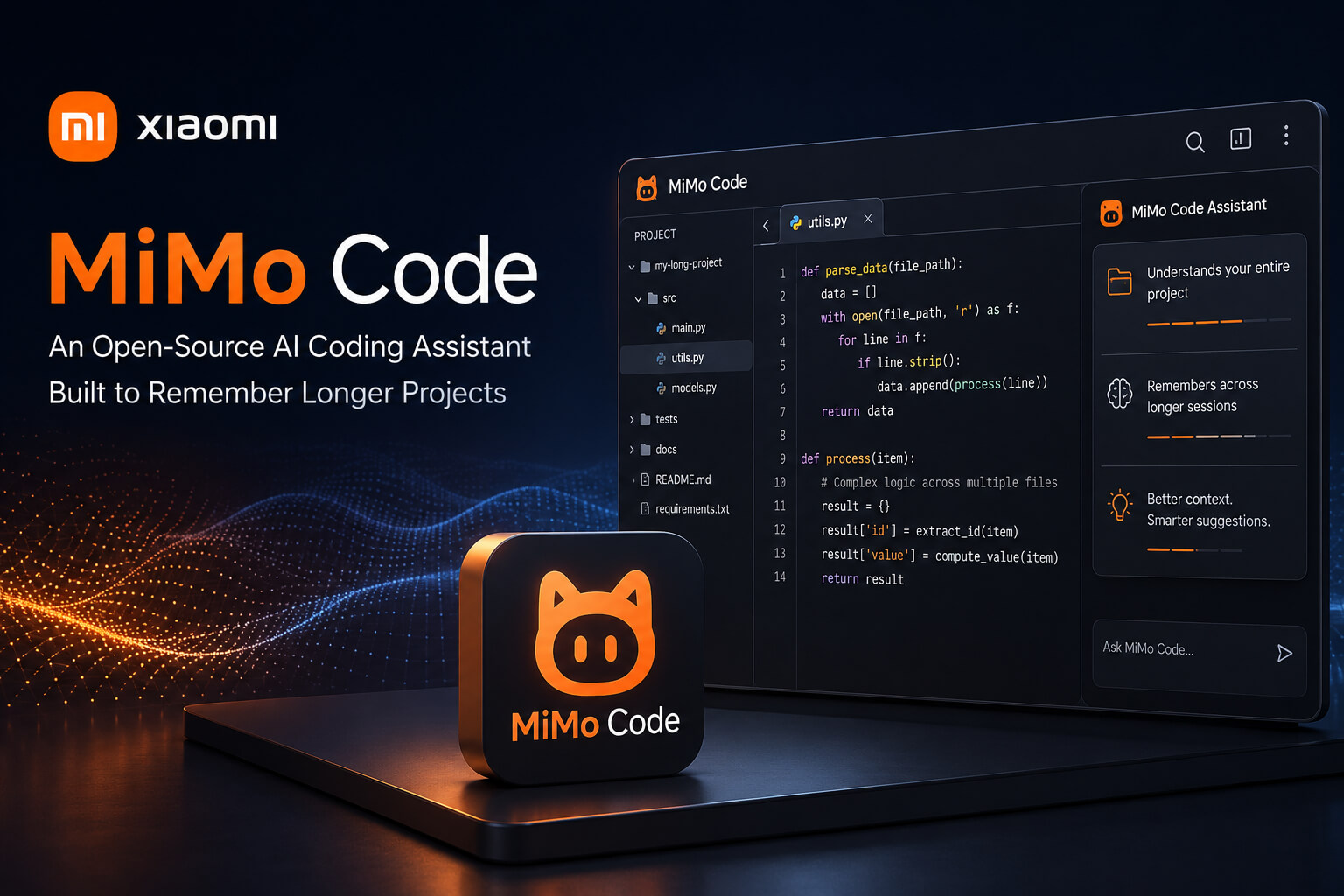
Xiaomi launches MiMo Code: an open-source AI coding assistant designed to remember longer projects Xiaomi has officially announced MiMo Code, a new AI coding assistant designed to help developers work their way through longer software projects without losing critical context along the way.
The tool, released as MiMo Code V0.1.0, is free and open-source. Unlike many AI coding tools that can forget earlier parts of a conversation once the session becomes too long, MiMo Code is built around a memory-focused system that helps preserve key project details during extended development work.
Xiaomi MiMo Code Focuses on Better AI Memory
One of the biggest frustrations with AI coding assistants is context loss. A developer may ask an AI tool to fix a bug, explain a function, or suggest a change, only for the assistant to later forget previous instructions or project details.
Xiaomi’s MiMo Code aims to solve that issue by using a background helper system. While the main AI assistant handles the coding conversation, a smaller helper process monitors the session and summarizes important information before the assistant loses track of earlier context.
This allows MiMo Code to continue working with a clearer understanding of the project, even during longer coding sessions.
Terminal-Based AI Coding Assistant
MiMo Code runs directly inside the computer terminal, meaning developers do not need to open a separate browser-based workspace or standalone app. After installation, users can launch the assistant by typing “mimo” in the terminal.
The setup process lets users choose which AI model they want to use. Xiaomi includes access to its own AI model, MiMo-V2.5, but users can also switch to other supported models such as DeepSeek, Kimi, or GLM.
Xiaomi Claims Strong Benchmark Results
According to Xiaomi, MiMo Code has achieved competitive results in professional coding benchmarks. The company says the tool scored 62% on SWE-Bench Pro and 73% on Terminal Bench 2, placing it ahead of a comparable coding assistant in Xiaomi’s own reported testing.
These benchmark claims suggest Xiaomi is positioning MiMo Code not just as an experimental AI tool, but as a serious developer assistant for coding, debugging, and project management.
Voice Commands Are Also Supported
MiMo Code also includes voice interaction powered by Xiaomi’s MiMo-V2.5-ASR model. This enables the user to speak commands, to correct input errors by voice, and to activate actions such as sending or executing instructions.
Voice support could make the tool more convenient for developers who want faster interaction during repetitive coding tasks.
Available on Mac, Linux, and Windows
Xiaomi says MiMo Code supports macOS, Linux, and Windows. On Mac and Linux, users can install the tool through a terminal command, while Windows users can install it through npm.
The company also says users who choose Xiaomi’s free AI model do not need to create an account or complete a sign-up process.
Why This Matters
The launch of Xiaomi MiMo Code shows how fast the AI coding assistant market is expanding. Tools like GitHub Copilot, Claude Code, Cursor, and other AI-powered coding platforms have already changed how developers write and debug software.
Xiaomi’s entry into this space is notable because it combines open-source access, terminal-based workflows, model flexibility, voice commands, and a memory-focused design.
For developers, the biggest selling point may be simple: an AI coding assistant that remembers more of the project and stays useful for longer sessions.
Final Thoughts
Xiaomi MiMo Code could become a useful option for developers. It offers a free, open-source AI coding assistant with stronger long-session memory. However, its real-world value will depend on how well it works across different projects.
The launch also shows rising competition in AI-powered software development tools. As AI coding assistants improve, the best tools may stand out through stronger memory, better model selection, and developer-friendly workflows.
