


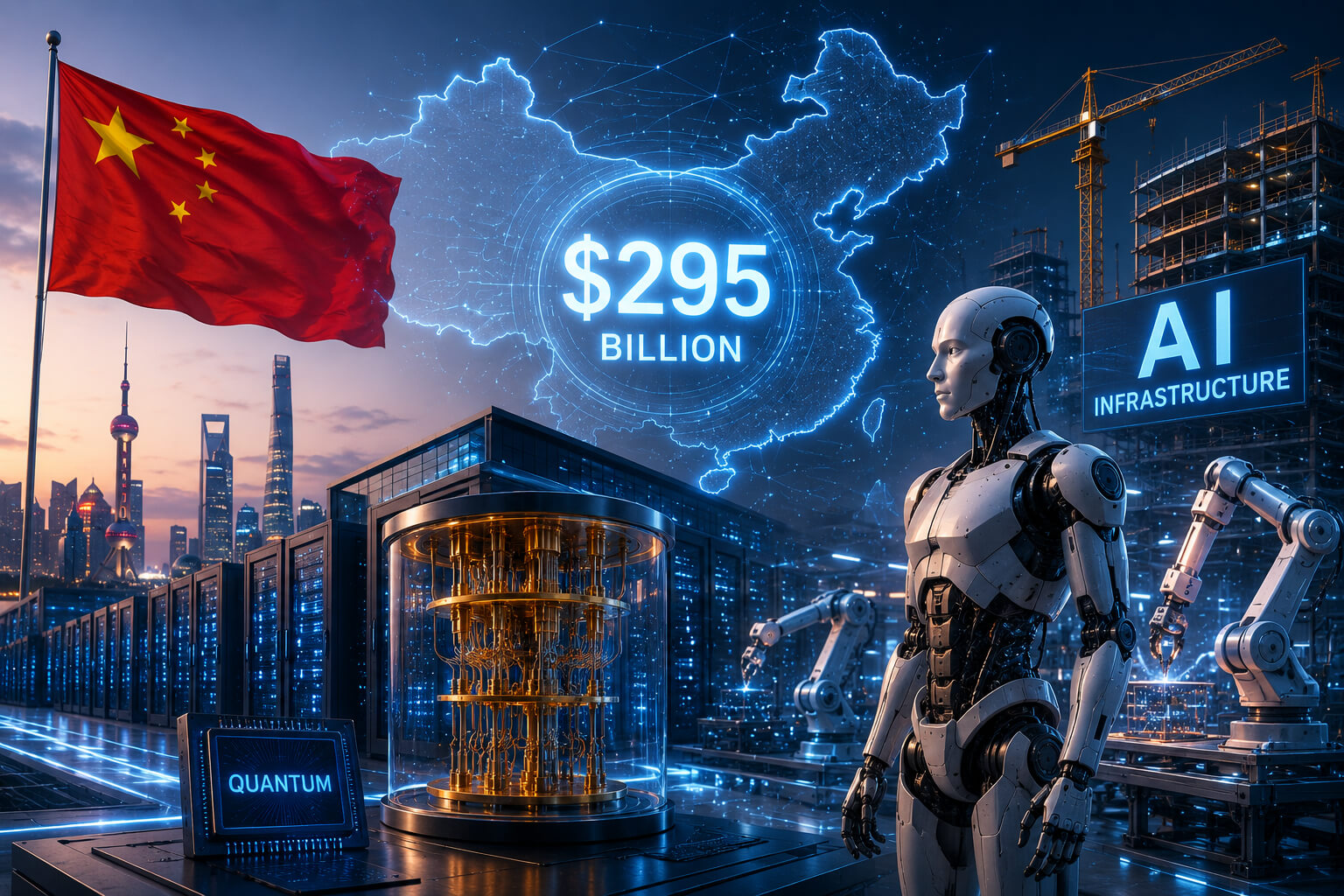
China is readying for one of the world’s most ambitious artificial intelligence infrastructure expansions. It is planning to invest about 2 trillion yuan, or $295 billion, over the next five years. The move is intended to bolster the country’s AI backbone and boost quantum computing research. It will also support humanoid robotics and lessen reliance on foreign technology.
The plan is part of a broader effort by Beijing to create a self-sufficient AI ecosystem. China wants more of its AI infrastructure to be powered by domestic suppliers rather than relying heavily on U.S. chips, cloud systems and overseas computing networks. This includes chips, servers, software, networking equipment, and data center operations.
China’s AI Infrastructure Investment Signals a Bigger Tech Strategy
The reported investment is not only about building more data centers. Moreover, it’s part of a broader national effort to create a coordinated computing network. This network can support advanced AI workloads across industries.
Artificial intelligence systems require huge amounts of computing power. High-performance infrastructure is critical for building large models, deploying AI applications, creating robotics systems and supporting future quantum research. China is investing heavily in data centres and domestic hardware to build the groundwork for long-term AI expansion.
The strategy also comes amid a heating global race for AI supremacy. The U.S. remains home to many of the world’s leading AI chipmakers and cloud providers. Meanwhile, China is seeking to catch up through state-backed planning, local manufacturing and tighter control over critical infrastructure.
Why China Needs Home-Grown AI Chips
Much of China’s investment in AI infrastructure is driven by a focus on home-grown technology. Reports have suggested Beijing wants a large portion of the AI hardware used in future projects to be sourced from Chinese firms.
That is particularly the case as advanced AI chips have become a key flashpoint between China and the United States. U.S. export restrictions have limited China’s access to some high-end semiconductors used for AI training and data center computing. In retaliation, China is speeding up efforts to support domestic chipmakers and reduce its reliance on foreign supply chains.
Huawei and other domestic technology firms are expected to play a larger role in supplying AI hardware. In addition, state-linked telecom operators such as China Mobile and China Telecom may also be central to managing and connecting the country’s computing infrastructure.
What This Means for Quantum Computing
Quantum computing remains one of the most important emerging technologies in the global tech race. While practical, large-scale quantum systems are still developing, governments and technology companies are investing heavily because of their potential impact. These impacts include encryption, drug discovery, materials science, logistics, and advanced simulation.
China’s investment in AI infrastructure could help pave the way for quantum computing. This would happen by increasing access to powerful data centers, specialized research environments, and high-speed computing networks. Quantum research often demands massive computational power and sophisticated hardware. In addition, sustained funding is crucial. A national infrastructure plan could facilitate collaborations among research institutions, state-backed firms, and regional computing hubs.
Quantum computing may be a different field from artificial intelligence. However, the two are becoming more linked. AI may be able to optimize quantum experiments, and quantum systems may one day be able to speed up certain calculations related to AI. China’s investment suggests Beijing sees next-generation computing as a strategic priority, not just a commercial opportunity.
Humanoid Robots Also a Possibility
China’s plan also supports the development of humanoid robots. These robots will depend heavily on AI models, sensor systems, real-time decision-making and advanced manufacturing.
Humanoid robots need a ton of training data and computing power. They have to interpret things like vision, movement, balance, speech, and information about the environment. To improve these systems, companies need a solid AI infrastructure that can handle simulation and model training. This infrastructure is also essential for deployment in the real world.
A more robust computing network would allow China to provide robotics firms with more resources to develop sophisticated humanoid machines for factories, logistics, healthcare, elder care and service industries. This fits with China’s wider industrial automation goals. The country is looking to boost productivity and maintain its manufacturing strength.
A State-Led AI Model
Unlike the U.S. model, where private companies such as OpenAI, Microsoft, Google, Amazon, Nvidia, and Meta drive much of the AI infrastructure race, China’s approach is more state-coordinated. A national framework is expected to bring together government agencies, state-owned enterprises, telecom operators and domestic technology suppliers.
That could allow China to move quickly and align infrastructure spending with national priorities. But it also carries risks. One risk is overcapacity, if demand does not grow fast enough to soak up large-scale data centre expansion. There are also technical challenges, particularly if domestic chips are not yet on par with the most advanced foreign alternatives.
Still, China seems willing to absorb those challenges in exchange for more control over its AI future.
Global AI Competition Is Entering a New Phase
China’s $295 billion AI infrastructure plan shows that the next stage of the AI race will not only be about chatbots or individual AI models. It will also be about who controls the computing power, chips, data centers, and energy systems behind those models.
For China the goal is clear: build up domestic AI infrastructure, invest in quantum computing and robotics, and reduce dependence on foreign technology. For the rest of the world, this investment is another indication that AI infrastructure is becoming a core element of national competitiveness.
China’s approach could shift the global balance of power in artificial intelligence, quantum computing and advanced robotics. This shift comes as countries race to develop sovereign AI capabilities.
