


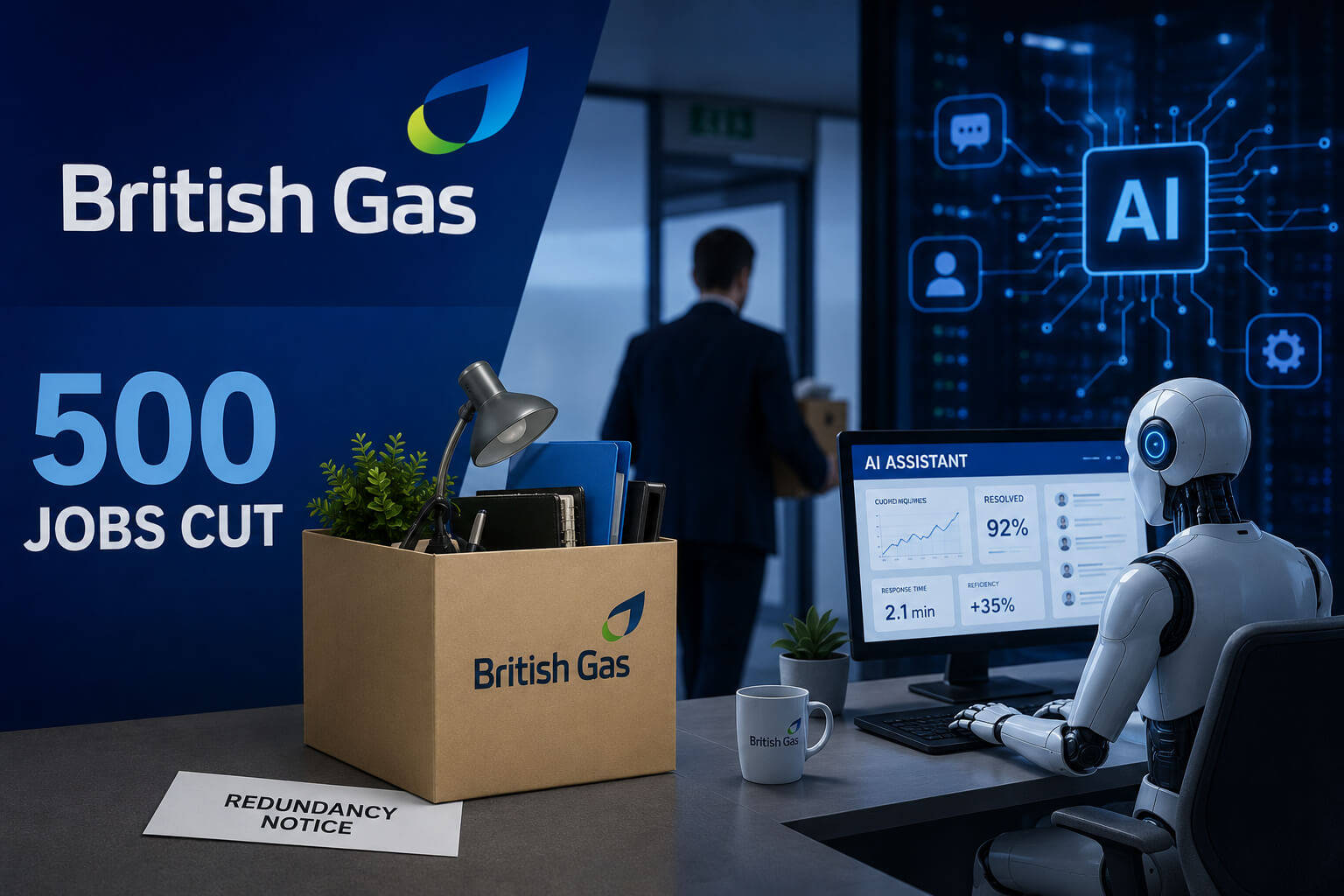
British Gas is facing criticism after announcing plans that could affect around 500 customer service roles. Union leaders claim that workers are being replaced by artificial intelligence and chatbot technology.
The proposed job cuts are part of a wider customer service transformation programme across British Gas operations. The affected roles are reportedly linked to the company’s Services and Energy call centre teams. These teams support customers with bills, complaints, repairs, boiler issues, HomeCare policies, and other account-related concerns.
The move has intensified concerns about the growing use of AI in customer service. Especially as more companies shift support operations toward apps, chatbots, websites, WhatsApp messaging, and self-service tools.
Union Says Workers Are Being Replaced by AI
The GMB union has strongly criticised the planned cuts. They argue that British Gas employees are being pushed aside as the company increases its reliance on digital support channels.
Union representatives say staff are already under heavy pressure. Furthermore, they believe that cutting hundreds of human roles could make it harder for customers to get support when they need it most.
The concern is not only about job losses, but also about the wider direction of customer service work. As AI systems become more capable of answering questions, processing requests, booking appointments, explaining bills, and handling basic troubleshooting, call centre roles are increasingly seen as vulnerable to automation.
British Gas Denies AI Is Replacing Staff
British Gas has rejected the claim that the affected jobs are being directly replaced by AI or new chatbot systems.
The company says customer behaviour has changed significantly. More people now choose to manage their accounts through digital channels rather than speaking to call centre advisers. According to the company, inbound customer contact has dropped since 2023. Also, more interactions now take place through online tools, apps, chatbots, and messaging platforms.
British Gas said it would continue to support customers who need a human touch, including those who need additional assistance. The company said it was also in talks with trade unions and offering voluntary redundancy where possible.
AI Is Changing Customer Service Jobs
The British Gas case is part of a broader trend in many industries. Companies are using AI and automation to reduce the number of everyday customer service interactions human workers handle.
Today’s AI-driven support systems can handle many routine customer requests, including payment processing, appointment scheduling, account updates, meter readings and basic troubleshooting. For companies, these tools can reduce costs and accelerate service. For employees, however, they are raising increasing fears about job security.
The big question is whether AI is simply making human teams more efficient, or whether it is replacing roles altogether. This line is becoming increasingly blurred in customer service.
Why This Matters
The British Gas job cuts highlight one of the biggest questions in the AI economy. How many human jobs will be transformed, reduced or replaced as businesses adopt automation?
These changes are often labeled as digital transformation by companies. But workers and unions are increasingly warning that the implementation of AI can be at the expense of stable employment.
For customers, the change also creates another worry. While digital tools are fine for straightforward tasks, many still want human support when they are dealing with urgent, sensitive or complex issues.
The Bigger Picture
AI is not a future workplace issue. It is already transforming the way big companies build teams, provide customer service and control costs.
The row over British Gas’s AI job cuts highlights automation as a major issue for employers, workers, unions and customers alike. As more businesses adopt AI-powered support systems, similar disputes are likely to become more common across the UK and beyond.
For now, British Gas says the proposed changes are about responding to changing customer behaviour. The union argues that human workers are being replaced by technology. Either way, the story is another clear sign that AI is reshaping the future of work.
