


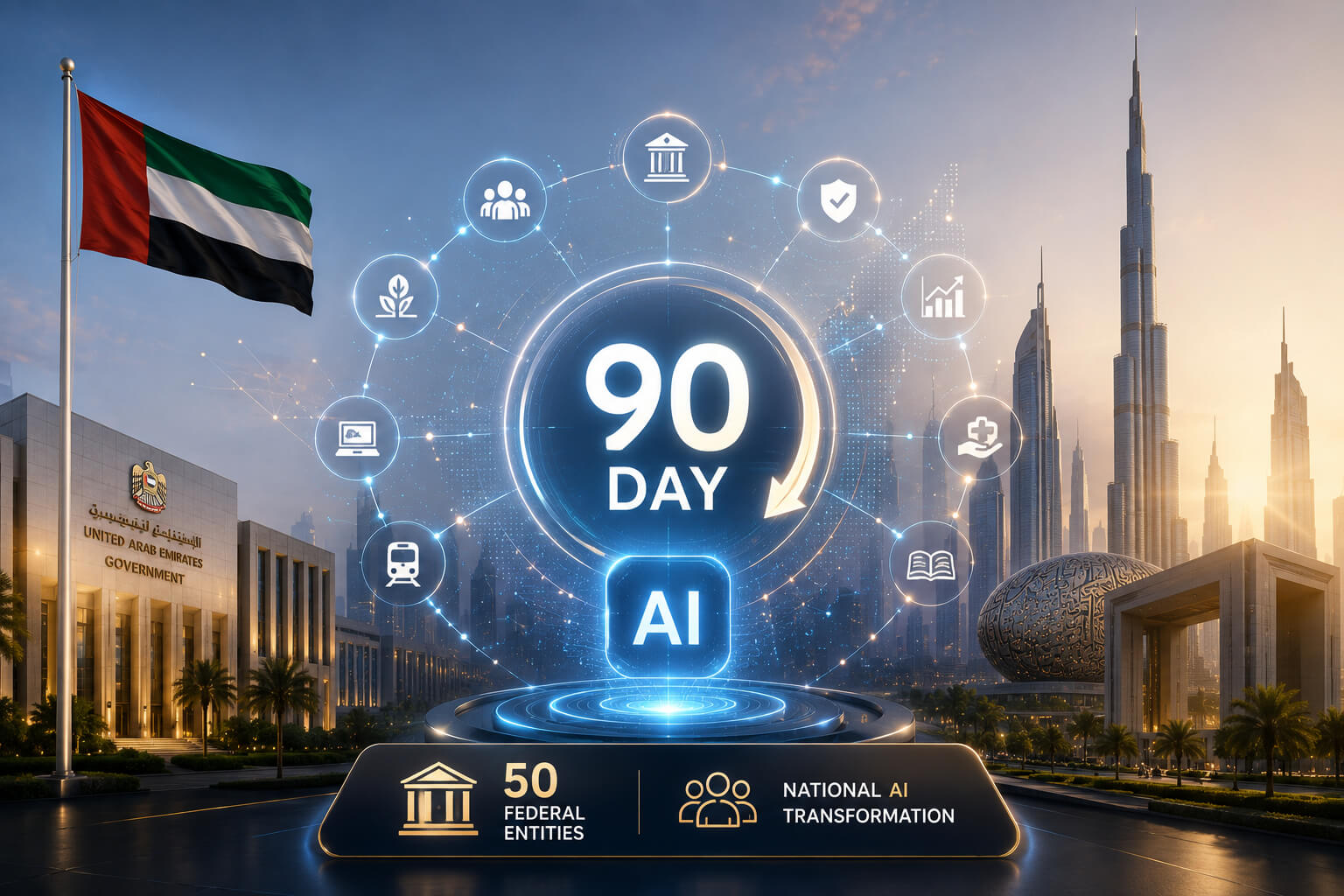
The United Arab Emirates has launched a major 90-day agentic AI sprint across 50 federal entities. This marks a new phase in the nation’s efforts to revolutionize government functions with artificial intelligence.
The initiative began with a government workshop in Dubai attended by more than 300 officials. The session moved the UAE’s agentic AI strategy from planning into practical implementation. As a result, each federal entity must identify, design, and prepare to launch an AI-powered service or operation within 90 days.
UAE Accelerates Agentic AI Adoption in Government
The UAE’s latest AI sprint is part of a wider national programme to transform 50% of government sectors, services, and operations using agentic AI within two years.
Agentic AI refers to artificial intelligence systems that can take actions, manage workflows, make decisions, and improve processes with limited human input. Traditional AI tools are primarily utilized for delivering recommendations or for automating straightforward tasks. On the other hand, agentic AI systems are developed to perform more intricate operations. They are also able to adapt to evolving scenarios.
The UAE government aims to use these systems to improve service delivery, reduce operational costs, increase efficiency and create better experiences for citizens, residents and businesses.
What the 90-Day AI Sprint Will Look Like
In the 90-day sprint, each participating federal entity will go through a structured process to identify and prepare an agentic AI use case.
The process is split into three main stages:
Exploration – Finding the best fit government service or operation to transform with agentic AI.
Design: Defining how the target service journey mapping will be supported or taken over by AI agents.
Implementation Planning: Determine technical requirements, execution plans, and early launch steps.
Throughout the sprint, the UAE government will monitor progress to ensure all entities are on track. It will also ensure the selected services are moving towards implementation within the set timeframe.
Key Government Areas Targeted by Agentic AI
The workshop identified a number of priority areas where agentic AI could have a high operational impact. These include: human resources, procurement, contracts, financial administration, legal affairs, internal audit, digital transformation, technical support, communications, facilities management, maintenance and shared government processes.
Entities will assess potential AI use cases based on several factors. These include transaction volume, service frequency, number of beneficiaries, data availability, automation readiness, and expected improvements in service quality.
This approach allows the UAE to focus on high-impact government services where AI agents can create tangible benefits.
Why It Matters
Artificial intelligence is at the core of the UAE’s government modernization efforts. The country is running a simultaneous sprint across 50 federal entities to create a coordinated approach. This approach supports large-scale public sector AI adoption.
The move also shows a shift from AI experimentation to real-world implementation. Instead of testing isolated tools, the UAE is asking ministries and agencies to redesign actual services around agentic AI systems.
If successful, the programme could become a benchmark for how governments around the world adopt autonomous AI systems in public services.
UAE’s Broader Agentic AI Strategy
The 90-day sprint follows the UAE’s earlier announcement of a government-wide framework. This aims to deploy agentic AI across half of federal government sectors and services within two years.
The broader strategy aims to introduce AI systems that can monitor changes, manage operations, support decision-making, and improve services in real time. Additionally, senior officials and government leaders are expected to be directly involved in driving adoption across their departments.
This is in line with the UAE’s ambition to be one of the first countries to deploy agentic AI at scale across government functions.
The Bigger Picture for AI in Public Services
Agentic AI is quickly becoming one of the most important trends in artificial intelligence. While many organizations are still experimenting with chatbots and generative AI assistants, governments and enterprises are now considering AI agents. These agents can complete tasks, manage workflows and coordinate multiple systems.
In public services, this could mean faster approvals, personalised government support, automated case management, smart allocation of resources and fewer bureaucratic delays.
But for organizations to adopt agentic AI widely, they must govern it robustly, support it with trustworthy data, protect it with cybersecurity, oversee it with humans, and hold it clearly accountable. These safeguards will be critical as the UAE moves from planning to implementation.
Conclusion
The UAE’s 90-day agentic AI sprint is a major advance in the country’s AI transformation agenda. With 50 federal entities coming together and a clear implementation timeline, the government is taking agentic AI from concept to action.
As countries around the world explore how artificial intelligence can improve public services, the UAE’s programme could offer an early example of how agentic AI may reshape the future of government operations.
