


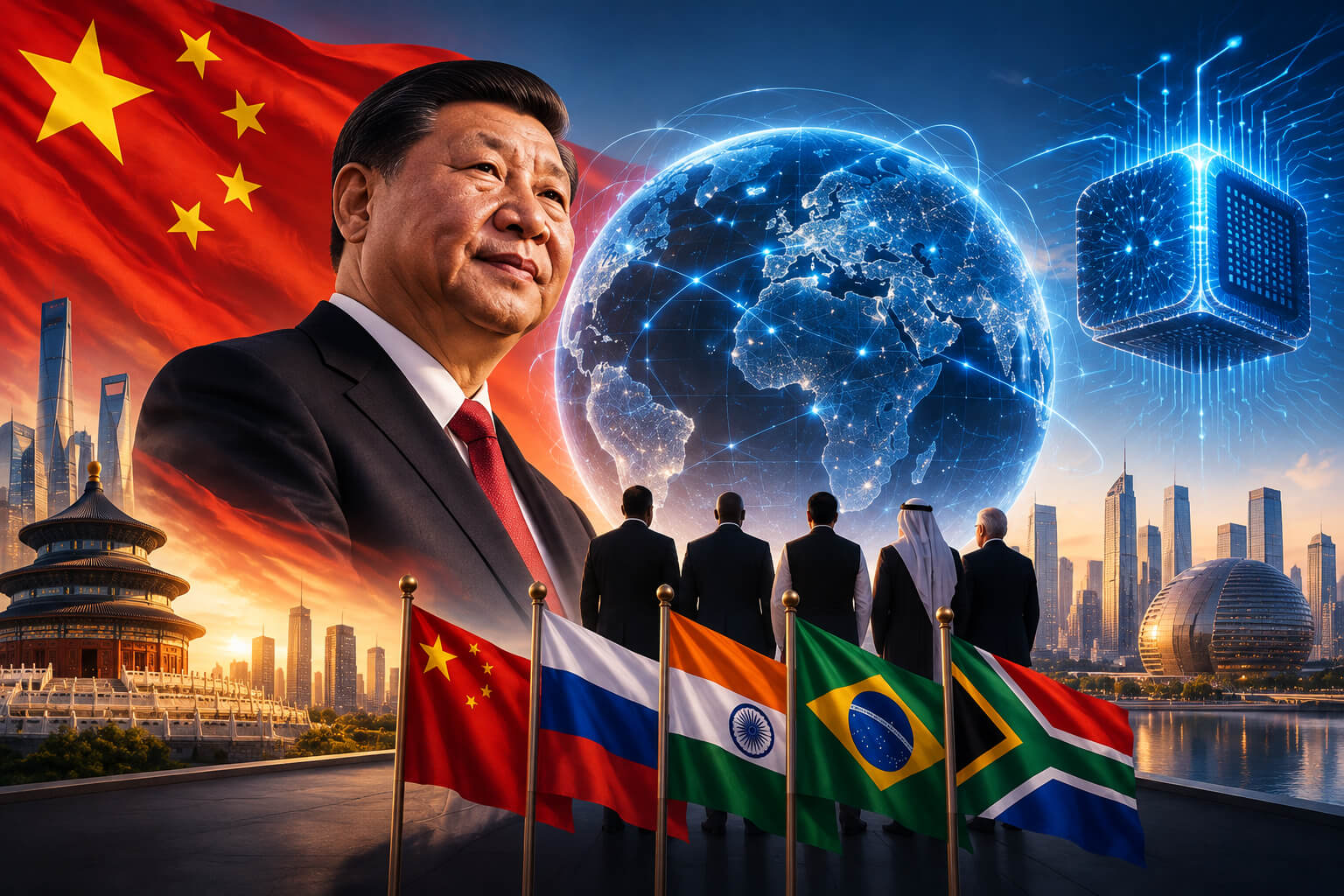
Chinese President Xi Jinping is pushing artificial intelligence much deeper into the BRICS agenda, positioning AI cooperation as part of a broader effort to strengthen technology ties among emerging economies.
Speaking during the 18th BRICS Summit in New Delhi, Xi called for greater collaboration in artificial intelligence, open-source technologies, digital infrastructure and advanced manufacturing. The proposals show that China wants BRICS cooperation to move beyond broad political commitments and into more practical technology development, including AI training, cloud infrastructure and large language models.
The initiative also arrives as Beijing looks for new ways to expand its technology influence across developing economies. BRICS gives China a platform to promote AI cooperation with countries that may want alternatives to technology ecosystems dominated by the United States and other Western markets.
China Wants a BRICS AI Open-Source Community
One of Xi’s most notable proposals was the creation of a BRICS AI open-source community. China said it is prepared to take an active role in building the initiative while supporting cooperation around large language models, AI development and practical deployment. The idea could give BRICS members a shared platform for exchanging technology, research and technical expertise while making AI tools more accessible to countries with smaller domestic AI ecosystems.
Open-source AI has become an increasingly important part of the global technology race because it lowers barriers for developers and organizations that cannot afford to build frontier models from scratch. For China, encouraging open-source cooperation inside BRICS could also help Chinese-developed models, frameworks and standards gain wider international use.
Large Language Models Are Part of the Plan
Large language models are another important part of Xi’s BRICS technology agenda. China wants member countries to cooperate not only on developing LLMs, but also on applying them across industries and public services. The focus suggests Beijing is interested in turning AI collaboration into something practical rather than limiting it to research discussions or high-level policy statements.
Xi has also linked AI development with a broader push for new industrialization. That approach could see BRICS countries explore how large language models and other AI systems can improve productivity, automate processes and support digital transformation across sectors such as manufacturing, finance, logistics and government services.
A BRICS Digital Cloud Platform Could Follow
Xi also proposed building a BRICS digital ecosystem cloud platform, giving the group another possible layer of shared technology infrastructure. Such a platform could eventually support AI development, cloud computing, digital services and cross-border technology projects among participating countries.
The proposal remains broad, and many details have yet to be defined. Questions around data governance, cybersecurity, infrastructure ownership and interoperability would need to be addressed before such a system could operate at scale. Even so, the idea shows that China is thinking beyond individual AI models and toward the infrastructure needed to support a larger digital ecosystem.
China Is Linking AI With Smart Factories
China’s BRICS AI strategy also extends into manufacturing. Xi said China is willing to support BRICS countries in developing smart factories and strengthening cooperation around intelligent manufacturing standards and technologies. This would bring artificial intelligence directly into industrial production, where AI can support automation, predictive maintenance, robotics and supply chain optimization.
China already has significant experience combining AI with manufacturing, robotics and industrial automation. Sharing those capabilities with BRICS partners could make the initiative particularly attractive to countries looking to modernize factories and expand domestic manufacturing without building every technology from the ground up.
Beijing Wants to Build the Talent Pipeline Too
AI cooperation will require more than infrastructure and software, which is why talent development also appears in Xi’s proposal. China wants to establish a BRICS engineer cultivation alliance aimed at supporting joint training programs and the mutual recognition of engineering competency standards.
The proposal also includes youth exchanges focused on science, technology and innovation. These programs could help build a larger pool of engineers and technical specialists across BRICS economies while creating stronger links between universities, research institutions and technology industries.
China’s World AI Cooperation Organization Looms in the Background
Xi’s BRICS proposals also connect with China’s broader effort to build international institutions around artificial intelligence. He encouraged BRICS members to participate in the World Artificial Intelligence Cooperation Organization, or WAICO, which Beijing has promoted as a platform for AI cooperation and capacity building.
The organization fits into China’s wider strategy of expanding its role in global AI governance and development. Instead of competing only through domestic AI companies and models, Beijing is also trying to shape the institutions, partnerships and standards that could influence how AI develops across emerging markets.
AI Governance Is Becoming Part of the BRICS Conversation
Artificial intelligence governance is also becoming a larger part of the BRICS agenda. Xi called for faster progress toward a global AI governance framework based on broader international consensus, while arguing that developing economies should have more influence over the rules that shape the technology.
This matters because global AI regulation remains fragmented. Governments continue to debate issues such as safety standards, open-source models, data protection, intellectual property and access to advanced computing. A coordinated BRICS position on these issues could give the bloc more influence in international discussions about AI regulation.
BRICS Is Becoming a Technology Battleground
The broader significance of Xi’s proposals goes beyond a single AI initiative. BRICS now represents a much larger group of emerging economies, giving its technology discussions more economic and political weight than in previous years.
China appears to view that expansion as an opportunity to build deeper technology cooperation around AI, cloud computing, digital infrastructure and advanced manufacturing. If member countries begin adopting shared platforms, training programs and technical standards, BRICS could gradually develop into a more connected technology ecosystem.
What Xi’s BRICS AI Push Means
China’s latest BRICS proposals reflect how the global AI race is changing. Competition is no longer limited to which company can release the most powerful model. Countries are now competing over cloud infrastructure, computing access, industrial applications, engineering talent and international technology partnerships.
For Beijing, BRICS offers a way to expand those partnerships across the Global South. If the proposed initiatives move from summit announcements into actual projects, China could gain a stronger role in shaping how AI develops across emerging economies.
That would also give BRICS countries another path into the AI economy, particularly those that do not have the resources to build large-scale AI ecosystems on their own.
Sources
CNBC — China’s Xi pushes AI and tech cooperation at BRICS
https://www.cnbc.com/2026/09/13/china-xi-ai-tech-brics.html
Chinese Foreign Ministry / Consulate — Xi Jinping’s Session II statement at the 18th BRICS Summit
https://chicago.china-consulate.gov.cn/eng/xw/202609/t20260913_12021317.htm
