


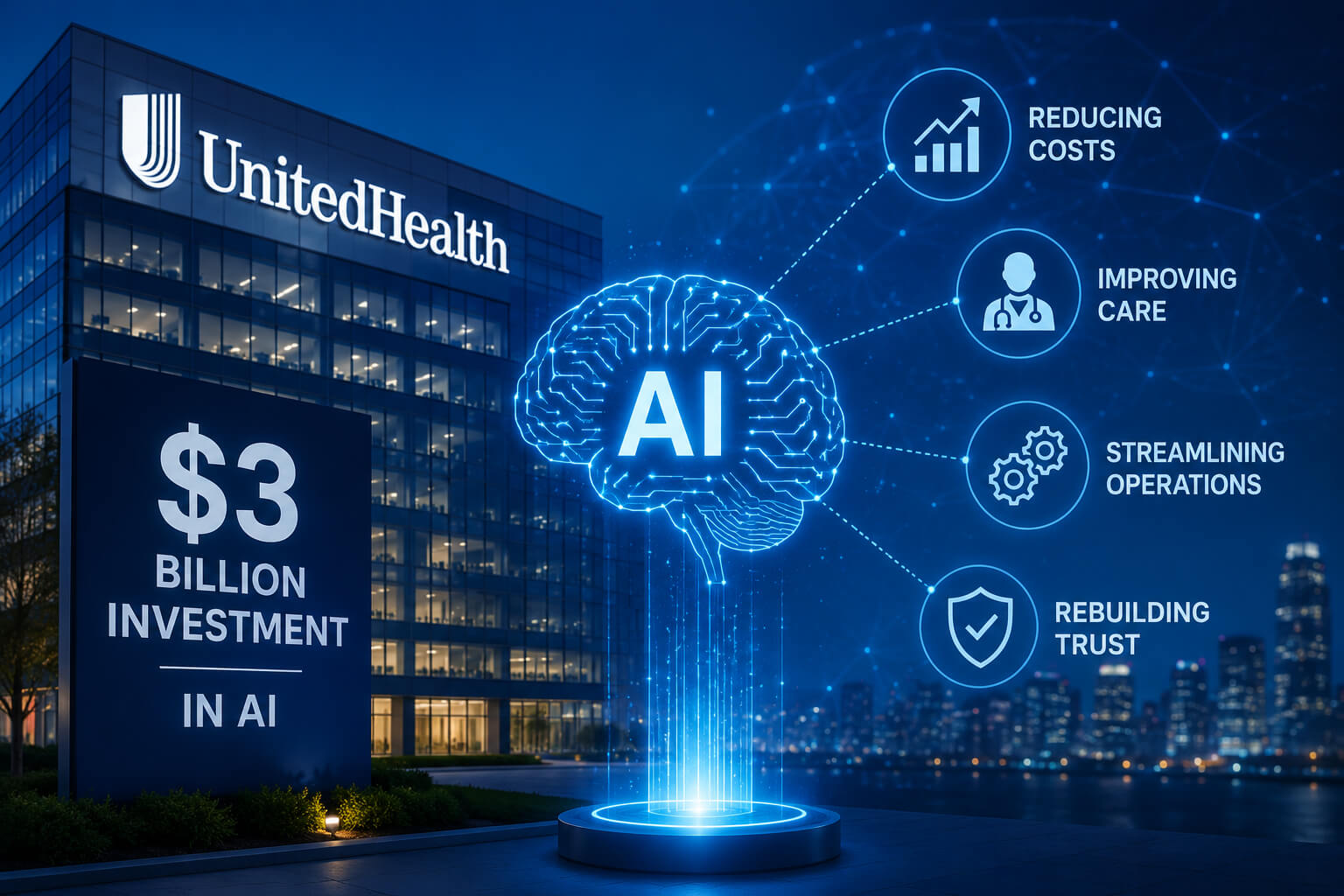
UnitedHealth Group is making one of the biggest artificial intelligence bets in the U.S. healthcare industry. It is reportedly committing about $3 billion to AI as it looks to reduce operating costs and streamline insurance processes. It is also hoping to repair public trust after years of criticism over claims, prior authorization, and administrative complexity.
The company’s AI strategy comes at a critical moment. UnitedHealth, the parent company of UnitedHealthcare and Optum, is under pressure from patients, doctors, regulators, and investors. Healthcare costs are rising. Insurance practices are facing public scrutiny. The company is trying to show that technology can make the system faster, cheaper, and less frustrating.
UnitedHealth’s AI Investment Targets Cost Savings
A major goal of the UnitedHealth AI investment is cost reduction. The company has said it is investing heavily in AI-related initiatives in 2026. It also plans to use automation and advanced software across claims processing, customer service, clinical workflows, and administrative operations.
Even tiny efficiency gains can add up to big savings for a giant like UnitedHealth. AI tools can trim the paperwork, quicken routine decisions, support call-center workers and spot patterns in mountains of healthcare data.
UnitedHealth executives have positioned AI as a way to improve productivity while also making the healthcare experience easier for members and providers. The company is not simply testing AI in isolated pilots. Instead, it is attempting to embed the technology deeper into its core business operations.
Why UnitedHealth Is Turning to AI Now
UnitedHealth’s AI push comes after a period of intense pressure on the health insurance industry. Patients and providers have long criticized prior authorization requirements, claim denials, delayed approvals, and complicated administrative systems.
The backlash has grown louder as Americans increasingly question whether insurers are using technology to improve care or mainly to control costs. As a result, that makes UnitedHealth’s AI strategy both an opportunity and a risk.
If the technology makes healthcare more accessible and easier, it could help the company rebuild trust. But if AI is seen as another tool for denying care or reducing human review, it could deepen public frustration.
How AI Might Reshape Prior Authorization
One of the most closely watched areas is prior authorization. This is the process that requires doctors to seek approval from insurers before certain treatments, tests or procedures are covered.
UnitedHealthcare has already said it would cut prior authorization requirements. This includes a broad pledge to reduce general prior authorizations by 30% by the end of 2026. The company has also moved to reduce pediatric prior authorization requirements. In addition, it is working to simplify parts of the approval process.
AI could help find procedures that no longer need pre-approval, speed up routine reviews, and help providers submit cleaner documentation. In theory, that could help reduce delays for patients and cut down on administrative burden for doctors.
But the use of AI in prior authorization has been controversial. Critics worry that automated systems could make coverage decisions less transparent. This is especially concerning if patients and doctors don’t know how decisions are made or how to appeal them.
UnitedHealth’s AI Companion Avery Highlights Consumer-Facing Strategy
UnitedHealthcare has also launched Avery, a generative AI companion to help members navigate their healthcare benefits. The tool is meant to answer questions, guide users through benefits information, and support customer service representatives.
This shows that UnitedHealth’s AI strategy is not limited to back-office cost cutting. The company also wants AI to become part of the member experience.
For patients, that could mean faster answers on coverage, appointments, claims and benefits. For UnitedHealth, it could mean fewer calls handled entirely by human agents and reduced customer service costs over time.
The Bigger Picture: Healthcare AI Is Accelerating
UnitedHealth’s multibillion-dollar AI strategy is a sign of a broader movement in healthcare. Hospitals, insurers and health tech companies are deploying AI to automate documentation, crunch claims, assist clinical decisions, identify fraud and optimize scheduling.
Healthcare is one of the most sensitive areas for AI adoption, however. Errors can affect access to care, medical bills and patient outcomes. Consequently, companies deploying AI in insurance and care management will face increasing pressure to prove their systems are accurate, fair and transparent.
Regulators are also scrutinizing insurers’ use of algorithms. As AI becomes more baked into claims and coverage workflows, companies may need tighter oversight, clearer appeal processes and greater human accountability.
Can AI Help UnitedHealth Repair Its Reputation?
If UnitedHealth’s investment in AI leads to real improvements for patients and providers, it could be a game changer for the company. Faster approvals, fewer unnecessary prior authorizations, better customer support and lower administrative costs are all meaningful wins.
But the company faces a difficult balancing act. Investors may welcome AI-driven savings, but patients and doctors will judge the technology by whether it makes care easier to access.
The biggest question is not whether UnitedHealth can deploy AI at scale. With its data, capital, and Optum technology infrastructure, it clearly has the resources to do so. However, the bigger question is whether the company can use AI in a way that improves trust instead of intensifying concerns about automated healthcare decisions.
What This Means for the Future of Health Insurance
UnitedHealth’s AI strategy may influence the entire health insurance industry. If the company proves that AI can reduce costs while improving the member experience, other insurers will likely accelerate their own automation plans.
But if AI becomes associated with opaque claim denials or reduced human oversight, regulators and the public may push back harder.
For now, UnitedHealth’s $3 billion AI bet signals that artificial intelligence is no longer a side project in healthcare. It is becoming central to how major insurers plan to manage costs, process claims, support members, and compete in the next era of digital healthcare.
The success of that strategy will depend on one key factor: whether AI makes healthcare feel more human, not less.
