


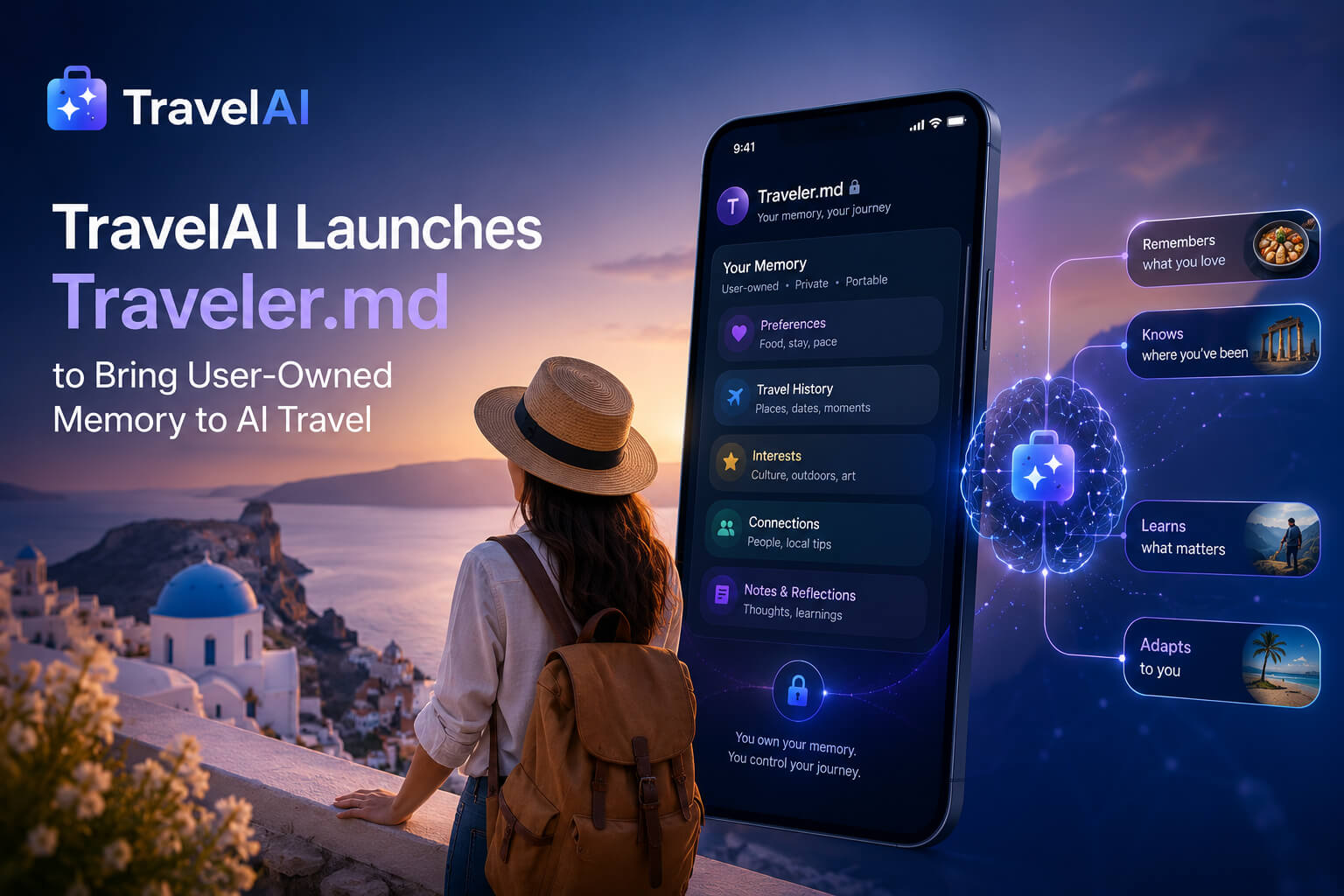
TravelAI has launched Traveler.md, a new user-owned travel memory file. It is designed to make AI-powered travel planning more personal, efficient, and permission-based.
The company introduced Traveler.md at Phocuswright Europe in Barcelona. At the event, travel and technology leaders are discussing how artificial intelligence can move from experimental use cases into real-world products. These products aim to solve everyday customer problems.
Traveler.md is built around a simple idea: travelers should not have to repeat their preferences, past trips, needs, and plans every time they use a new booking platform or AI travel assistant. Instead, they should be able to carry their travel context with them across tools and services.
What Is Traveler.md?
Traveler.md is a portable travel memory file that stores useful travel-related context about a person. This can include who they are, what they prefer, where they have been, what they have done, and what they intend to do next.
Unlike traditional customer profiles that are locked inside one travel company’s system, Traveler.md is designed to travel with the user. That means AI systems can access the file only when the traveler gives permission.
According to TravelAI, the goal is to shift AI travel experiences from “cold-start” interactions to “warm-start” interactions. In other words, instead of starting from zero every time, an AI travel assistant can provide more relevant recommendations. This is possible because it understands the traveler’s real preferences and history.
Why Traveler.md Matters for AI Travel
AI is becoming increasingly important in travel planning, booking, customer support, and personalization. But many AI travel tools still have a big limitation: they often don’t have memory.
Without reliable context, travelers may need to repeat the same information (e.g., preferred airlines, hotel styles, accessibility needs, dietary requirements, budget range, loyalty memberships or travel habits).
Traveler.md aims to solve this by creating what TravelAI calls Portable Traveler Context. This gives AI travel systems a permission-based way to understand the traveler better. At the same time, it keeps the user in control of their information.
For travelers, this could mean faster planning, more accurate suggestions and fewer repetitive booking steps. For travel companies, it could help improve personalization, customer trust and conversion rates.
Traveler.md Employs Permission-Based AI Memory
One important feature of Traveler.md is its focus on user consent. TravelAI explains that the file is only accessible to AI systems with the traveler’s explicit permission.
This is a sign of the times in artificial intelligence: personalization must go hand in hand with privacy, transparency and control. As AI agents become more involved in planning and booking trips, travelers may become more selective about which systems can access their personal context.
Traveler.md is designed to give users more ownership over that context. Instead of letting each platform build a separate profile, the traveler can carry a governed and portable memory file. This file works across compatible systems.
TravelAI’s Broader Strategy
Traveler.md is the first part of TravelAI’s larger three-part strategy. The company describes this strategy as portable memory for travelers, governed memory for enterprises, and better memories for all.
The first rollout will apply Traveler.md across TravelAI’s proprietary network of more than 531 consumer-facing brands. The company plans to use this network to demonstrate how warm-start personalization can improve both traveler experiences and business outcomes.
After that, TravelAI plans to make Traveler.md available to enterprise customers. Individual travelers can also create their own profile for free through Traveler.md.
A Step Towards More Personalised AI Travel
Traveler.md is a good example of the travel industry moving to more personalised and context-aware AI experiences.
AI travel systems can leverage permission-based memory to better understand what travelers truly want. This makes travel planning less repetitive and more useful, rather than treating each search, booking or support request as a new interaction.
For the AI industry, Traveler.md is also an example of how portable memory files may become more important as agentic AI tools grow. If users increasingly rely on AI assistants to help with complex tasks, those assistants will need trustworthy, user-controlled context.
TravelAI’s Traveler.md may be an early step toward that future. In this scenario, travelers own their preferences and decide how their data is used across the digital travel ecosystem.
Key Takeaway
TravelAI Traveler.md is designed to give travelers a portable, permission-based memory file that can improve AI-powered travel planning and booking. Traveler.md could help AI systems retain important travel context, making travel experiences more personal, efficient, and in the user’s control.
