


Artificial intelligence has a space problem. And a power problem. And, increasingly, a water problem.
So some developers are looking somewhere that has plenty of all three: the ocean.
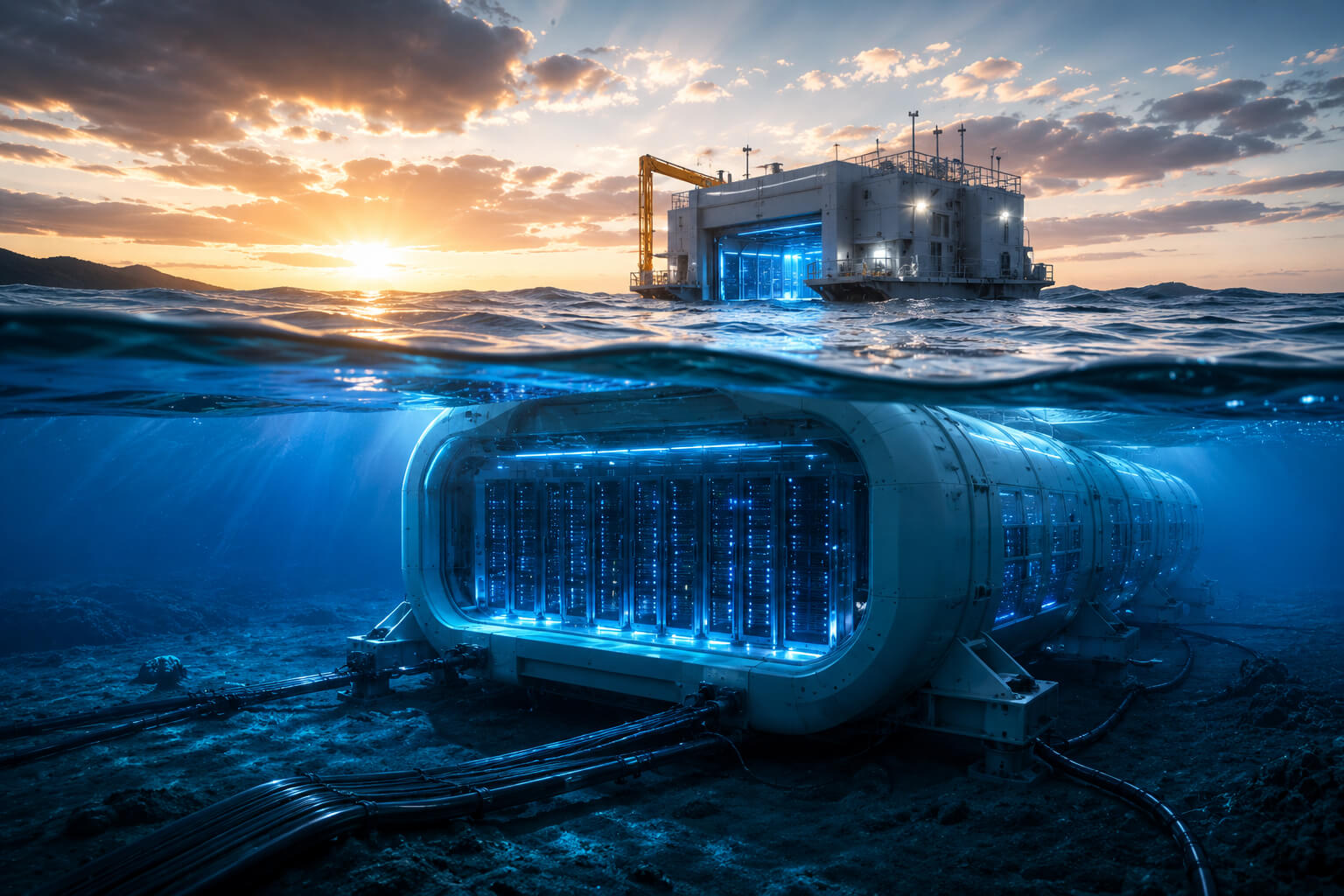
Underwater and floating data centers are moving from strange engineering experiments toward something companies are seriously considering as AI infrastructure expands. The basic argument is hard to ignore. Oceans offer enormous amounts of space, naturally cold water for cooling, and access to offshore wind, solar and tidal energy.
That does not make putting thousands of servers at sea simple. It just makes the idea much less ridiculous than it sounded a few years ago.
AI’s Data Center Boom Is Running Into Physical Limits
Modern AI systems depend on huge amounts of computing infrastructure. Training models is expensive, but running them for millions of users also requires racks of GPUs operating around the clock.
Those machines produce heat. Lots of it.
Traditional data centers have to spend additional electricity cooling that hardware, sometimes while consuming significant quantities of freshwater. Then there is the land required for gigantic server campuses and the grid connections needed to keep them running.
That pressure is already visible in projects such as Oracle’s massive Project Jupiter AI data center, where power, water and local infrastructure are becoming as important as the computing hardware itself.
Local resistance is becoming another factor. A Gallup poll published in March 2026 found that 70% of Americans opposed construction of AI data centers in their own communities.
The ocean neatly avoids the backyard problem.
At least geographically.
Microsoft Already Put 864 Servers Underwater
This isn’t purely theoretical.
Microsoft started exploring underwater computing more than a decade ago through Project Natick. In 2018, the company lowered a sealed data center containing 864 servers onto the seabed near Scotland’s Orkney Islands.
It stayed there for two years.
When Microsoft pulled the container back to the surface, researchers found something unexpected: the underwater servers had experienced roughly one-eighth the failure rate of comparable servers on land. Microsoft suggested several possible reasons, including the sealed nitrogen environment, lower exposure to oxygen and humidity, stable temperatures and the simple fact that nobody was walking around inside bumping or replacing equipment.
The project also showed that servers could be cooled without consuming freshwater.
Microsoft ultimately stopped Project Natick rather than turning it into a commercial underwater cloud network. Maintenance and upgrades remain awkward when your server rack is sitting on the bottom of the sea.
Still, the experiment proved that the concept works.
Others noticed.
China Has Already Gone Commercial
China has pushed the idea further. A wind-powered underwater data center in Shanghai began commercial operations in May 2026, according to the report. The roughly $226 million project uses seawater for cooling and offshore wind power for part of its electricity supply.
The facility reportedly uses at least 30% less electricity than a conventional data center. That number matters.
Data center operators are not moving servers offshore because putting computers underwater looks futuristic. They’re interested because cooling is expensive. If seawater can remove heat more efficiently while reducing freshwater use, the economics start looking very different. Japan is experimenting with another version.
Instead of sinking servers, companies are putting them on floating platforms. A containerized data center near Yokohama opened on a floating platform in 2025, using solar panels and battery storage. Testing is expected to continue through March 2027.
Singapore is thinking bigger. Infrastructure company Keppel began developing a four-story floating data center in 2026, with an opening targeted for 2028. In a country where land is extremely limited, putting computing infrastructure on water has an obvious appeal.
Offshore AI Data Centers Could Bring Power and Computing Together
There’s another reason the ocean suddenly looks attractive: renewable energy is already being built there. Offshore wind farms generate power far from traditional data center locations. Instead of transmitting all that electricity back to land and then sending it through crowded grids to server farms, developers could theoretically move some of the computing closer to the energy source.
The server does the work offshore. The resulting data travels back through fiber or wireless connections. Floating platforms could potentially combine wind turbines, solar panels, battery storage and computing equipment in the same offshore installation.
Other projects are looking at tidal energy. A proposed submersible AI data center in Maine’s Bay of Fundy, for example, would use turbines driven by strong tidal currents.
- It sounds almost too convenient.
- The ocean provides the cooling.
- The offshore installation provides the electricity.
- The servers provide the AI compute.
- Then the headaches begin.
Fixing an Underwater GPU Is Not Easy
A broken server in a normal data center is annoying. A broken server sealed inside a container sitting on the seabed is a different category of problem. Technicians cannot simply walk into an underwater facility, swap a GPU and leave. Depending on the design, an entire module may need to be raised to the surface before repairs or upgrades can happen.
That becomes particularly awkward in AI, where chips can become outdated quickly. Corrosion is another obvious threat. So are storms, underwater cables, anchoring systems and marine growth. Floating facilities have their own engineering problems.
Ocean infrastructure has been dealing with harsh conditions for decades, of course. Oil platforms, submarine cables and offshore wind farms already prove that complicated machinery can operate at sea. Data centers introduce a different requirement: enormous numbers of delicate electronic components that users expect to work essentially all the time.
The Ocean Isn’t an Infinite Cooling System
Then there is the environmental question. Using seawater for cooling reduces freshwater demand, but the heat does not magically disappear. It gets transferred somewhere else. Into the ocean.
Existing projects have reported relatively small temperature increases in nearby water. China’s Hainan underwater facility has reportedly measured increases below 1°C, while the SIN01 data center in Portugal returns seawater roughly 1°C warmer after using it for cooling. One facility creating a slight temperature change may not sound dramatic.
Thousands of them could be different. Marine organisms often depend on narrow temperature ranges for feeding, reproduction and migration. Concentrated heat discharge could create localized thermal pollution, particularly as global ocean temperatures are already rising.
- That is the uncomfortable part of the underwater data center pitch.
- AI infrastructure does not lose its environmental footprint when it leaves the shoreline.
- The footprint just moves.
AI May Be Heading Offshore Anyway
AI companies need more computing capacity, and building endlessly larger data center campuses on land is becoming harder. Electricity connections take time. Water consumption is politically sensitive. Communities are pushing back. Suitable land near major population centers is limited and expensive.
The wider industry is already searching for new ways to finance and expand compute, with NVIDIA working with major financial institutions to mobilize more than $500 billion for AI infrastructure.
Meanwhile, more than half of the world’s population lives within roughly 120 miles of a coastline. That makes offshore infrastructure surprisingly well positioned for delivering low-latency services to heavily populated areas. Don’t expect giant underwater hyperscale data centers to suddenly replace the warehouses being built across the world. That’s probably the wrong way to look at this.
Ocean-based data centers could become another layer of AI infrastructure: smaller facilities near coastal cities, floating compute platforms attached to renewable energy projects, specialized underwater installations and distributed offshore AI clusters.
Some will fail. Some will probably prove too expensive to maintain. But the AI industry is running out of easy places to find cheap power, cooling and land at the same time. There happens to be an enormous amount of cold water just offshore.
