


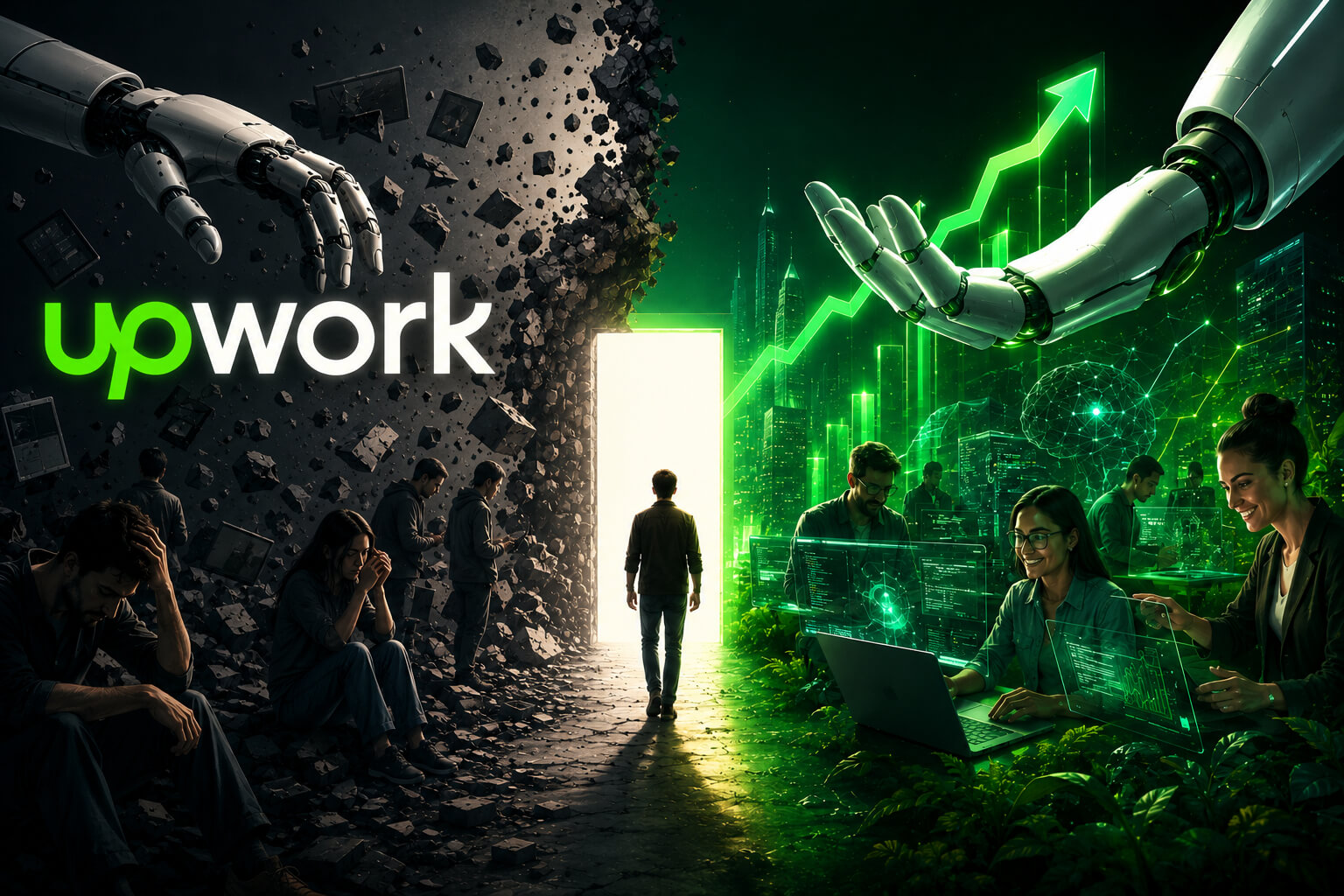
Artificial intelligence is changing Upwork in two directions at once.
Some of the freelance work that once kept the platform busy is being automated faster than expected. At the same time, clients are spending more on larger projects, AI consulting, and people who know how to turn AI output into something actually useful.
That tension showed up clearly in Upwork’s second-quarter 2026 results. Active clients declined, overall gross services volume slipped, and the company lowered its full-year revenue outlook. Yet spending per active client hit another record, while AI-related work continued growing.
This isn’t the clean “AI replaces freelancers” story people sometimes expect. The market looks messier than that.
AI Is Eating Into Upwork’s Simpler Freelance Work
Upwork had already identified roughly 10% of its gross services volume as being particularly exposed to AI automation.
That pressure is now arriving sooner.
According to comments from CEO Hayden Brown reported by PYMNTS, lower-complexity assignments are being automated faster than Upwork anticipated. The weakness represents a pull-forward of disruption the company previously expected to happen over a longer period.
The numbers show some of the damage.
Upwork’s active client count fell 4% year over year to 763,000 during the second quarter. Gross services volume declined 3.6% to $966.4 million, while revenue dropped 2% to $191.7 million.
Those are not catastrophic declines. They do suggest something important, though: AI automation is no longer an abstract threat hanging over freelance marketplaces. It is showing up in actual client behavior.
The easiest assignments to automate are beginning to leave.
But Clients Who Stay Are Spending More
Here is where the story stops being straightforward.
Upwork’s GSV per active client increased 5% to a record $5,230. It was the eighth consecutive quarter of sequential growth. Average hourly contracts also reached a record 100 hours, according to PYMNTS.
So Upwork has fewer active clients, but some of the clients who remain are handing freelancers larger assignments.
That may be an early clue about where freelance work goes in an AI-heavy economy.
Tiny execution jobs can be pushed toward software. Bigger projects still need someone responsible for getting the whole thing across the finish line.
That person might use AI heavily. They are still being hired.
AI Freelance Work Is Becoming a Business of Its Own
AI isn’t only removing work from Upwork. It is creating a surprisingly large category inside the marketplace.
Gross services volume from AI-related work grew more than 22% year over year in Q2 2026 and reached an annualized pace of roughly $330 million, according to Upwork.
AI Strategy & Consulting grew even faster, with GSV increasing by more than 50% year over year.
That distinction matters.
Businesses don’t necessarily need another person who can open an AI chatbot and type a prompt. They need people who understand what AI should do inside a particular company.
Which workflow should be automated? Which model should be used? Where should a human remain involved? How do you connect the tools to existing systems without creating a new operational disaster?
Those problems are considerably harder than generating text.
And apparently, companies are willing to pay for help solving them.
The New Freelance Job: Fix What AI Started
One particularly telling trend is appearing after AI has already been used.
Upwork says clients are hiring humans to finish or repair AI-generated work. Examples include taking AI-generated code and turning it into production-ready websites, or improving translations first produced by machine systems.
That’s an awkward development for the simple automation narrative.
AI can reduce the amount of labor required to begin a project. It can also create a new category of work around validation, refinement and completion.
The freelancer doesn’t disappear. The freelancer gets pushed further downstream.
That probably isn’t comforting to someone whose previous job consisted mainly of first drafts, basic translation, repetitive design variations or simple coding tasks. Those parts of the value chain look vulnerable.
But people capable of judging AI output may become more valuable precisely because AI output becomes cheap.
Clients Aren’t Always Calling It “AI Work” Anymore
Another curious detail: Upwork may be undercounting how deeply AI has already entered freelance work.
Nearly half of freelancers surveyed by the company said their most recent project involved AI. Only 16% of job postings explicitly mentioned AI, according to comments cited by PYMNTS.
The gap makes sense.
A company hiring a developer might not write “must use AI” because using AI has become ordinary. The same could eventually happen with writing, research, customer service, marketing and design.
Nobody puts “must know email” in most job descriptions anymore.
AI may be headed toward the same invisible status: less of a specialty, more of an assumed part of the toolkit.
Larger SMB Customers Are Moving Fast
Upwork’s Business Plus offering is also growing quickly.
Business Plus GSV increased 174% year over year and 24% quarter over quarter during Q2. Active clients in the segment rose 219% year over year, according to Upwork’s investor presentation.
These customers aren’t necessarily shopping for isolated $50 tasks.
Upwork says larger small and medium-sized businesses are using the platform for more complex and recurring work. PYMNTS reported that management sees the opportunity increasingly as helping businesses apply AI to specific industries, workflows and business problems.
That could become an important dividing line in freelance marketplaces.
Volume at the low end shrinks. Higher-value engagements become more important.
Not every freelancer will make that jump.
Upwork Still Has a Revenue Problem
The growing AI business hasn’t erased the immediate pressure.
Upwork lowered its full-year 2026 revenue forecast to between $730 million and $750 million, down from its previous range of $760 million to $790 million.
Third-quarter revenue is expected to land between $176 million and $184 million. Management said its forecast assumes continued elevated AI-related automation and no improvement in the labor market.
Investors didn’t love that message. Upwork shares fell roughly 20% in after-hours trading following the results, according to PYMNTS.
AI isn’t Upwork’s only problem either.
Changes in Google Search have reduced referral traffic, especially from unbranded searches, hurting new-client acquisition. Upwork expects that pressure to continue through the third and fourth quarters and plans to spend an additional $5 million to $10 million on marketing during the second half of the year.
So there are two transitions happening at once: how people find Upwork is changing, and what they hire people to do once they get there is changing too.
Uncomfortable timing.
Freelancing Isn’t Dying. Cheap Execution May Be
Upwork’s results offer a useful snapshot of what AI disruption can actually look like.
Not mass disappearance overnight.
More like compression.
Straightforward assignments get automated. Clients who previously outsourced small pieces of work may handle them with AI instead. Meanwhile, complicated projects become bigger, AI consulting grows, and businesses start paying people to repair, supervise and operationalize machine-generated work.
That creates winners and losers inside the same profession.
A freelancer competing purely on execution is now competing with software that can produce something passable in seconds.
A freelancer who can decide whether that output is correct, adapt it to a real business, connect it to other systems and take responsibility for the result is playing a different game.
Upwork’s Q2 numbers suggest clients are already beginning to recognize the difference.
And this shift is probably nowhere near finished.
