


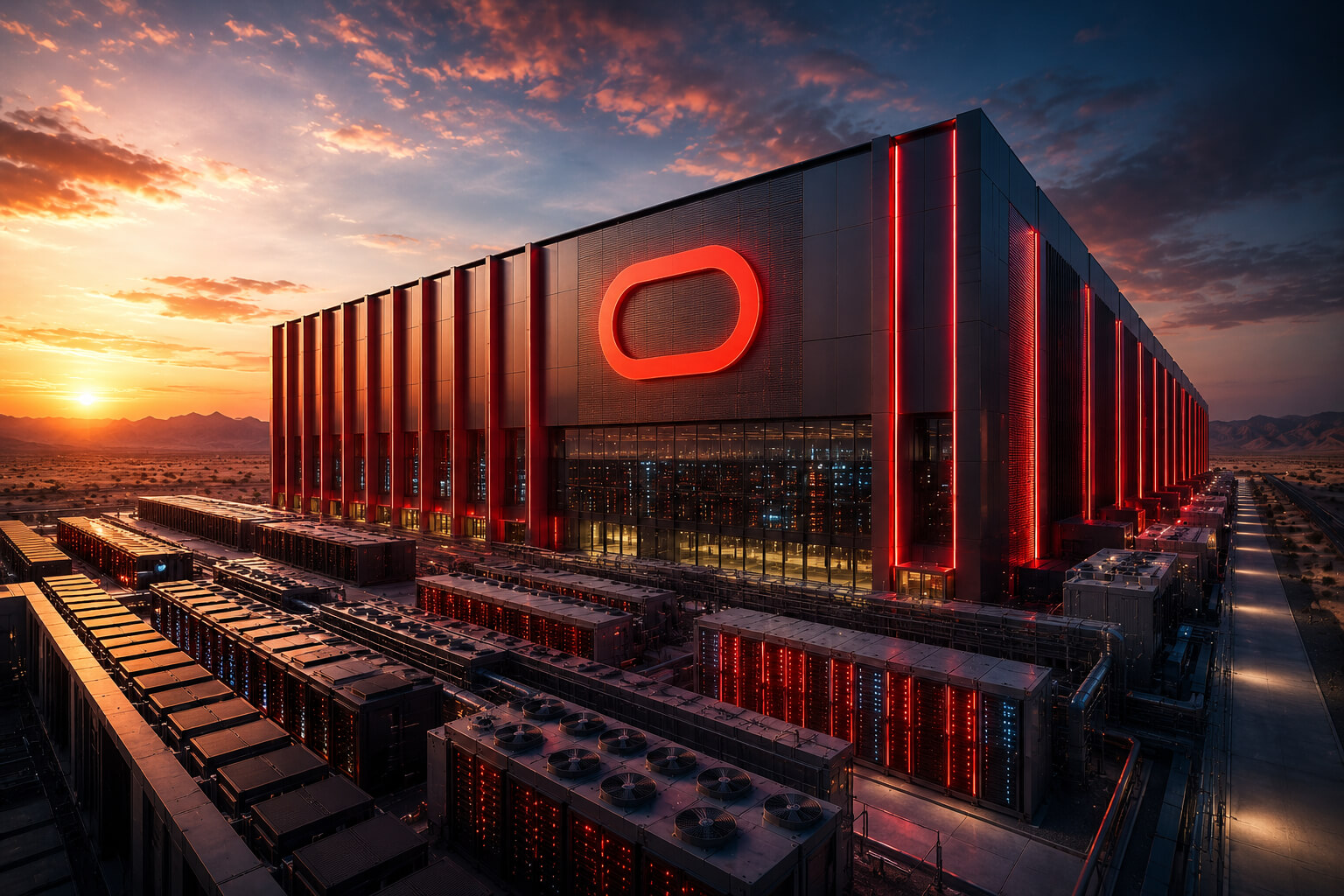
Oracle’s enormous Project Jupiter AI data center in New Mexico is still moving forward on schedule, according to the company, despite the kind of regulatory, environmental, and power challenges that can easily derail infrastructure projects of this size.
And “size” is doing a lot of work here.
Project Jupiter is planned as a roughly 1,400-acre AI data center campus in Doña Ana County, New Mexico. The development has been associated with as much as $165 billion in long-term investment, making it one of the most ambitious AI infrastructure projects currently under development in the United States.
The project is expected to support infrastructure used by Oracle and OpenAI as the companies push to secure the enormous amount of computing capacity required for increasingly demanding AI models.
Oracle Says Project Jupiter Construction Remains on Track
A report published on August 14 said Oracle had confirmed that Project Jupiter remains on schedule, with more than 2,700 workers reportedly already on site. That matters because Project Jupiter is no ordinary server farm. The campus is being designed for AI workloads requiring extraordinary amounts of computing hardware and electricity.
Once fully developed, the site could include multiple hyperscale data center buildings and several gigawatts of power capacity. Industry reports have put the planned on-site generation capability at as much as 2.45 gigawatts.
This is becoming the less glamorous side of the AI race. Everyone talks about models. The physical infrastructure underneath them is turning into an equally important competition.
The $165 Billion Figure Needs Some Context
Project Jupiter is commonly described as a $165 billion project, although that number represents the potential long-term scale of investment rather than the price of a single data center building.
New Mexico economic development documents have cited $165 billion in private capital connected with Project Jupiter, while local approvals have also involved up to $165 billion in industrial revenue bonds.
The campus itself is expected to develop over many years, with spending covering data centers, computing equipment, energy systems and supporting infrastructure. So no, Oracle is not simply writing a $165 billion construction check tomorrow morning. Still, the number gives a useful indication of how much capital the AI infrastructure boom could absorb.
Jobs and Tax Revenue Are Already Becoming Part of the Story
Oracle has been pushing the local economic impact of Project Jupiter particularly hard.
In July, the company said the project had already generated almost $80 million in state and county tax revenue and could eventually produce more than $4.7 billion in long-term economic impact through taxes, investment and additional commercial activity. Oracle also said nearly 700 New Mexico residents had already worked at the construction site at that point.
More recent reporting cited more than 2,700 workers on site overall, with thousands of construction roles expected during development and roughly 1,500 project-supported permanent positions once operations reach scale. Those numbers explain why state and local officials see projects like Jupiter as more than technology investments. They are becoming regional economic-development projects.
Project Jupiter Changed Its Power Strategy
Power has been one of the project’s biggest headaches. Oracle originally planned a system heavily dependent on natural-gas turbines and backup generators. That approach ran into environmental and regulatory resistance, particularly around emissions and water consumption. The company eventually changed course.
Oracle now plans to use Bloom Energy fuel cells as a major part of Project Jupiter’s on-site power infrastructure. Oracle says the redesigned system will reduce water consumption and local emissions compared with its original combustion-based proposal. That shift is important beyond New Mexico.
Power availability is rapidly becoming one of the limiting factors in AI expansion. GPUs can be ordered. Buildings can be constructed. Finding several gigawatts of reliable electricity in the right place is much harder. The AI industry is beginning to design around that reality.
OpenAI’s AI Infrastructure Push Is Getting Physical
Project Jupiter also fits into OpenAI’s broader Stargate infrastructure strategy. OpenAI has described Stargate as its long-term effort to build the computing foundation needed for increasingly capable AI systems. The company already has infrastructure projects underway across Texas, New Mexico, Wisconsin and Michigan.
Oracle is one of the major cloud and infrastructure partners behind that expansion. OpenAI’s flagship Stargate site in Abilene, Texas, for example, runs on Oracle Cloud Infrastructure and uses NVIDIA systems. OpenAI said in April that the Abilene development was already ahead of schedule.
The pattern is becoming obvious: AI companies no longer just need cloud contracts. They need campuses, substations, cooling systems, power generation, construction crews and billions upon billions of dollars in financing. AI is becoming heavy industry.
Not Everyone in New Mexico Is Convinced
The economic promises haven’t erased local opposition. Residents and environmental groups have raised concerns over Project Jupiter’s water requirements, emissions, permitting process and overall environmental footprint. Those concerns became particularly sensitive because the project sits in southern New Mexico, where water is hardly an unlimited resource.
Some reporting has also questioned the political and regulatory process surrounding the project, while local activists continue to challenge elements of its development. Oracle’s decision to replace the original turbine-heavy power design with fuel cells appears partly aimed at answering those objections. Whether it settles them is another matter.
Why Project Jupiter Matters for the AI Race
Project Jupiter provides a useful glimpse at what the next phase of artificial intelligence actually looks like. It doesn’t look like a chatbot. It looks like cranes, electrical infrastructure and thousands of workers in the New Mexico desert.
The biggest AI companies increasingly need physical infrastructure at a scale once associated with utilities, energy companies and heavy industry. Projects measured in hundreds of billions of dollars may still be exceptional today, but multi-billion-dollar AI campuses are becoming much less unusual.
Oracle keeping Project Jupiter on schedule would therefore be more than a construction milestone. It would be another sign that the global AI competition is moving from software into concrete, steel, electricity and land. And that race is only getting more expensive.
Sources
- Pluang — Oracle’s $165B AI data center Project Jupiter stays on schedule
- Oracle — Project Jupiter Will Bring More Than $4.7 Billion to New Mexico
- Oracle — Data Centers and Project Updates
- Oracle — Project Jupiter Fuel Cell Power Plan
- OpenAI — Building the Compute Infrastructure for the Intelligence Age
- NPR/KPBS — Worries Over Water as a Giant Data Center Moves Into the New Mexico Desert
