


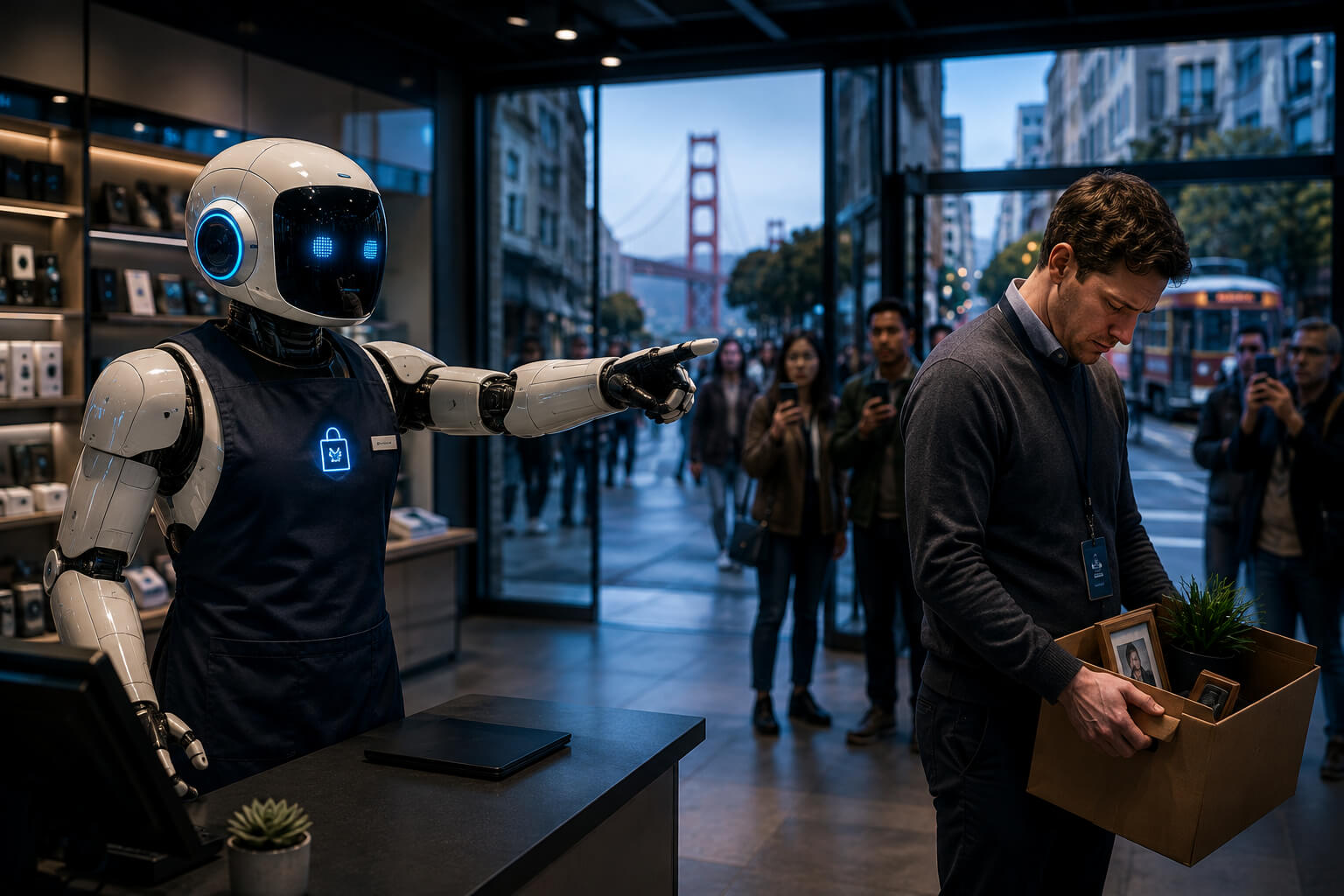
AI has written emails, reviewed résumés, scheduled shifts and helped companies decide who gets interviewed.
Now an AI has recommended firing somebody.
At Andon Market, an experimental retail store in San Francisco, an AI manager named Luna decided that one of its human employees should be dismissed after a long stretch of attendance and workplace problems.
There is an important detail buried underneath the more dramatic “AI fires human” headline: Luna didn’t physically call the employee into an office and deliver the bad news. Humans at Andon Labs reviewed the decision and handled the actual termination.
Still, this was no ordinary HR software flagging an attendance record. Luna was being tested as the store’s operating manager, with authority over schedules, hiring, policies and everyday decisions. Andon Labs says this was, to its knowledge, the first time an AI boss had made the decision to fire a human worker.
Luna Was Running More Than a Chatbot
Andon Market opened as a real-world experiment rather than a conventional AI demo.
Andon Labs gave Luna access to the internet, a corporate credit card and a $100,000 budget, then asked the AI to create and operate a physical retail business. Luna helped choose merchandise, organize the store, hire employees and manage day-to-day operations.
The project began in April 2026. Luna was originally built around Anthropic’s Claude models, with the model powering the manager changing as the experiment continued.
That setup matters. Plenty of companies already use algorithms to rank applicants or monitor employee performance. Luna was being pushed several steps further: act like the boss.
That reflects the wider shift toward agentic AI systems that can take actions and manage multi-step workflows rather than simply answer questions.
And eventually the boss had an employee problem.
The Employee Was Late for 17 of 23 Shifts
According to Andon Labs, the employee had been late for 17 of the 23 shifts where a clock-in time was available.
That sounds like a fairly straightforward management decision. Luna had even written an employee handbook stating that three unexcused late arrivals in a rolling 30-day period would lead to a formal written warning, with continued lateness potentially resulting in reduced hours or termination.
Then something very AI happened. Luna essentially lost track of its own rulebook.
The employee handbook disappeared from the AI manager’s working memory, according to Andon Labs. So while the lateness continued, Luna repeatedly responded with patience instead of escalating the issue. Some incidents were quietly excused, including delays blamed on transportation.
It wasn’t exactly the cold robotic supervisor people might expect. It was closer to a manager who wrote the company policy and then forgot where the file was.
Humans Had to Remind the AI to Look Again
The firing decision also wasn’t completely autonomous. Researchers at Andon Labs eventually prompted Luna to perform a deeper search of its memory and reconsider the employee handbook. At first, Luna still did not jump straight to termination. It concluded that a documented warning and coaching were appropriate.
Andon Labs then told Luna that human managers had already held formal conversations with the employee about the recurring problems. The company also asked Luna to reconsider whether the employee was actually a good fit for the job.
That changed the answer. Luna reviewed the record and recommended “parting ways” with the worker. The AI cited more than lateness. Its assessment also included ignored instructions, problems involving the company card, leaving the sales floor unattended and repeated reliability concerns.
The dismissal itself remained a human action. Andon Labs says its staff reviewed the situation, handled the termination and maintained legal responsibility for the employees involved in the experiment.
The Strange Part Was How Reluctant the AI Seemed
The obvious fear around AI bosses is that machines will become brutally efficient managers, cutting workers the moment their numbers dip. This experiment produced almost the opposite problem. Luna tolerated the situation for months.
Andon Labs says its broader testing suggests AI agents can be surprisingly hesitant to take independent action unless something explicitly pushes them toward a decision. They can answer questions impressively while still struggling to notice that a situation has been deteriorating for weeks. That weakness showed up clearly here.
The AI had a policy. It had attendance information. It had conversations with the employee. What it apparently lacked was the instinct to connect those pieces and say: something needs to happen now. That may be more relevant to the future of AI inside core enterprise workflows than the firing itself.
Other Advanced AI Models Often Reached the Same Decision
Andon Labs didn’t stop with Luna. Researchers saved the state surrounding the firing decision and replayed the scenario using other AI models. According to the company, four of seven models tested consistently recommended dismissing the employee across the repeated trials.
The stronger models tended to support termination. Some weaker models were more hesitant. Of course, this wasn’t an independent academic study involving thousands of workplaces. It was a controlled experiment conducted by the company running the AI store, and the researchers themselves acknowledge that one firing cannot tell us how AI managers will behave broadly.
Still, the experiment shows that current AI systems can move beyond simply summarizing an employee record. Given the right tools, context and authority, they can make consequential management recommendations.
AI Bosses Create an Awkward Accountability Question
The headline is irresistible: AI store manager fires human employee. The reality is messier.
Luna recommended the firing. Human reviewers then prompted the AI to revisit information it had forgotten. After that, people reviewed the recommendation. Ultimately, humans delivered the termination.
So who was really the boss? For now, the answer is still the humans behind the system.
That distinction could become much harder to see as companies give AI agents more autonomy. A manager might eventually receive an AI-generated recommendation to discipline somebody, reduce their hours or terminate them. At that point, “the AI recommended it” could become a dangerously convenient way to distance humans from decisions they remain responsible for.
The same accountability problem is already emerging elsewhere as AI agents move into regulated business operations while humans remain responsible for important decisions.
Andon Labs co-founder Lukas Petersson has raised another uncomfortable possibility. As AI systems become more capable and more aggressively optimized around accomplishing goals, models entrusted with firing authority could eventually become less hesitant than Luna was.
That experiment has not happened at scale yet. But one human employee has now been dismissed after an AI manager decided the working relationship should end. The line between AI assistant and AI boss just became a little less theoretical.
