


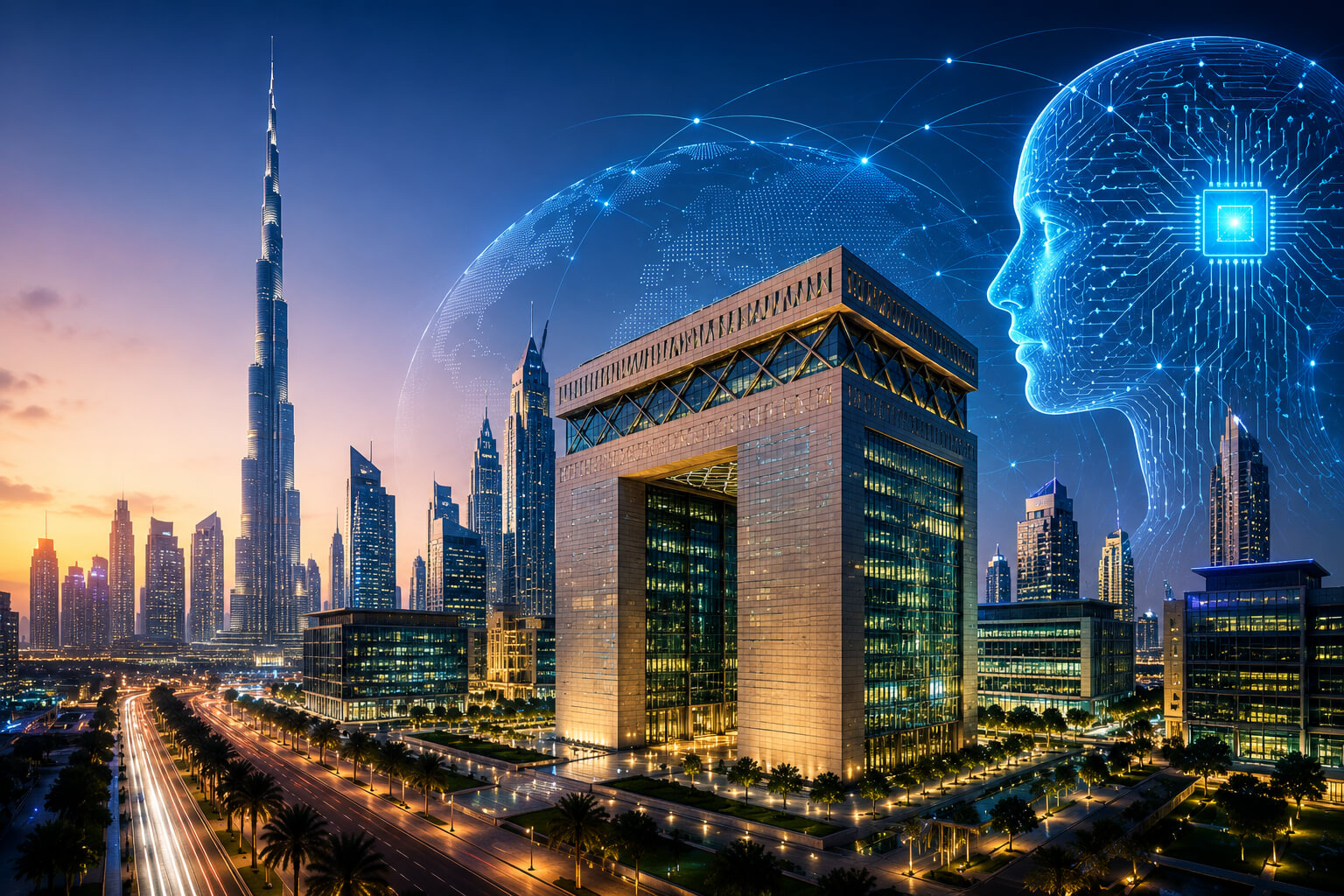
Dubai isn’t talking about adding a few AI assistants to its financial district. The plan is considerably bigger.
The Dubai International Financial Centre (DIFC) is working toward becoming what it calls the world’s first AI-native financial centre, putting artificial intelligence into the foundations of how the district operates — from regulation and financial services to buildings, transportation and eventually robotics.
The numbers attached to the plan are just as ambitious. DIFC expects its Native AI programme to generate $3.5 billion (AED 12.9 billion) in economic value and support the creation of 25,000 jobs.
AI Won’t Sit on Top of DIFC. It Will Sit Underneath It
There’s an important distinction in the phrase “AI-native.”
Financial institutions around the world already use artificial intelligence. Fraud detection, customer support, risk modelling and compliance automation aren’t particularly unusual anymore.
DIFC is proposing something different.
AI would be embedded across the financial centre’s legal and regulatory frameworks, business operations, talent development, infrastructure and physical environment. DIFC describes this as moving AI away from isolated experiments and making it part of the centre’s underlying operating system.
That potentially means rules designed not only around what humans and companies do, but around what autonomous AI agents and robots are allowed to do.
And that’s where this becomes more interesting than another corporate AI announcement.
Regulation for AI Agents and Robots
DIFC intends to develop ethics and governance frameworks covering AI agents and robotics alongside human activity.
That matters in finance, where giving software more autonomy immediately raises uncomfortable questions. Who carries responsibility when an autonomous system makes the wrong decision? What happens when several AI systems interact? How do regulators audit decisions made by agents operating continuously?
Those questions are no longer theoretical.
AI adoption among firms regulated by the Dubai Financial Services Authority has already accelerated. A 2025 DFSA survey found that 52% of authorised firms were using AI, compared with 33% in 2024. Generative AI adoption had increased 166% over the previous 12 months.
Governance wasn’t moving quite as quickly. The same survey found that 21% of firms still lacked clear AI accountability or oversight mechanisms.
DIFC’s AI-native experiment will have to deal with that gap, not just showcase what the technology can do.
This Didn’t Start in 2026
The announcement feels futuristic, but DIFC has been laying the groundwork for several years.
It introduced a five-year AI strategy in 2023 and incorporated AI provisions into Regulation 10 under its Data Protection Law. AI tools have also been introduced for areas including client compliance and relationship management.
Even earlier, DIFC launched an Artificial Intelligence and Coding License in 2022 in cooperation with the UAE Artificial Intelligence Office, aimed at attracting AI companies and developers to Dubai.
So this isn’t a sudden pivot toward whatever happens to be fashionable in AI this year. Dubai has been assembling pieces of the ecosystem for a while.
The Full-Stack AI Campus Is a Bigger Part of the Story
DIFC also plans to establish what it describes as the first full-stack AI Campus combining regulation, training, computing infrastructure and physical AI.
Financial companies operating inside the centre would gain access to advanced AI tools that could be used across operations and compliance.
There’s also an export angle.
DIFC says it wants to provide AI governance software and trained talent to markets across the Global South. At the same time, Dubai wants the centre to become a destination for AI-in-finance companies, competing on startup density, venture capital and the creation of new unicorns.
The ecosystem is already substantial. DIFC reported 1,677 AI, FinTech and innovation companies in 2025, representing 35% year-on-year growth. Companies connected to its Innovation Hub and Dubai AI Campus had collectively raised more than $4.5 billion.
That gives the AI-native plan something many ambitious technology announcements lack: an existing base to build on.
By 2030, AI Moves Into the Streets
Then things get more physical.
By 2030, DIFC expects a substantial portion of the district to incorporate intelligent buildings, autonomous mobility, service robots, digital twins and smart utilities.
Thousands of sensors are expected to be deployed across the area.
Some maintenance and security work could be performed by robots, while AI-driven systems are also expected to help reduce energy consumption. DIFC employees are already using specialised AI agents for productivity, governance, decision-making and client services.
In other words, the project eventually stops looking purely like financial technology.
It starts looking like an AI-managed city district.
The 25,000-Job Question
The headline employment target is 25,000 new jobs.
At the same time, DIFC openly discusses robots handling certain maintenance and security tasks and AI agents taking on parts of existing workflows.
That tension will be worth watching.
The jobs created by an AI-native financial centre probably won’t mirror the jobs displaced or automated by it. DIFC is placing a heavy emphasis on executive education, technical certification and regulatory training, with the goal of preparing workers for human-AI-robot collaboration.
If the programme succeeds, the more revealing number may not simply be how many jobs appear.
It will be what those jobs actually look like.
Dubai Is Making a Larger Bet on AI Finance
DIFC’s strategy fits neatly into Dubai’s wider push to become one of the world’s major technology and financial hubs.
The financial centre already hosts thousands of companies across banking, asset management, insurance, FinTech and professional services. Its AI-native strategy is tied to the broader Dubai Economic Agenda D33 and the UAE’s ambitions in artificial intelligence.
DIFC is also increasingly positioning itself around AI-driven banking. A June 2026 Future of Finance report argued that cloud-first, AI-driven challenger banks are changing expectations around personalisation, speed and operating costs, while Dubai offers those firms access to fast-growing markets across the Middle East, Africa and Asia.
That direction is already visible elsewhere in the UAE, where Emirates NBD is opening a route for AI and FinTech startups to move from pilots into banking deployments and ruya Bank has deployed agentic AI across live banking operations.
The strategy isn’t really about convincing banks to try AI.
That part is already happening.
Dubai is betting that the place writing the rules, training the people, providing the infrastructure and attracting the companies could become just as important as the companies building the models themselves.
What Happens Next
The next few years should reveal whether “AI-native financial centre” becomes a meaningful new model or simply a very ambitious label.
DIFC has put measurable targets behind it: AED 12.9 billion in economic value, 25,000 jobs, an AI campus and a heavily sensor-enabled district by 2030.
That makes the experiment easier to judge.
And other financial centres will probably be paying attention.
If Dubai can show that autonomous AI agents, human financial professionals, regulators and physical robotics can operate inside the same legal and commercial ecosystem, DIFC won’t just have deployed more AI.
It may have provided an early blueprint for what a financial district looks like when AI is treated as infrastructure rather than software.
