


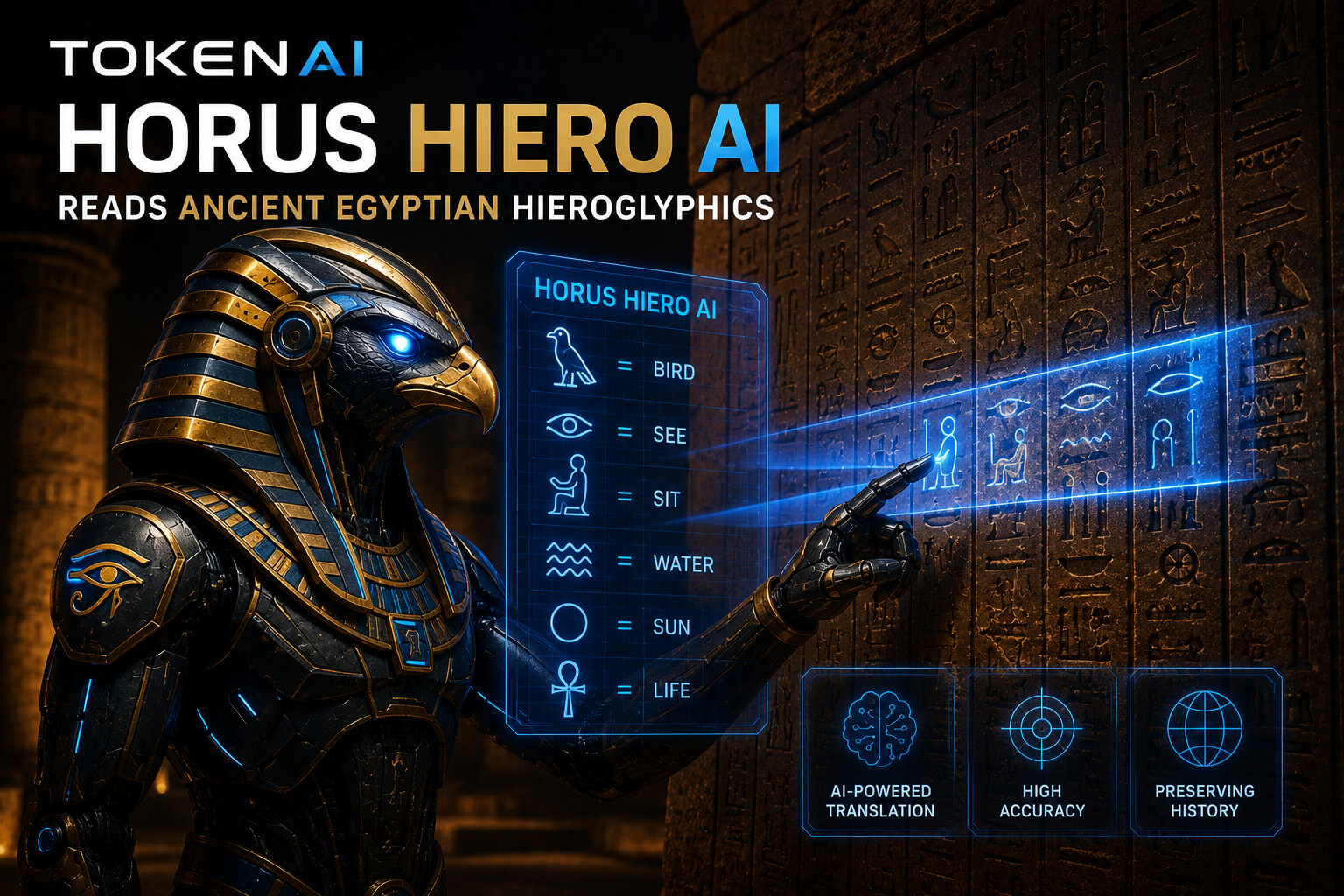
Egyptian AI startup TokenAI has released Horus Hiero, a new multimodal AI model designed to read and translate Ancient Egyptian hieroglyphics. It sounds niche at first. Then you think about museums, archaeology, cultural archives, tourism apps, academic research, and all the old material still locked behind specialist knowledge.
That is where this becomes more interesting.
The Alexandria-based company has introduced Horus Hiero 9B and Horus Hiero Mini 4B, two models built for hieroglyphic understanding, Arabic dialects, and more than 100 languages. According to Middle East AI News, the models can process epigraphic drawings, stone reliefs, and papyrus documents, then turn those visual inputs into structured English or Arabic translations.
TokenAI Builds AI for Ancient Egyptian Script
Most AI vision systems can spot symbols. That is not the same as understanding a 5,000-year-old writing system.
Hieroglyphics are not just pictures placed beside each other. They carry sound, grammar, religious meaning, cultural context, and historical references. A model that simply labels symbols will miss the point very quickly.
TokenAI says Horus Hiero was built with a native hieroglyphic processing engine. That matters because the model is not just passing images through a general-purpose vision tool and hoping for the best. It is trained to recognize the symbols, transliterate them, translate them, and reason about what they mean in context.
For Egyptology researchers, that could save time. Museums could use it to build more interactive visitor tools. Tourists may eventually point a phone camera at an inscription and get something closer to a readable explanation, not just a symbol-by-symbol guess.
Horus Hiero Comes in Two Versions
The flagship model is Horus Hiero 9B. TokenAI also released Horus Hiero Mini 4B, a smaller version designed for lighter hardware.
That second part may be more important than it sounds. Not every researcher, student, museum, or developer has access to expensive GPU infrastructure. A model that can run on standard CPUs or mobile devices opens the door to offline translation tools, field research apps, and budget-friendly educational products.
Middle East AI News reported that Horus Hiero Mini scored 84.2 percent on TokenAI’s internal Hieroglyphic AI Benchmark, while the larger Horus Hiero model scored 90 percent overall. The benchmark covers recognition, transliteration, translation, and contextual reasoning.
Why This Is Bigger Than Translation
The easy headline is that AI can now read hieroglyphics. The bigger story is regional AI.
TokenAI is building models shaped around Egyptian and Middle Eastern linguistic needs, not just English-first benchmarks. Horus Hiero supports modern Arabic dialect mapping, including Egyptian, Levantine, Gulf, and North African variants. It also supports more than 100 languages.
That gives the model a strange but useful mix: ancient Egyptian script on one side, modern regional language understanding on the other.
For the Middle East and North Africa, this is not a small detail. AI development in the region is often judged by how well global models can serve Arabic-speaking users. TokenAI is taking a different route by building from local language, culture, and heritage outward.
Open-Weight Release Could Help Researchers Build Faster
TokenAI plans to release both Horus Hiero models as open-weight models under a custom developer license. A Horus Chat web and mobile interface is also expected to follow.
Open-weight access could make the model more useful for universities, museums, developers, and cultural heritage teams that want to test or adapt the technology. It also gives researchers a base to improve hieroglyphic OCR, historical archive search, and inscription translation tools.
There is a commercial angle too. Museum apps, tourism platforms, digital heritage projects, and education tools all need better ways to make ancient material accessible without flattening it into shallow summaries.
TokenAI Is Quietly Building Around Cultural AI
TokenAI previously released Horus 1.0-4B in April 2026, a smaller open-source model that reportedly performed strongly against larger global models on selected benchmarks. The company has also worked on Horus Lens 1.0 for image generation.
Horus Hiero now pushes the company into a more distinct lane: cultural AI.
That category still feels underdeveloped. Most AI model launches chase coding, agents, enterprise productivity, or general reasoning. TokenAI is aiming at something more specific and, in some ways, harder to fake: language, heritage, context, and historical meaning.
What Comes Next for Horus Hiero
The next test will be real-world use. Internal benchmark scores are useful, but Egyptologists, museum teams, educators, and developers will want to see how Horus Hiero performs on messy inscriptions, damaged surfaces, incomplete texts, and ambiguous symbols.
Still, the direction is clear. AI is moving beyond generic chatbots and into specialized cultural tools. TokenAI’s Horus Hiero shows what that can look like when a model is built around a region’s own history and language instead of treating them as add-ons.
For ancient Egyptian texts, this could become a practical research tool. For regional AI, it is another sign that the Middle East’s AI story is no longer just about adopting models built elsewhere.
