


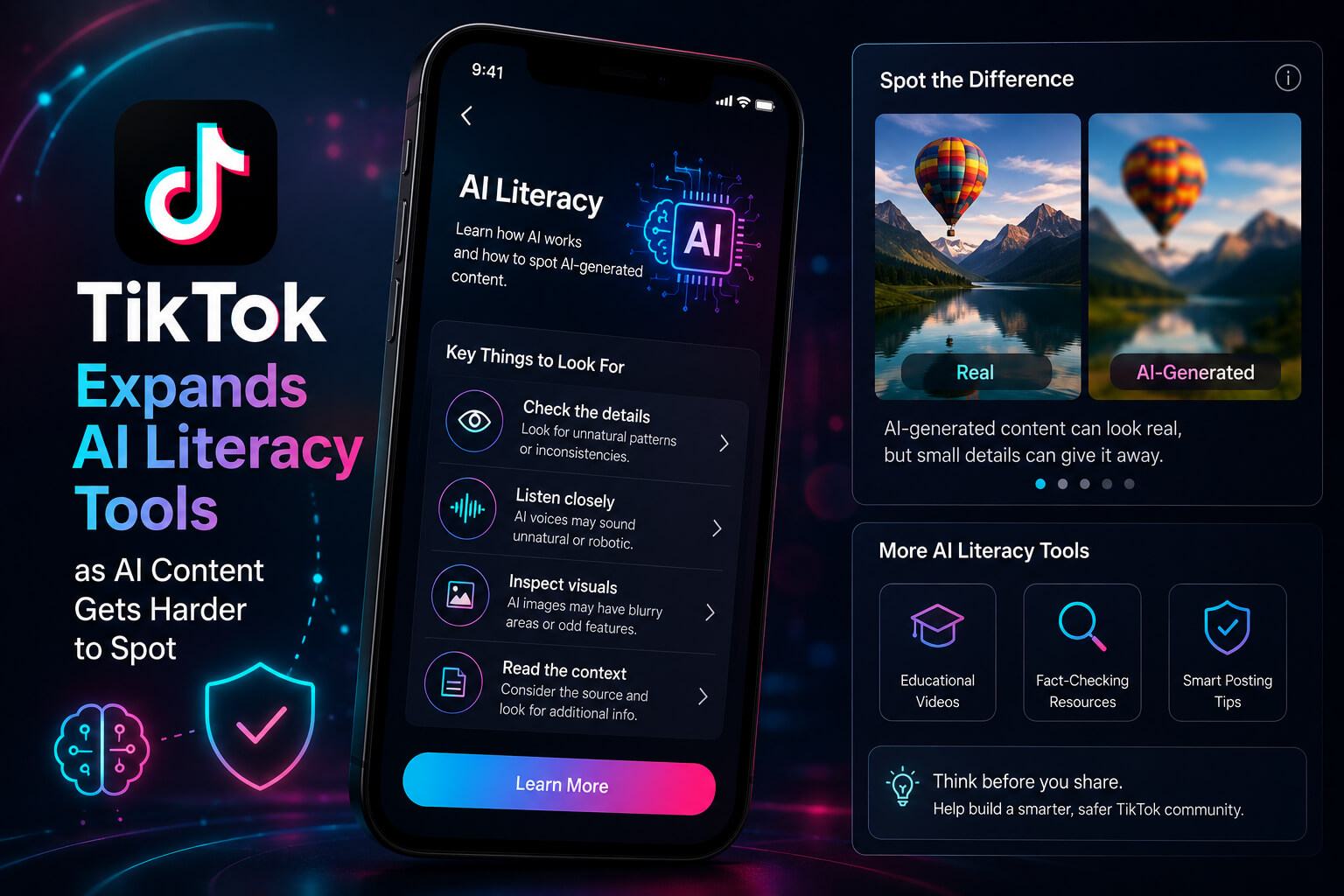
TikTok is trying to make AI content a little less confusing.
The platform has introduced new AI literacy measures to help users understand when they are watching something created, edited, or shaped by artificial intelligence. It is a timely move. AI-generated videos, synthetic edits, fake accounts, and polished-looking misinformation are now part of the normal social media feed.
That is the problem.
People scroll fast. They react even faster. And AI content does not always announce itself clearly.
TikTok Wants Users to Recognize AI-Generated Content
TikTok’s latest push focuses on helping users spot AI-generated content before they trust it too quickly.
The company has launched an AI literacy guide developed with the National Association for Media Literacy Education and AI expert Henry Ajder. The guide explains how AI tools work, how AI-generated media can appear online, and what users should watch for when content looks suspicious or unusually polished.
It also includes video explainers. That part matters because TikTok users are not going to read long policy pages while scrolling. Short, practical education fits the platform better.
This is not about stopping people from using AI. TikTok clearly knows AI is already part of the creator economy. Filters, edits, voice tools, visuals, scripts, avatars, and synthetic clips are everywhere now. The bigger issue is whether users understand what they are seeing.
An AI Literacy Hub Is Coming Inside the App
TikTok is also preparing to launch an in-app AI literacy hub.
The hub will appear when users search for AI-related terms, giving them easier access to information about spotting AI-generated content. That is a smart placement. People who are already searching about AI may be more open to learning how it works, where it can mislead, and how labels should be read.
The company is also supporting AI literacy programs through NoFiltr and the Raspberry Pi Foundation. These efforts are meant to improve public understanding of artificial intelligence, especially among younger digital users who spend much of their time inside platforms like TikTok.
And yes, this is also about trust.
TikTok needs users to feel that the app is not turning into a feed full of synthetic confusion.
TikTok Has Already Labeled Billions of AI Videos
TikTok says it has labeled more than 3 billion videos as AI-generated content, or AIGC.
That number shows how fast AI content has moved from a niche creator tool into a mainstream part of online media. TikTok uses several methods to label AI content, including Content Credentials, creator labeling tools, and invisible watermarking.
The goal is simple enough: give users more context.
A label will not solve everything. Some people ignore labels. Some creators may try to avoid them. Some AI content may still slip through. But labels at least give users a signal that what they are watching may not be fully real, fully human-made, or fully captured from the real world.
That small warning can change how people react.
AI Spam and Misinformation Are Becoming Bigger Risks
TikTok is also improving its detection systems for AI-generated spam and misinformation.
This is where the update becomes more serious. AI-generated content is not only used for jokes, fan edits, product demos, or creative storytelling. It can also be used to push misleading political posts, fake medical advice, financial scams, and current event misinformation.
TikTok said it removed more than 86 million fake accounts in the first three months of the year as part of its anti-spam efforts.
Now the platform plans to test stronger detection systems for accounts posting AI-generated spam around politics, current events, financial advice, and medical content. Those areas are sensitive because bad information can move quickly and create real-world harm.
A fake dance video is one thing. A fake health claim or fake election-related clip is another.
Why TikTok’s AI Literacy Push Matters
AI content is getting better. That is the awkward truth.
Faces look more natural. Voices sound more believable. Edited scenes can look like real footage. Even text-based misinformation can now be produced at scale, rewritten in different tones, and pushed across accounts quickly.
So platforms are being forced into a new role. They are no longer only hosting content. They are also expected to explain what kind of content users are seeing.
TikTok is not alone here. Social platforms, search companies, and AI firms are all under pressure to make synthetic media easier to identify. Google has introduced disclosures for advertisements created or edited with AI, while Meta recently faced backlash over an Instagram AI image feature involving public profiles. But TikTok has a unique challenge because its content spreads through short, emotional, highly shareable videos.
People do not always pause to check.
That is exactly why AI literacy is becoming part of platform safety.
TikTok Is Trying to Protect Trust Before It Breaks
TikTok’s new AI literacy tools are not a magic fix. The platform will still have to deal with mislabeled content, unlabeled AI posts, spam networks, and creators who may not disclose AI use properly.
But this update shows where social media is heading.
AI is no longer just a feature inside apps. It is becoming part of the entire content system. The feed, the creator tools, the ads, the edits, the comments, and even the scams are changing because of it.
TikTok’s move is really about keeping users from feeling lost inside that shift.
A simple question now matters more than ever: is this real, edited, generated, or manipulated?
TikTok wants more users to ask that question before they believe what they see.
