


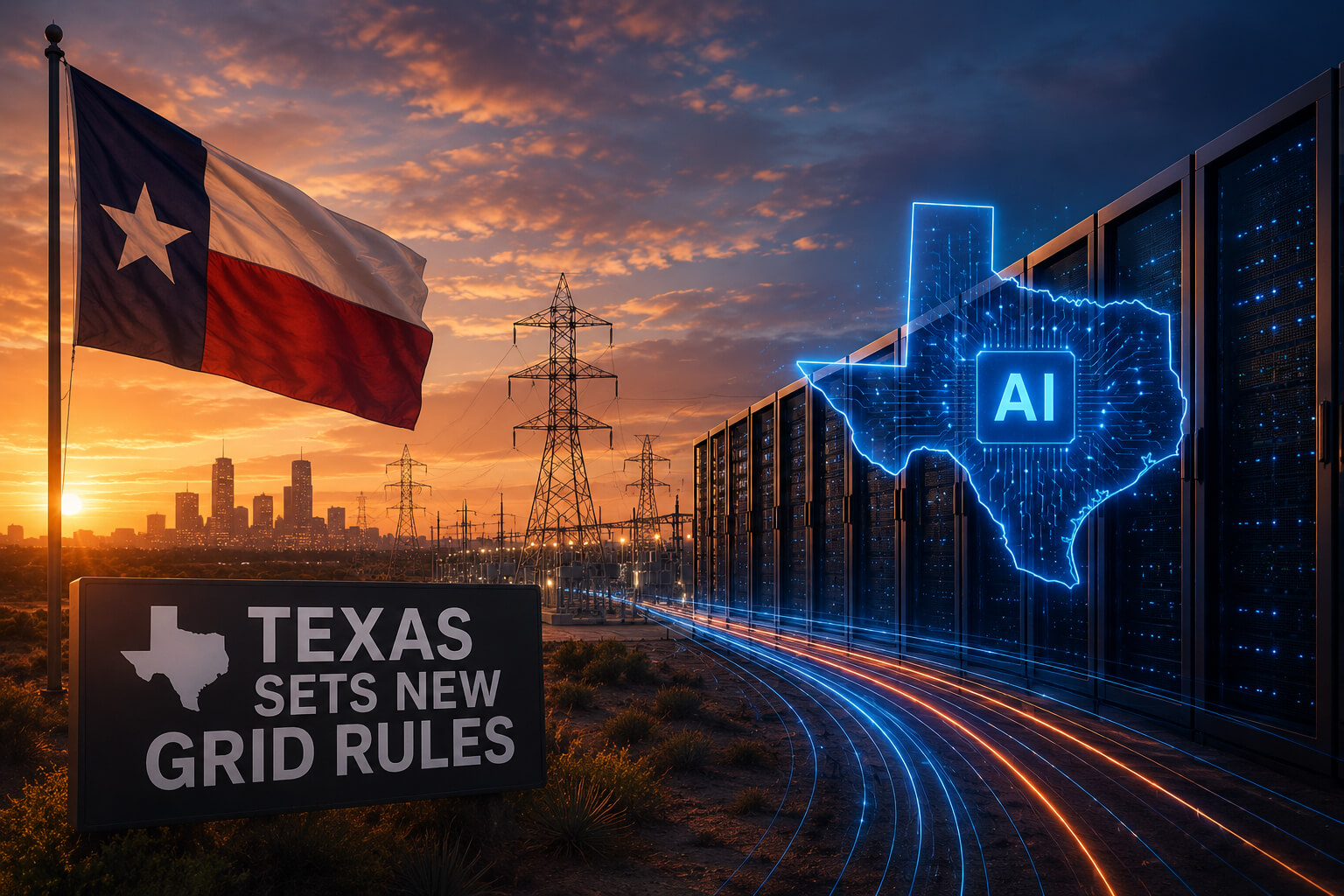
Texas is moving to tighten how large electricity users connect to the state grid as artificial intelligence continues to fuel massive demand for data centers.
The Public Utility Commission of Texas has approved a new review process from the Electric Reliability Council of Texas, better known as ERCOT, for large power users such as AI data centers, industrial facilities, and other energy-intensive projects. Instead of reviewing each grid-connection request one by one, ERCOT will now evaluate large load requests in groups.
The change is designed to help Texas better understand which projects are likely to move forward and how much electricity they may require. As AI companies and data center developers race to build new infrastructure, state officials are trying to balance economic growth with grid reliability and consumer protection.
Why Texas Is Changing Its Grid Review Process
Texas has become one of the most important states for data center expansion. The state has business-friendly policies, plenty of land and access to major energy resources. But the rapid rise of AI infrastructure is putting new pressure on the electric grid.
AI data centers consume massive amounts of electricity to power servers, cooling systems and networking equipment. As more projects seek to connect to the grid, ERCOT needs a clearer way to separate serious proposals from speculative ones.
Under the new process, ERCOT will study large power users in batches. This would also help in planning for future transmission needs. In addition, it would help in identifying projects that can move forward. It will also reduce uncertainty around long term demand for electricity.
ERCOT’s “Batch Zero” Will Target Advanced Projects
The first group of projects that ERCOT will review, called “Batch Zero,” will be those that are furthest along in the process. This group may include projects that have obtained land, financing or other signs of serious commitment.
That matters because not all of the proposed data centers will end up being built. Texas regulators hope to avoid overbuilding infrastructure for projects that may never come to fruition. They will do this by prioritizing projects with stronger development signals.
The batch-based review system could also help utilities and transmission planners better prepare for future demand. As AI adoption grows, grid operators need more accurate forecasts to determine where new transmission lines, substations or generation resources may be needed.
AI Growth Creates New Energy Challenge
The boom in generative AI has made computing power a strategic priority. Companies are building bigger data centers to support AI model training, cloud computing and enterprise AI services.
But this expansion costs something. Data centers can draw as much power as small cities and their electricity demands are often concentrated in specific regions. If grid planning does not keep up, the result could be higher costs, reliability issues, and added stress on residential electricity customers.
Texas officials are now trying to make sure data center growth does not shift too much financial burden onto households. Gov. Greg Abbott has directed state energy officials to look for ways to protect residential customers from paying for infrastructure needed mainly by large data centers.
Water Use Is Also Part of the Debate
Electricity is not the only concern. Many data centers also require water for cooling, especially in regions with high temperatures. In Texas, where water availability can already be a major issue, officials are paying closer attention to how new facilities may affect local communities.
Abbott has said data centers should operate in ways that reduce costs for residential electricity customers, avoid draining water needed by communities, and consider neighborhood impacts.
That signals that future Texas legislation may address both energy and water use by data centers. As AI infrastructure grows, lawmakers could seek new rules on how these facilities connect to the grid. They might also create rules about how companies pay for upgrades and how they manage local resource demands.
What this means for AI companies
The new Texas grid rules could provide a more streamlined path to approval for AI companies and data center developers. Developers with land, financing and clear construction plans may find it easier to navigate the review process.
Speculative projects may attract more scrutiny, however. ERCOT and Texas regulators want more information before committing grid resources to large new electricity users.
This may encourage developers to prepare more complete project documentation before seeking grid interconnection. It may also push companies to consider energy strategy earlier in the planning process, including location, transmission availability, backup power and long-term operating costs.
What this means for Texas residents
The biggest question for Texas residents is whether the growth of AI data centers will send your electricity bills higher or put a strain on the grid.
A new review process is in part designed to avoid that. By looking at large users in groups, ERCOT can get a better handle on where demand is increasing and what infrastructure is actually needed.
But as AI infrastructure grows rapidly, the issue is not likely to disappear. Texas is positioning itself to be a major hub for AI and data centers. However, that growth will require careful planning to protect both economic opportunity and grid reliability.
The Bigger Picture
Utilities and regulators across the United States are rethinking power demand forecasts as AI data centers proliferate. Texas is not alone in this. The AI boom is changing assumptions about electricity growth after years of relatively flat demand in many regions.
The new Texas AI data center grid rules show how quickly energy policy is adapting to the rise of artificial intelligence. As AI becomes more deeply embedded in business and consumer technology, the physical infrastructure behind it — electricity, water, land, and transmission — is becoming a central policy issue.
Texas now faces a difficult balancing act: attract high-value AI investment while making sure ordinary customers are not left paying the price.
