


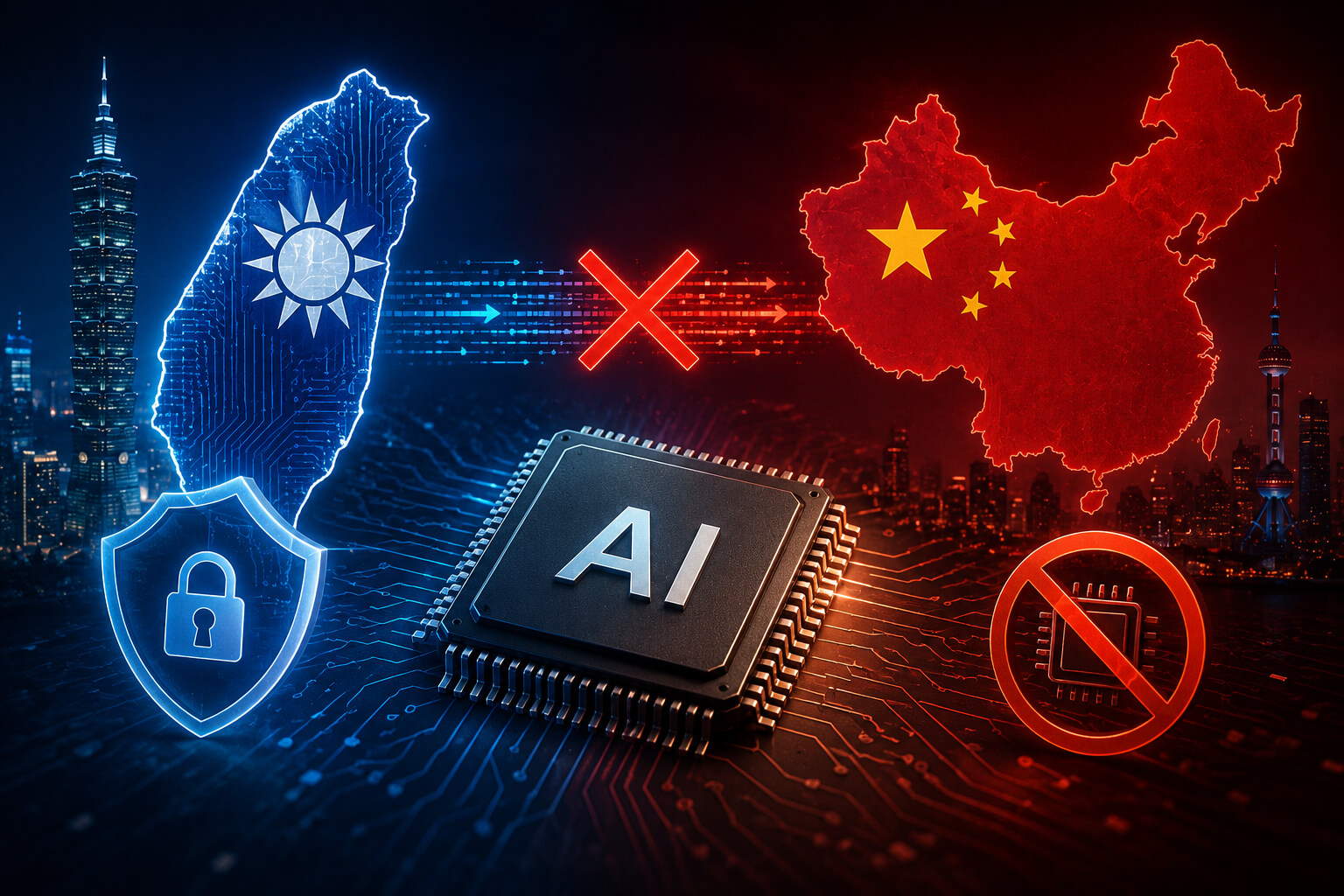
Taiwan is contemplating tighter controls on the export of sophisticated AI chips to China, potentially changing the course of the global semiconductor race. As artificial intelligence becomes increasingly dependent on high-performance computing, access to advanced chips has become one of the most important battlegrounds in the technology rivalry between China, Taiwan, and the United States.
The reported policy shift would bring Taiwan more closely in line with U.S. efforts to limit China’s access to cutting-edge AI hardware. That could create new obstacles for Beijing to acquire the processors it needs to train large AI models, power data centers and underpin advanced computing research.
But the move could also have an unintended consequence: accelerating China’s push to develop a more independent semiconductor industry.
Why Taiwan is Critical to the Global AI Chip Supply Chain
Taiwan is a crucial hub in the global semiconductor industry. It is home to some of the world’s most advanced chip manufacturing facilities, making it a vital source for leading tech companies and AI innovators.
Many of the processors used to train and run modern AI systems are designed by U.S. companies but manufactured in Taiwan. This makes Taiwan a strategic hub in the AI supply chain, especially as demand for advanced chips continues to increase across cloud computing, enterprise AI, robotics, defense technology and data center infrastructure.
Because of this position, any change in Taiwan’s export policy can have global consequences. Tighter rules on chip sales to China would not only affect Chinese technology firms but could also influence supply chain planning for multinational companies that depend on Taiwan’s semiconductor ecosystem.
Taiwan AI Chip Export Curbs Add Pressure on China
The possible Taiwan AI chip export curbs come at a time when China is already facing major restrictions from the United States. Washington has spent years tightening rules on the sale of advanced AI chips, semiconductor manufacturing tools, and related technologies to Chinese companies.
These restrictions are designed to slow China’s progress in areas such as artificial intelligence, supercomputing, and advanced military applications. If Taiwan adopts stricter export rules, it could make those controls more effective by closing potential gaps in the global chip supply chain.
For China, the first effect may be less access to the most advanced AI processors. That would make it harder for Chinese firms to scale up big AI systems at the same speed as competitors in the United States and other allied markets.
The power to compute is a fundamental prerequisite for the development of AI. Without enough powerful chips, companies might face higher costs, slower model training, and constraints on the size and performance of future AI systems.
Why China Might Double Down on Domestic Chips
Export restrictions could create short-term pressures but also push China to invest even more aggressively in its own semiconductor industry.
China has already made chip self-sufficiency a major national priority. As foreign access becomes less predictable, Beijing has stronger incentives to support domestic chip design, manufacturing, packaging, and supply chain development.
This does not mean China can easily replace Taiwan’s advanced manufacturing capabilities. “Building leading edge AI chips requires advanced equipment, specialized materials, experienced engineering teams and years of manufacturing expertise.” Taiwan’s position was built over decades and would be difficult to replicate quickly.
Still, tighter restrictions could strengthen China’s long-term determination to reduce dependence on foreign suppliers. In that sense, export controls may slow China’s AI progress in the near term while motivating greater investment in local alternatives over time.
The AI Chip Race Is Now a Geopolitical Contest
The AI chip race is no longer just a business competition. It has become a geopolitical contest of national security, economic power, and technological leadership.
Washington and its allies view the Biden administration’s move to restrict China’s access to advanced chips as a means to protect strategic technology and maintain dominance in artificial intelligence, while China sees the curbs as a challenge to its long-term technology ambitions.
Taiwan is at the centre of this contest. Its semiconductor industry gives it enormous influence over the future of AI hardware, but it also places the island under intense geopolitical pressure.
A stronger export control policy would signal that Taiwan is moving closer to the U.S.-led approach on China technology restrictions. That could improve cooperation with Washington but also could raise tensions with Beijing.
What Tighter Taiwan AI Chip Export Curbs Could Mean for the Global AI Industry: Risks and Opportunities
Companies that depend on sophisticated chips may have to pay closer attention to export compliance, supply chain transparency and customer screening. Chipmakers and server vendors may have to be more careful about where their products go and how they are used.
At the same time, demand for AI infrastructure is unlikely to slow down. Cloud providers, startups, research labs and enterprises are still looking for powerful chips to build and deploy advanced AI systems. If China faces more restrictions, demand might shift even more to approved markets, while Chinese firms might look for alternative hardware, domestic chips or more efficient AI training methods.
This could mean a more fragmented AI hardware market, with different supply chains and technology ecosystems in various regions.
A defining moment for AI and semiconductors
The announcement by Taiwan of a tightening of AI chip exports to China underscores the importance that semiconductors have assumed in global power. Advanced chips are now the backbone of AI development and control of those chips can determine the course of whole economies.
In the near term, more stringent export rules could limit China’s access to the most powerful AI hardware. In the long term, they may also accelerate China’s efforts to build a self-reliant semiconductor industry.
Either way, the message is clear: the future of artificial intelligence will not be decided by software alone. Countries and companies that dominate the supply chains for advanced chips will have a major say on who leads the next wave of AI innovation.
