


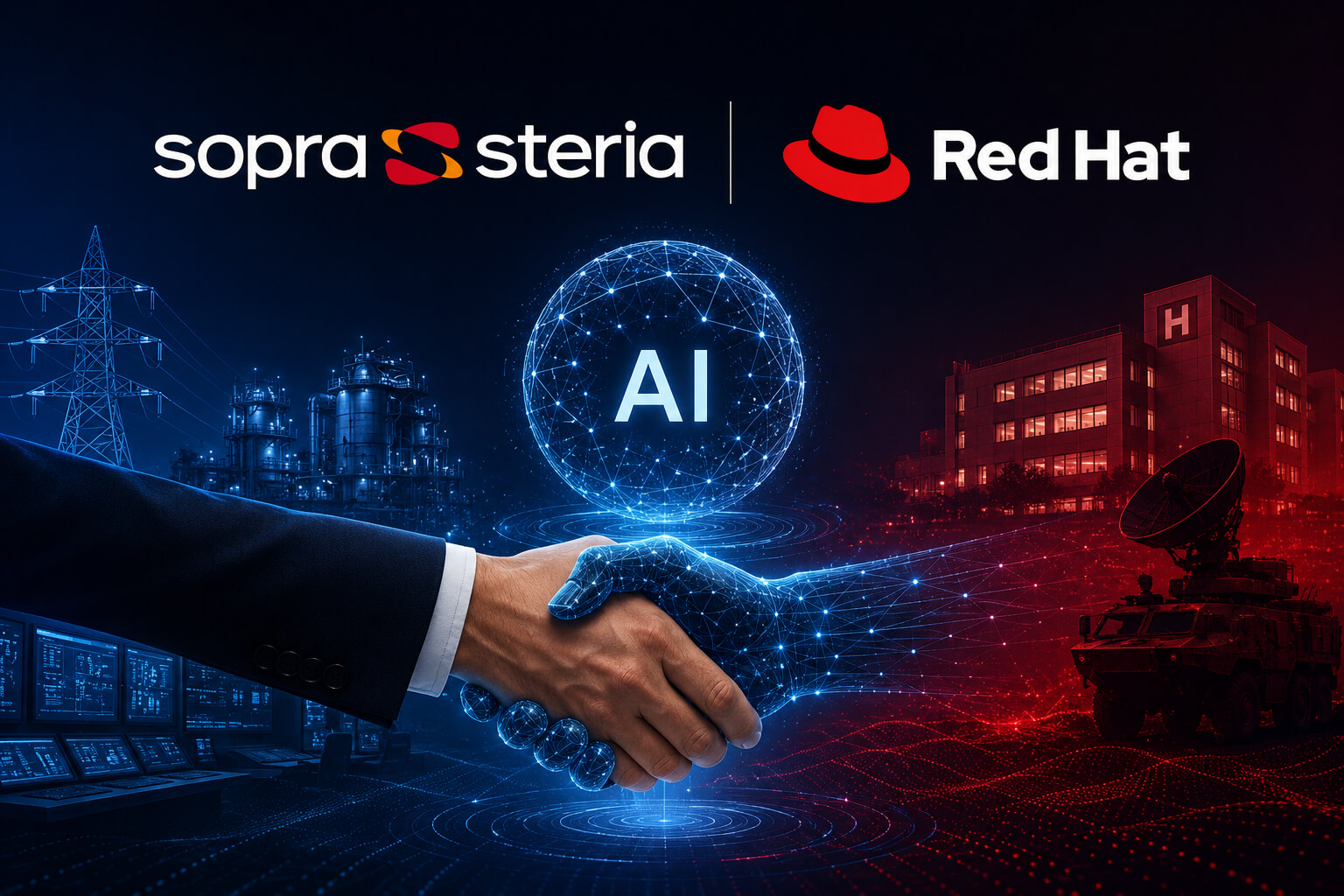
Sopra Steria has expanded its strategic collaboration with Red Hat to industrialise sovereign embedded AI. The aim is to help organisations deploy artificial intelligence in highly regulated and mission-critical environments.
The initiative is designed to support AI systems that can operate from data centres to constrained field equipment. This includes devices with limited computing power or unreliable network connectivity. As a result, the collaboration is particularly relevant for defence, public services, critical infrastructure, transport and regulated communications.
Sopra Steria and Red Hat are not just looking at cloud-based AI. Instead, they are targeting real world environments where data control, operational resilience and local decision making are a must.
Why Sovereign Embedded AI Matters
Sovereign embedded AI is AI that runs close to where data is created. It helps organisations maintain control over their data, models and infrastructure.
This is all the more important for sectors that cannot rely on permanent cloud connectivity. For example, in defence operations, public terminals, transport networks and critical infrastructure, AI systems may need to continue operating when central systems are down.
With AI processing now closer to devices in the field, organizations can reduce latency and improve continuity. In addition, they can maintain tighter control over sensitive information.
From AI Experiments to Production Systems
Many organisations have tested AI through pilots and proof-of-concept projects. However, moving those experiments into secure, reliable, production-ready systems remains a major challenge.
Sopra Steria and Red Hat aim to address that gap by combining open source technologies with integration, security, and operational expertise. Red Hat provides the open technology foundation. Meanwhile, Sopra Steria integrates and operates the systems for deployment in regulated environments.
The companies say the approach is intended to help organisations move from experimental AI pilots to production-scale intelligence.
Red Hat Technologies Behind the Initiative
The expanded collaboration uses a hybrid cloud environment built around Red Hat technologies.
Red Hat OpenShift AI supports model training and lifecycle management. It helps organisations manage AI development in a centralised environment. Meanwhile, Red Hat Device Edge enables lightweight AI models to run on constrained field equipment. In addition, Red Hat Edge Managersupports fleet-wide maintenance and updates, including for devices with degraded or intermittent connectivity.
Together, these tools are designed to create an end-to-end AI lifecycle. This lifecycle can support both centralised development and distributed field deployment.
Key Use Cases for Sovereign Embedded AI
The collaboration targets several practical use cases across critical sectors.
In transport and fleet logistics, embedded AI could help detect anomalies in real time. It could also improve predictive routing directly on electronic boards within mobile networks.
In public terminal infrastructure, AI could support local diagnostics and secure data filtering for health or security terminals. This is possible even when those terminals are disconnected from central systems.
In regulated communications and signal processing, distributed AI inference could run on low-power field devices. This would help reduce latency and enable faster local processing.
Open Standards and Sovereign AI
Sopra Steria describes the initiative as its first industrialised edge AI offering built entirely on open standards. This is significant because open standards can reduce vendor lock-in. Additionally, open standards give organisations more control over how their AI infrastructure is built, deployed, and governed.
For governments, defence agencies, and regulated industries, that control is becoming a central part of AI adoption. As AI becomes more embedded in operational systems, organizations are looking for ways to balance innovation with sovereignty, security and compliance.
What it means for the AI industry
The Sopra Steria/Red Hat partnership is indicative of a wider trend in enterprise AI — the transition from cloud-only experimentation to operational AI systems that can run at the edge in a secure manner.
As demand grows for sovereign AI, companies are increasingly focusing on infrastructure that supports local processing. They are also adopting hybrid cloud management and secure deployment across distributed environments.
For critical sectors, the next stage of AI adoption may depend less on flashy generative AI demos. Instead, it may depend more on whether AI can work reliably in the field, under strict operational conditions.
Sopra Steria and Red Hat’s expanded collaboration shows how open source infrastructure and systems integration could play a larger role in that transition.
Conclusion
Sopra Steria and Red Hat are extending their partnership to industrialise sovereign embedded AI for critical and regulated sectors. By combining hybrid cloud, edge computing, open standards, and AI lifecycle management, the collaboration aims to bring production-ready AI closer to where decisions are made.
For defence, public services, transport, and critical infrastructure, this could mark an important step toward AI systems that are not only intelligent, but also resilient, secure, and sovereign.
