


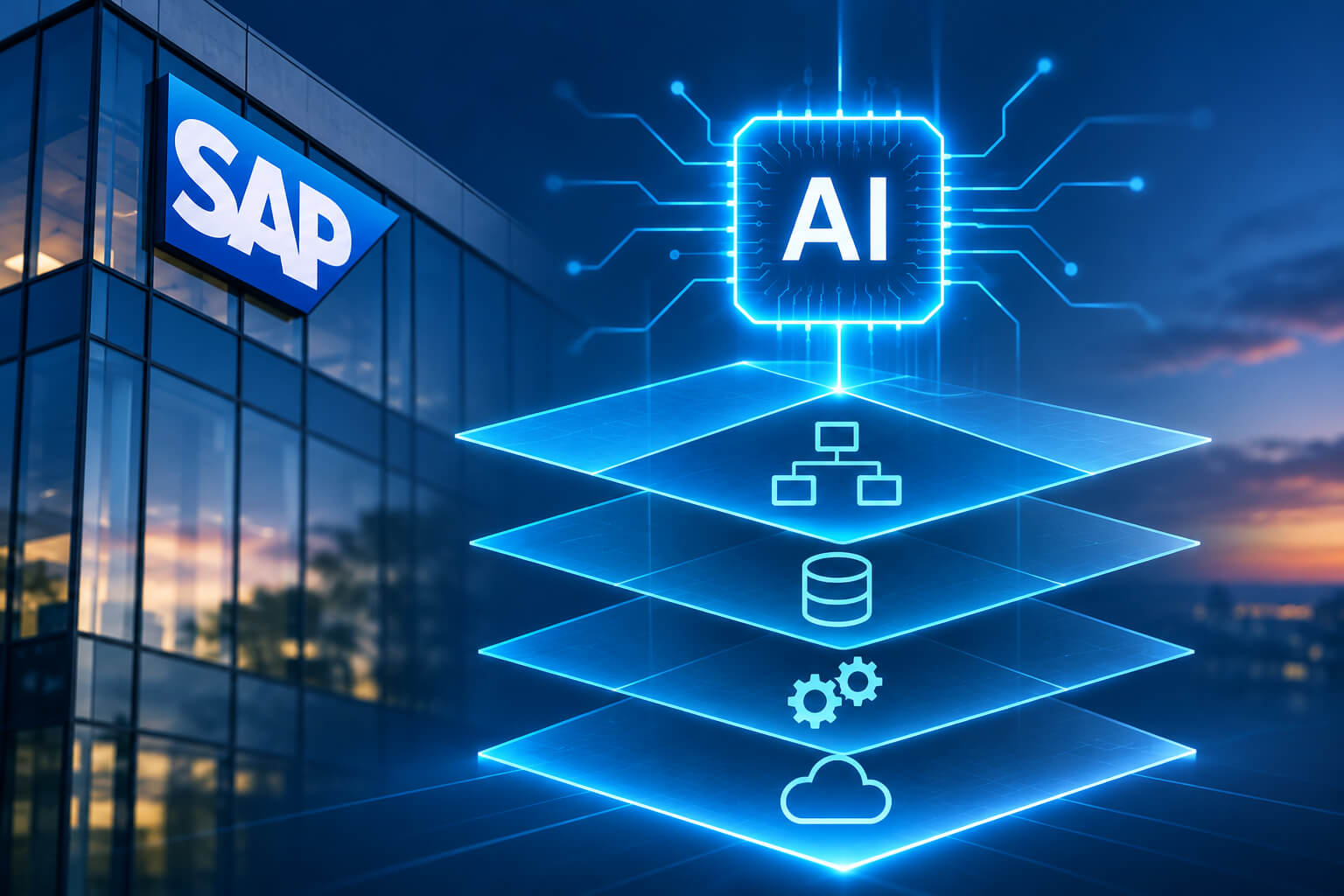
Artificial intelligence is spreading across businesses faster than many organizations can adapt. Companies are launching AI assistants, automating workflows, and experimenting with intelligent agents. Yet turning those investments into measurable business results remains difficult.
SAP believes the problem goes deeper than choosing the right AI model.
Enterprise architecture, the framework connecting an organization’s technology, data, and business processes, is emerging as a critical factor in whether AI projects succeed or struggle.
As businesses move toward more autonomous AI systems, disconnected applications, unreliable data, and outdated infrastructure are becoming harder to ignore. AI may be getting smarter, but the systems supporting it are not always keeping pace.
Why Enterprise Architecture Matters for AI Adoption
Enterprise architecture has traditionally helped organizations manage technology infrastructure, integrate applications, and align IT systems with business requirements. With artificial intelligence becoming part of daily operations, that responsibility is expanding.
AI systems need access to accurate information, but access alone is not enough. They also need to understand how different applications interact, how business processes operate, and which rules govern particular decisions.
A customer record might exist across several platforms, including sales, accounting, and customer support systems. Each application holds part of the information, but an AI assistant may struggle to understand the complete customer relationship when those systems remain disconnected.
Enterprise architecture helps establish the structure needed to connect these environments. Without it, companies risk building AI applications that perform well during demonstrations but struggle when introduced into complex business operations.
Poor Data Quality Is Slowing Enterprise AI Progress
Businesses have accumulated enormous amounts of information over the years. Unfortunately, much of that data remains fragmented across legacy systems, cloud platforms, and individual departments.
SAP identifies data quality, missing business context, weak governance, and architectural debt as major challenges affecting enterprise AI adoption.
These problems become more visible when companies attempt to scale AI beyond small experiments. An AI assistant might retrieve information from several databases, but conflicting records or inconsistent definitions can lead to unreliable results.
Legacy technology creates another obstacle. Older applications were not necessarily designed to communicate with modern AI systems, making integration more complicated and expensive.
The challenge is not simply collecting more information. Businesses need to make existing data consistent, accessible, and understandable before expecting AI to deliver dependable outcomes.
SAP Highlights the Importance of Business Context in AI Systems
One of the biggest limitations of enterprise AI is its ability to understand what information actually means within a specific organization.
SAP emphasizes that successful AI systems require several interconnected layers of context, including data relationships, business knowledge, governance requirements, operational processes, and company-specific policies.
These layers help AI applications interpret information rather than simply retrieve it.
For example, an AI agent processing a purchase request must understand more than the supplier’s name and the transaction amount. It needs to recognize approval limits, purchasing procedures, budget restrictions, and the responsibilities of different employees.
Without that knowledge, an automated system could recommend actions that conflict with company policy.
Providing business context allows AI applications to operate more accurately within established workflows. It also becomes increasingly important as organizations move toward systems capable of making decisions with less direct human involvement.
AI Agents Are Changing Enterprise Technology Requirements
The growing popularity of agentic AI is putting additional pressure on enterprise technology infrastructure.
Unlike conventional AI chatbots, which mainly respond to questions, AI agents can perform tasks, interact with applications, and coordinate activities across multiple systems.
That level of automation requires reliable connections between enterprise software, databases, and business processes.
SAP encourages organizations to develop AI agents as reusable capabilities rather than isolated solutions designed for individual applications. This approach can make it easier to maintain AI systems as business requirements change.
Standardized integration technologies, including Model Context Protocol (MCP), may also help AI agents interact with different tools and information sources.
Flexibility matters because enterprise systems rarely remain unchanged. Businesses regularly upgrade applications, migrate infrastructure, and introduce new platforms.
AI applications built around rigid integrations could become difficult to maintain when those changes occur.
AI Governance Becomes More Important as Automation Expands
As AI systems take on more responsibilities, businesses face growing questions about security, accountability, and oversight.
An AI agent might be capable of retrieving employee records, processing financial information, or initiating transactions. That does not mean it should have unrestricted access to those activities.
SAP highlights the need to incorporate governance into enterprise AI architecture rather than treating it as an additional requirement after deployment.
Organizations must establish clear permissions, monitor AI activities, and ensure automated systems follow internal policies.
A financial AI assistant, for instance, should recognize when a transaction requires management approval. An employee-facing chatbot should also respect restrictions surrounding confidential personnel information.
These safeguards become especially important when AI agents operate across several business applications.
Companies need to understand what their AI systems are doing, which information they are using, and when human intervention is required.
Enterprise Architects Are Taking on a Larger Role in AI Transformation
The increasing complexity of enterprise AI is changing the responsibilities of enterprise architects.
Their work is no longer limited to designing technology infrastructure or maintaining connections between applications. They are becoming more involved in determining how AI fits into broader business operations.
Enterprise architects must evaluate whether existing systems can support new AI capabilities, identify potential integration problems, and help organizations prioritize technology investments.
They also need to understand business objectives.
Introducing AI into a poorly designed workflow may simply automate existing inefficiencies. An enterprise architect can help identify those weaknesses before an organization invests heavily in automation.
Communication is another important part of the role. Technical teams, business executives, and operational departments need a shared understanding of what AI can realistically accomplish.
Without that coordination, AI projects may remain disconnected experiments rather than becoming useful business capabilities.
What Enterprise Architecture Means for the Future of Business AI
The next stage of enterprise AI adoption may depend less on introducing new tools and more on improving the systems that support them.
Businesses investing in advanced AI models still need reliable data, connected applications, clear governance policies, and well-defined processes.
Enterprise architecture provides a framework for bringing those elements together.
For organizations planning to expand their use of AI agents, the challenge is particularly significant. Automated systems must operate across departments while respecting business rules and maintaining security.
SAP’s perspective reflects a broader shift in enterprise technology. AI is moving beyond individual productivity features and becoming part of how organizations manage operations and make decisions.
Companies that ignore their underlying technology architecture may find themselves spending more on AI without achieving the results they expected.
The real competitive advantage may not come from deploying the largest number of AI tools. It could come from building an organization where those tools can work together effectively.
Sources
- SAP News Center — Why Enterprise Architecture Is Becoming Key to Successful AI — November 20, 2026. SAP News Center
- SAP Architecture Center — AI-Native Architecture: Executive Summary. SAP Architecture Center
- SAP News Center — The Operational Backbone of the Autonomous Enterprise — September 22, 2026. SAP News Center
