


Cities used to wait for problems to show up. Traffic builds up, then officials respond. Pipes break, then repair teams arrive. Housing pressure grows, then planners try to catch up. But AI in urban innovation is beginning to change that rhythm, making the old reactive approach feel outdated.
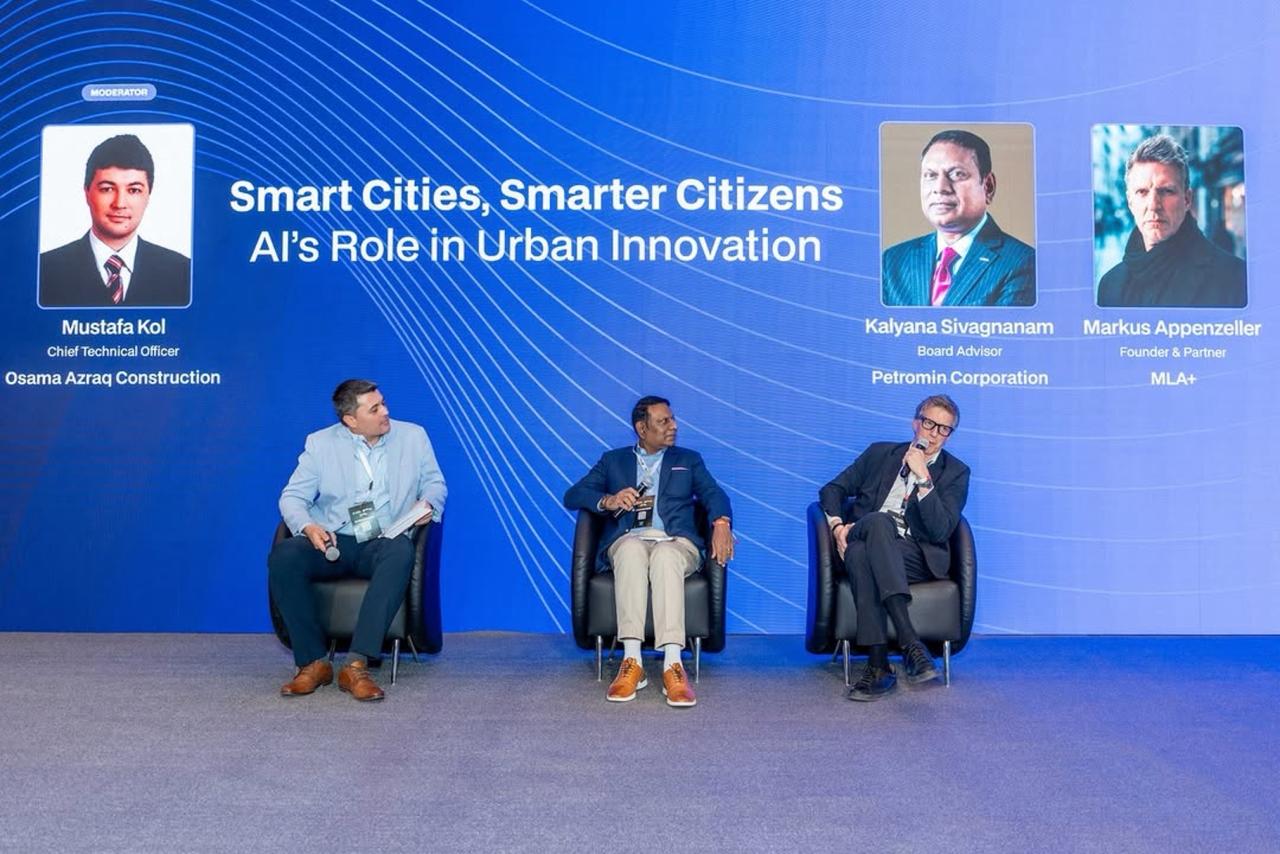
At the Smart Infra fireside chat “Smart Cities, Smarter Citizens: AI’s Role in Urban Innovation,” the conversation focused on a different kind of city model. One where artificial intelligence helps urban systems act earlier, respond faster, and understand citizen needs in real time.
The session was moderated by Mostafa Kol, Chief Technical Officer at Osama Azraq Construction, with insights from Kalyana Sivagnanam, Board Advisor at Petromin Corporation, and Markus Appenzeller, Founder & Partner at MLA+. The discussion moved across AI citizen services, automated planning, autonomous transit, computer vision, and digital twins for infrastructure resilience.
From Reactive Cities to Proactive Services
Most city systems still work in a reactive way. Something goes wrong, a report is filed, a department reviews it, and action follows. Sometimes quickly. Sometimes not.
AI changes the timing.
With real-time data, predictive analytics, and connected urban platforms, cities can move closer to proactive service delivery. That means identifying risks before they become public complaints, adjusting services based on live demand, and giving citizens faster support without making them chase different offices for answers.
This is where AI citizen services become important. Not as another chatbot slapped onto a government website, but as part of a larger city operating system. A system that can understand patterns across transport, utilities, housing, public safety, and infrastructure.
A smarter city should not only collect data. It should know what to do with it.
The Risk of Bias in Automated Urban Planning
The fireside chat also raised a serious question: how do cities prevent AI bias in automated urban planning and housing allocation?
That part matters. A lot.
Urban planning already affects who gets access to housing, transport, jobs, public spaces, and essential services. If AI systems are trained on biased data or built without proper safeguards, they can repeat old inequalities at a much larger scale.
This is one of the uncomfortable sides of smart city innovation. The technology may look clean, but the decisions behind it can carry real social consequences.
Technical safeguards need to be built into the system from the start. That includes transparent data practices, regular audits, human review, fairness testing, and clear accountability when automated systems influence planning or housing decisions. Cities cannot afford to treat AI as neutral by default.
It is not neutral just because it is digital.
Autonomous Transit Meets Old City Layouts
Another major theme was autonomous transit. The idea sounds futuristic, but the problem is very practical: most cities were not designed for autonomous vehicles.
They have old road networks, dense intersections, informal pedestrian patterns, mixed traffic behavior, aging signage, and layouts that were built long before computer vision entered the conversation.
This is where AI has to work with reality, not a perfect simulation.
Computer vision can help autonomous transit systems understand road conditions, detect pedestrians, manage lane behavior, and adapt to complex urban environments. But integration will not happen overnight. Cities need infrastructure upgrades, traffic data, mapping systems, policy support, and strong safety standards before autonomous mobility can become part of daily life.
The challenge is not only making vehicles smarter. It is making the city ready enough to support them.
Digital Twins Could Help Cities See Problems Earlier
The discussion also explored AI-driven digital twins and their role in preventing urban infrastructure failure.
A digital twin is more than a 3D model. In a city context, it can act like a living simulation of roads, bridges, utilities, buildings, energy systems, and other critical assets. When connected with real-time data, it can help planners see stress points before they turn into breakdowns.
That matters because urban infrastructure often fails quietly before it fails publicly.
A bridge does not suddenly become weak in one day. Drainage systems do not collapse without warning signs. Power networks, transport corridors, and public facilities all produce signals. The problem is that cities often miss them, or the signals sit across separate departments that do not talk to each other well enough.
AI-driven digital twins could change that. They can help city leaders test scenarios, predict failures, plan maintenance, and decide where to invest before the damage becomes expensive or dangerous.
Smart Infrastructure Needs Human Trust
The phrase “smart city” can sound cold if it only focuses on systems, sensors, and automation. The fireside chat brought the conversation back to citizens.
A smarter city should not simply be more automated. It should be more livable.
That means AI must improve how people experience the city: shorter delays, safer roads, fairer services, better housing decisions, cleaner infrastructure management, and faster response when something goes wrong.
But trust will decide whether citizens accept these systems. People need to know how AI is being used, what data is being collected, who controls the decisions, and how mistakes can be challenged. Without that trust, even the most advanced urban platform can become another source of public frustration.
Urban Innovation Is Becoming Real-Time
The biggest takeaway from the fireside chat was that urban innovation is shifting from slow planning cycles to real-time intelligence.
Cities are becoming more complex. Climate pressure, population growth, mobility demand, housing shortages, and aging infrastructure are all hitting at once. Traditional city management cannot always keep up.
AI offers a way to see more, predict earlier, and act faster. But the technology has to be designed carefully. It needs safeguards against bias, practical integration with old infrastructure, and a clear focus on citizen benefit.
Smart cities are not just about smarter systems.
They are about whether citizens actually feel the difference.
