


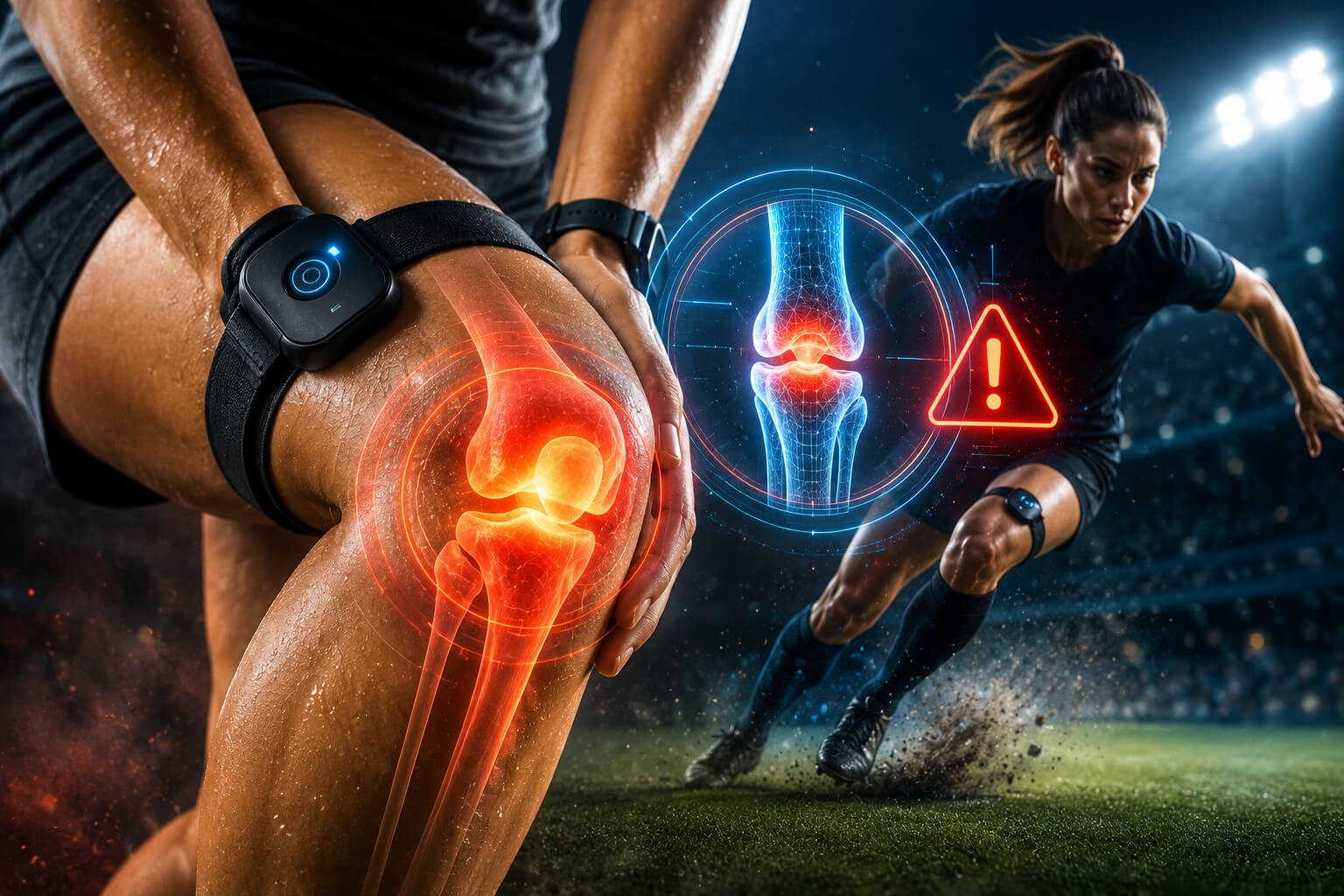
A bad landing. A sharp pivot. A foot planted for a fraction of a second too long. Now, innovative solutions like an AI wearable for ACL injury prevention are offering hope for athletes and active individuals.
That can be enough to tear an anterior cruciate ligament, or ACL — an injury capable of taking an athlete out of competition for months.
Researchers at the University of South Florida are working on a different approach to the problem: instead of dealing with the injury after it happens, use artificial intelligence to recognize dangerous movement before the ligament reaches that point.
The team is developing an AI-powered wearable for ACL injury prevention that could detect risky biomechanics while an athlete is moving and send an immediate warning. The idea is surprisingly practical. If the system notices the athlete approaching a dangerous movement pattern, a vibration or similar alert could give them a chance to correct it.
AI Is Looking for the Movements Humans Might Miss
The research brings together artificial intelligence, biomechanics and years of human-motion analysis. Dr. Nathan Schilaty of USF Health and John Templeton of USF’s Bellini College of Artificial Intelligence, Cybersecurity and Computing have been studying whether machine learning can recognize combinations of biomechanical variables associated with ACL rupture.
That matters because an ACL injury isn’t always the result of somebody crashing directly into the knee.
According to Schilaty, roughly 75% to 80% of ACL injuries occur in noncontact situations, including sudden deceleration, awkward pivoting and improper landings. Those moments happen quickly. To a coach standing on the sideline, the difference between an ordinary landing and a potentially dangerous one may be almost invisible.
A machine-learning system doesn’t have to watch movement the same way a person does. It can examine several biomechanical measurements together and hunt for combinations associated with higher injury risk. That’s where things get interesting.
Researchers Reported Up to 90% Accuracy Near Rupture Events
The wearable concept builds on research published in Scientific Reports in 2026. The researchers tested multiple machine-learning models to identify lower-extremity biomechanical predictors associated with ACL rupture. The reported results were notable.
The models achieved 86% accuracy when distinguishing pre-rupture conditions from ACL rupture and 90% accuracy when identifying conditions immediately preceding rupture events.
That doesn’t mean an algorithm can look at an athlete and announce that an ACL tear will happen in five seconds. The researchers aren’t making that claim.
What the AI appears capable of doing is recognizing when movement enters a biomechanical region associated with substantially greater risk. That distinction matters. This is closer to a warning system than a crystal ball.
From Research Data to a Wearable Knee Sleeve
Now comes the harder part: getting the technology out of a controlled research environment.
Schilaty and Templeton envision a wearable sleeve or sensor system that continuously collects movement data while an athlete trains or competes.
AI would analyze those measurements and look for the high-risk patterns uncovered in the team’s research. When the athlete begins approaching one of those patterns, the wearable could respond immediately — potentially with a haptic vibration.
- No trainer needs to yell across the field.
- No athlete needs to stop and review a video.
- The warning happens while they’re moving.
The researchers also identified a core set of biomechanical features that remained useful across several machine-learning models. Those findings could help determine which sensors actually need to be built into the eventual wearable, rather than loading the device with hardware that doesn’t contribute much to predicting risk.
One Football Player Knows Exactly What Is at Stake
The USF research isn’t being framed around an abstract injury. USF football player Jaden Alexis has experienced the consequences repeatedly.
Alexis tore the ACL in his right knee after a collision during preseason football camp. Following roughly a year of recovery, he later tore the ACL in his left knee in 2024 and suffered another partial tear to that knee in 2025. His experience illustrates why preventing even a portion of these injuries could matter.
ACL surgery can cost between $20,000 and $40,000, according to USF, while recovery can take around a year. Beyond surgery and rehabilitation, athletes also face the difficult process of rebuilding confidence in a knee after returning to sport. An early warning doesn’t need to prevent every injury to become useful. It needs to prevent enough of them.
The Technology Isn’t Ready for the Locker Room Yet
There’s an important catch. This is still developing technology, not a commercially proven ACL prevention device that athletes can buy and rely on today.
The researchers are seeking additional funding to expand testing and move the technology toward commercialization. Medical-device company Excite Medical has licensed the technology from USF, which could help move development beyond the research stage.
Real-world validation will be crucial. Athletes don’t move in clean laboratory conditions. They sprint, twist, collide, fatigue and change direction under wildly different circumstances.
A system that recognizes risky biomechanics in experimental data has to prove it can provide useful warnings in that messier environment without constantly buzzing athletes with false alarms. That’s a much higher bar.
AI Could Shift Sports Technology From Tracking to Intervention
Wearable sports technology has spent years telling athletes what already happened: how far they ran, how quickly they moved, how hard they trained or how their body recovered. This research points toward something more immediate.
A wearable could potentially recognize a dangerous movement as it develops and intervene before the athlete completes it. That changes the role of the device. It isn’t merely collecting statistics anymore. It’s becoming an active feedback system.
And ACL injuries are an unusually compelling test case because so many happen without direct contact. The bigger question is whether the same combination of wearable sensors, biomechanics and machine learning could eventually identify other injury-prone movement patterns.
For now, USF’s researchers are focused on the knee. The goal isn’t an AI that somehow knows an injury is inevitable. It’s a device that recognizes when an athlete is getting dangerously close — and gives them a warning while there’s still time to move differently.
Sources
- Medical Xpress — “ACL injuries may get an early-warning system through AI and wearable sensors”
- University of South Florida — “USF researchers develop AI system that predicts ACL injuries before they happen”
- Scientific Reports — “Utilization of machine learning to identify lower extremity biomechanical predictors of rupture in a validated cadaveric model of ACL injury”
