


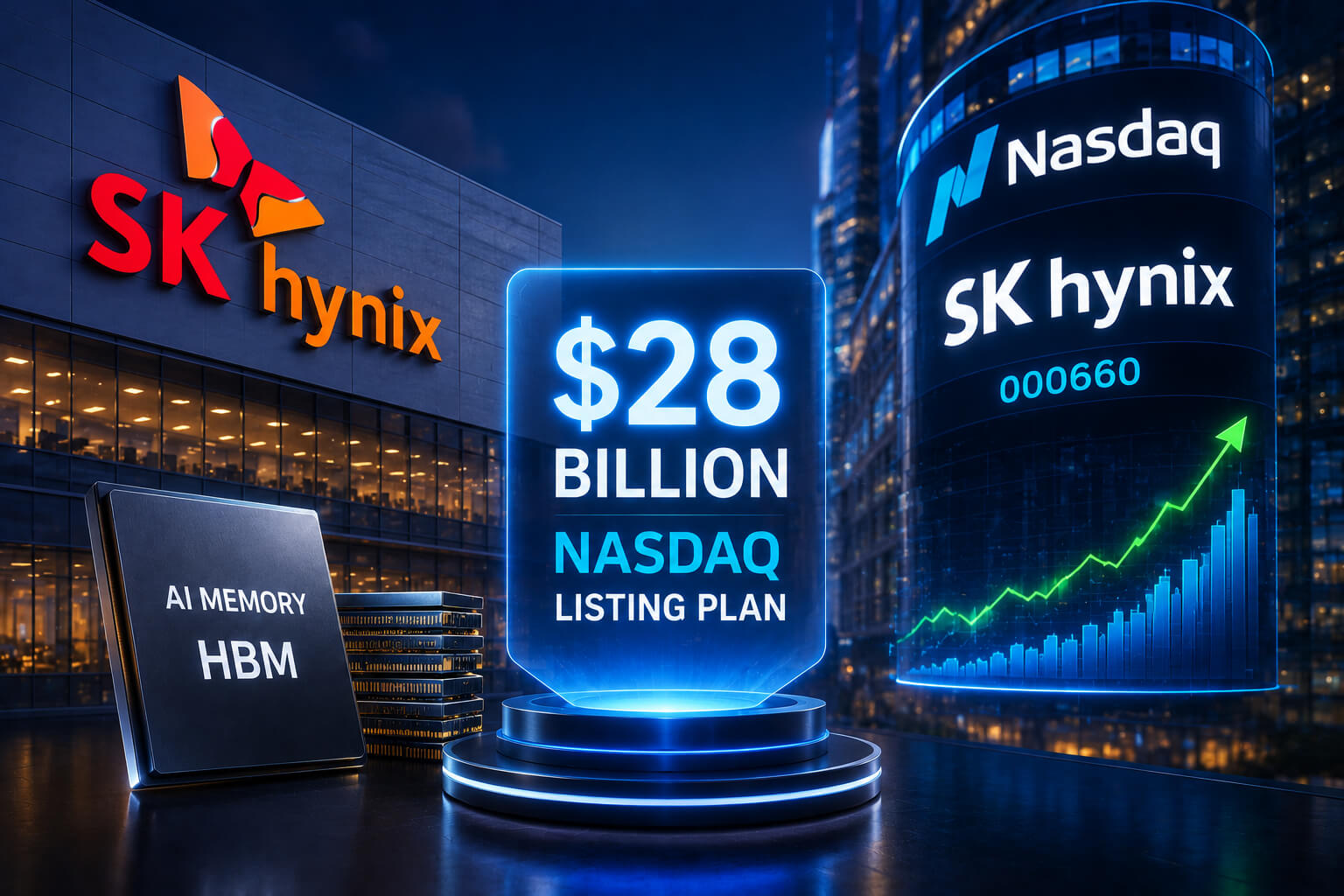
SK Hynix is heading toward Wall Street at a very interesting moment.
The South Korean memory chipmaker is reportedly preparing a US listing worth about $28 billion, a move that would place the company directly in front of American investors while the AI chip boom is still running hot. The listing comes through American depositary receipts on the Nasdaq, giving US investors a simpler way to buy into one of the companies sitting close to the center of the AI infrastructure race.
This is not just another overseas listing. SK Hynix has become one of the most watched names in high-bandwidth memory, the kind of memory used inside advanced AI accelerators. Without fast memory, powerful AI chips cannot move data quickly enough. That is why HBM has become a quiet but important part of the AI supply chain.
Why SK Hynix Matters in the AI Boom
When people talk about the AI chip race, Nvidia usually gets most of the attention. Fair enough. Its GPUs are everywhere in the conversation.
But those GPUs need memory. A lot of it. Fast memory. Expensive memory. That is where SK Hynix has built its advantage.
The company supplies high-bandwidth memory to major technology customers, including Nvidia and Google, according to the report. As demand for AI servers, data centers, and accelerator chips keeps climbing, memory suppliers have started looking less like background players and more like critical infrastructure companies.
That shift has helped SK Hynix’s Seoul-listed shares rise sharply in 2026. Investors are not only betting on chips anymore. They are betting on the full AI stack: compute, networking, energy, data centers, and now memory.
What the Nasdaq Listing Includes
SK Hynix plans to sell 17.79 million new shares through American depositary receipts. Under the structure, ten ADRs will represent one common share. The indicative price range is expected to be based on the company’s Seoul trading price, with final pricing set before trading begins on Nasdaq.
The deal has been reported at around $28 billion, while some estimates have placed it closer to $29 billion. That difference is not unusual before final pricing is locked.
Either way, the number is huge.
For investors in the US, the listing offers a cleaner route into SK Hynix without having to go through the Korean market. For SK Hynix, it opens the door to deeper US capital at a time when AI-related semiconductor names are still attracting heavy attention.
AI Memory Is Becoming a Market of Its Own
The AI boom is creating strange winners. Some are obvious. Cloud companies. GPU makers. Data center builders.
Others were easier to overlook a few years ago.
Memory chips used to be treated as a cyclical, sometimes punishing business. Prices rise, companies expand production, supply catches up, prices fall, and everyone remembers why memory stocks can be brutal. That pattern has not disappeared.
But AI has changed the current setup.
High-bandwidth memory is harder to produce, more closely tied to advanced AI systems, and more strategically important than ordinary memory chips. SK Hynix has benefited from that shift because it has been one of the leaders in HBM supply.
That makes the Nasdaq listing more than a fundraising event. It is a market test. How much are US investors willing to pay for direct exposure to AI memory?
The Risk Nobody Wants to Ignore
There is still a catch.
Memory has always been cyclical. That is the part investors cannot simply delete from the story. SK Hynix and Micron both faced heavy pressure during the previous demand downturn, and new capacity being added today could become a problem later if supply starts running ahead of demand.
That is the uncomfortable side of the AI trade. Companies are building aggressively because demand looks enormous. But aggressive building can create oversupply if forecasts turn too optimistic.
SK Hynix is not immune to that. No memory company is.
The stock’s sharp rise also means expectations are already high. A Nasdaq listing could bring more demand from US investors, but it also brings more scrutiny. Every comment about AI memory sales, production capacity, pricing, and customer demand will matter.
South Korea’s Bigger AI Chip Push
The listing also fits into a wider South Korean push to strengthen its position in chips and AI infrastructure. Seoul has backed a large chip and AI plan involving major players such as Samsung and SK Hynix, while SK Hynix has also announced major investment plans for new plants, including NAND flash facilities.
This is becoming a national competition as much as a corporate one.
The US wants stronger semiconductor supply chains. China is pushing domestic chip development. South Korea already has memory giants. Japan is trying to rebuild parts of its chip industry. Europe wants more control over critical technology.
AI has made semiconductors political again, not just profitable.
Why This Listing Could Be a Signal for AI Investors
SK Hynix’s Nasdaq move will show how much appetite still exists for AI-linked semiconductor exposure outside the usual names.
If investors welcome the listing strongly, it could suggest that the AI infrastructure trade still has room to run beyond Nvidia and major cloud companies. If the response is softer, it may show that investors are becoming more selective after a huge rally in AI-related stocks.
The timing is important. AI demand remains strong, but the market is already asking harder questions. Are companies spending too much on data centers? Will returns justify the scale of investment? Can AI memory demand stay tight, or will supply eventually catch up?
SK Hynix is stepping into that debate at full volume.
A Big Listing With a Bigger Question Behind It
The SK Hynix Nasdaq listing is about money, yes. Around $28 billion is not a small deal.
But the bigger story is confidence.
Investors are being asked to believe that AI memory will remain one of the most important parts of the next computing cycle. They are being asked to believe that high-bandwidth memory is not just having a good year, but entering a longer period of structural demand.
Maybe that is true. The AI buildout is still massive. Data centers are still expanding. Nvidia’s ecosystem still needs memory. Cloud companies are still buying.
Still, memory markets have humbled investors before.
That is what makes this listing worth watching. SK Hynix is not only selling shares in the US. It is testing how far the AI memory story can travel on Wall Street.
