


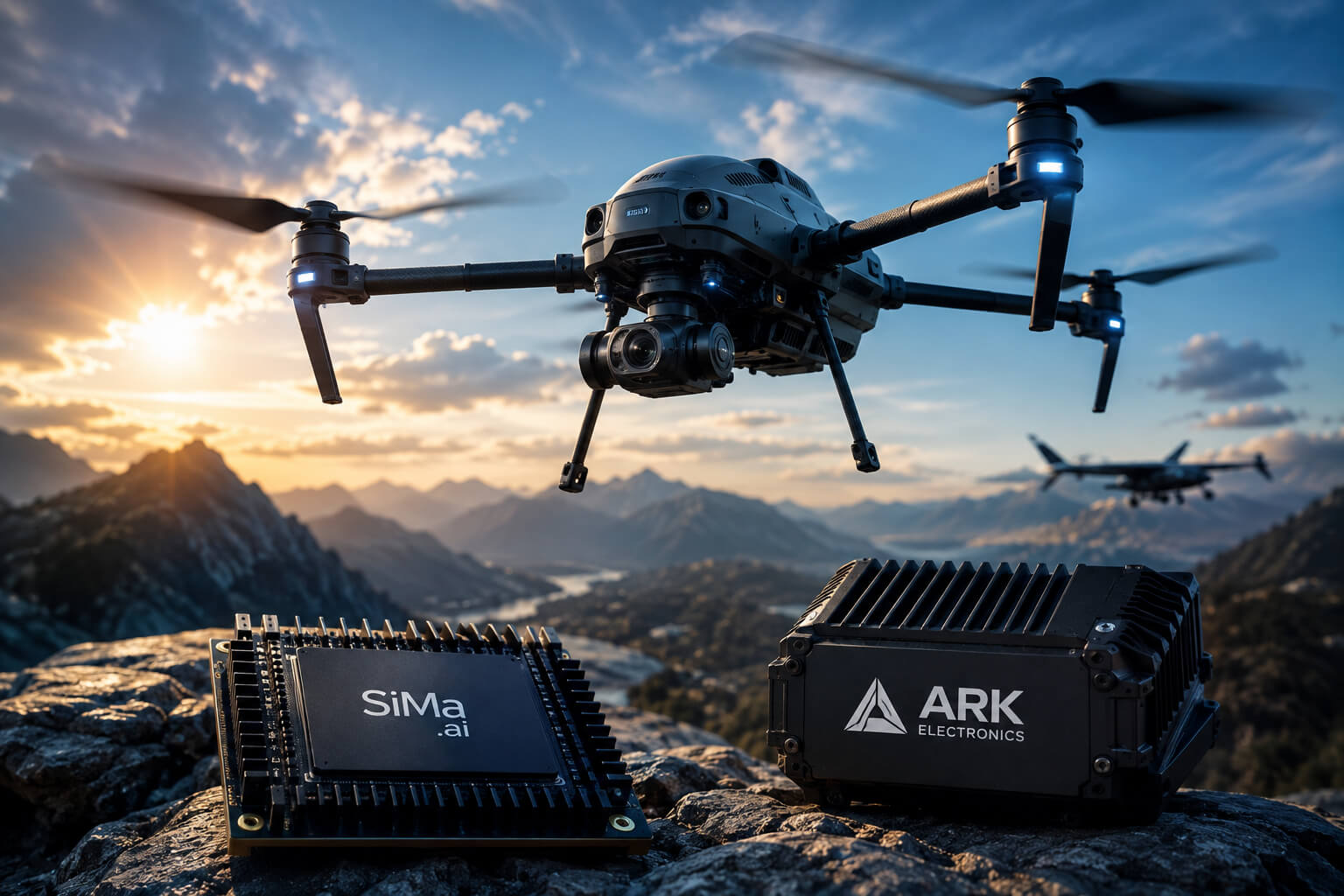
Autonomous drones are getting another hardware boost. This time, SiMa.ai ARK Electronics autonomous drones are at the forefront of the latest advancements.
SiMa.ai and ARK Electronics have formed a strategic partnership around intelligent drone development. The companies are combining AI computing with U.S.-made drone and robotics electronics.
The goal is fairly practical. They want manufacturers to build smarter drones faster, without piecing together complex hardware from scratch.
Their joint solution targets commercial, industrial, agricultural, and defense applications. It also puts more AI processing directly on the drone. That matters when connectivity is weak, delayed, or unavailable.
SiMa.ai and ARK Electronics Are Building a Ready-to-Use Drone AI Platform
The partnership centers on new ARK-SiMa.ai Modalix MLSoC Bundles. These are production-ready computing packages for drone manufacturers and system integrators. SiMa.ai provides the AI computing platform. ARK Electronics brings its experience in drone and robotics electronics. Together, they want to reduce the work needed before an intelligent drone reaches deployment. The bundles are aimed at both commercial and defense markets.
Physical AI Moves More Intelligence Onto the Drone
SiMa.ai describes its platform as Physical AI. In simple terms, the system allows machines to process AI models locally. A drone can analyze sensor data without sending everything to a remote cloud server. This can improve response times during flight. It can also reduce dependence on network connectivity. For autonomous systems, those seconds and milliseconds matter. SiMa.ai already targets drones, robotics, industrial automation, aerospace, and other edge AI applications.
Modalix MLSoC Sits at the Center of the Partnership
The joint platform uses SiMa.ai’s Modalix System-on-Module. That module runs on the company’s Modalix MLSoC architecture. It handles AI workloads inside compact edge devices. SiMa.ai also pairs the hardware with its Palette Neat development environment. The company says Palette Neat can shorten AI development cycles from months to days. That combination gives drone builders both the compute hardware and software tools needed for development.
ARK Electronics Brings U.S.-Made Drone Hardware
ARK Electronics fills a different part of the stack. The company develops electronics for drones and robotics systems. Its products include flight controllers, GPS modules, sensors, and embedded computers. ARK also offers NDAA-compliant and Blue UAS-listed hardware. That makes the company especially relevant to U.S. defense and government drone programs. Its role in the partnership includes building and validating the joint solution for the wider drone ecosystem.
Power Efficiency Is a Big Part of the Pitch
Drone AI cannot simply chase raw computing power. Weight and energy use matter just as much. Every extra watt can affect flight time. Extra hardware also adds weight. SiMa.ai and ARK are positioning the Modalix platform around those limits. They are focusing on size, weight, power, and cost, often grouped as SWaP-C. The companies say the platform can deliver stronger performance with lower power demands. That could make advanced AI more practical on smaller autonomous systems.
Compatibility Could Make It Easier for Drone Makers to Switch
SiMa.ai says the Modalix System-on-Module uses a familiar form factor. It is compatible with a leading GPU-based edge platform used across the industry. That could make adoption less disruptive for developers. Teams may be able to keep parts of their existing design approach. At the same time, they can move to a different AI computing architecture. The companies say this compatibility can reduce design risk and shorten development time.
Agriculture Could Be One of the Bigger Commercial Uses
The partnership is not focused only on military drones. Agriculture is one of the target markets. AI-enabled drones can inspect crops, identify stress, and monitor large areas. They can also process imagery during flight. That reduces the need to move every piece of data to the cloud first. Industrial inspection offers a similar opportunity. Drones can examine infrastructure and flag unusual conditions while still in the air. Those applications need strong edge computing without draining the battery too quickly.
Defense Drones Need AI That Works Without the Cloud
Defense brings a different set of requirements. Connectivity cannot always be guaranteed in contested environments. A drone may need to recognize objects or process sensor information locally. It may also need to make decisions with limited communication. That is where edge AI becomes particularly important. ARK’s background in U.S.-made defense electronics fits that requirement. SiMa.ai provides the computing layer for running AI closer to the aircraft itself.
SiMa.ai Has Been Building a Wider Drone AI Ecosystem
The ARK partnership is not happening in isolation. SiMa.ai has been steadily expanding its drone partnerships during 2026. In June, it partnered with Mistral Solutions on an autonomous drone reference design. That project also combines SiMa.ai’s Physical AI platform with specialized drone engineering.
More recently, SiMa.ai worked with AVerMedia on another production-ready drone computing solution. That platform combines Modalix with AVerMedia hardware. It delivers 50 TOPS of AI compute while using less than 10 watts, according to SiMa.ai.
The pattern is becoming clear. SiMa.ai wants Modalix to become a common AI computing layer across the drone market.
Autonomous Drones Are Moving From Experiments to Deployable Systems
For years, autonomous drone demonstrations looked impressive but often required custom engineering. That makes scaling difficult. Drone manufacturers need smaller systems, lower power consumption, and predictable integration.
This partnership goes after that problem rather than another flashy drone demo.
SiMa.ai supplies the AI platform. ARK provides hardware already familiar to drone developers. Both companies are trying to turn autonomy into something manufacturers can actually ship.
The ARK-SiMa.ai Modalix MLSoC Bundles are already available to qualified drone manufacturers and system integrators.
If that model works, the next phase of drone AI may be less about proving autonomy is possible. It will be about making autonomous intelligence cheaper, smaller, and easier to deploy.
Sources
PR Newswire — SiMa.ai and ARK Electronics Partner to Accelerate Intelligent, Autonomous Drones
Read the original announcement
SiMa.ai — Drones and Physical AI
SiMa.ai drone platform overview
