


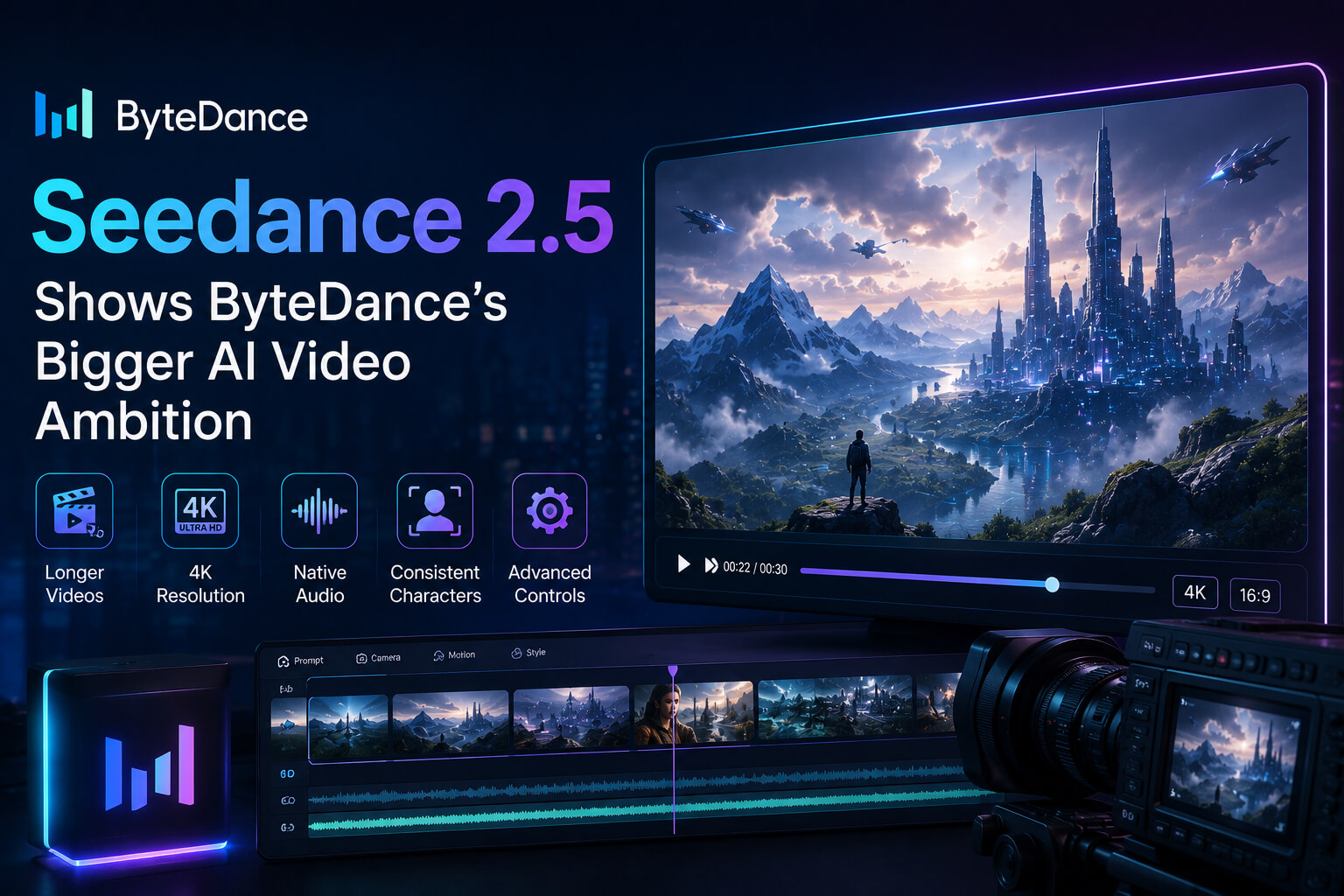
ByteDance is not slowing down in AI video. The new Seedance 2.5 AI video model is the latest demonstration of their innovation in this space.
Its next-generation model, Seedance 2.5, is already drawing attention from creators, marketers, and AI video watchers because the early previews point to a more serious production tool. Not just another short clip generator. Not just another flashy demo made for social media.
Seedance 2.5 is expected to bring sharper video quality, longer generation, better character consistency, native audio, stronger camera movement, and more flexible editing controls. ByteDance has not yet announced a full public rollout, but early previews suggest the company wants Seedance to compete more directly with the next wave of AI video platforms.
ByteDance Is Pushing AI Video Beyond Short Clips
The biggest thing people are watching is duration.
Seedance 2.5 is expected to support 30-second AI video generation from a single prompt. That sounds small until you compare it with the usual AI video workflow, where creators often stitch together several short clips, then spend extra time fixing continuity problems.
A 30-second single-take generation gives creators more breathing room. A product scene can unfold properly. A character can walk, speak, react, and move through a setting without the clip ending almost as soon as it starts. For marketing teams, that matters. For social video creators, it matters even more.
Short clips are useful. But they also feel like fragments.
Seedance 2.5 seems built for scenes.
Better Consistency Could Be the Real Upgrade
AI video still has one annoying problem: things change when they should not.
A character’s face shifts. Clothing changes slightly. Lighting jumps. Objects appear, disappear, or move in strange ways. One second the shot looks cinematic, then the next second the model forgets what it was doing.
Seedance 2.5 is expected to improve character appearance, facial details, clothing, lighting, and object placement across a video. That kind of consistency is not the loudest feature, but it may be the one creators care about most.
Because nobody wants to generate a strong opening shot and then watch the character become a different person halfway through.
Up to 50 Reference Assets Gives Creators More Control
Another expected feature is support for up to 50 reference assets.
That is a big deal for anyone trying to create repeatable visual work. Text prompts can only go so far. Sometimes creators need the AI to follow a specific character design, product shape, brand color, costume, location, or mood board.
With more reference assets, Seedance 2.5 could make it easier to keep a campaign visually connected. A brand could feed the model product shots. A creator could use character references. A filmmaker could guide the style of multiple scenes without rebuilding everything from scratch.
This is where AI video starts looking less like random generation and more like directed production.
Native Audio Makes Seedance More Than a Visual Tool
Seedance already stands out because it can generate video with speech, sound effects, and music inside the same workflow. Seedance 2.5 is expected to improve that further with better lip synchronization and dialogue timing.
That matters because audio is where many AI videos still fall apart.
The visuals may look impressive, but then the mouth movement feels off. The timing feels strange. The voice does not match the scene. The effect is close, but not quite believable.
If ByteDance can make synchronized audio feel natural, Seedance 2.5 could become much more useful for explainer videos, ads, social storytelling, product demos, and short branded films.
4K Output Points Toward Professional Use
Seedance 2.5 is also expected to support 4K video output. That moves the conversation away from casual AI clips and closer to professional production use.
Higher resolution means sharper scenes, better textures, cleaner details, and more room for post-production. It does not automatically make the video good, of course. Bad direction in 4K is still bad direction.
But for creators who want AI video to sit inside real campaigns, resolution matters.
A blurry demo might work on a feed. A client presentation needs more polish.
Camera Movement Is Becoming a Serious Battleground
The early Seedance 2.5 previews also point to smoother cinematic camera movement, including tracking shots, orbit shots, and dynamic transitions.
This is one of the areas where AI video tools are starting to separate themselves. You can also see this broader shift in how AI companies are competing beyond model benchmarks.
Basic motion is no longer enough. Creators want scenes that feel directed. They want the camera to move with intention. They want the shot to follow a person, reveal a product, shift mood, or create tension without collapsing into visual noise.
Seedance 2.5 appears to be moving in that direction.
Editing Smaller Sections Could Save Creators Time
One of the more practical expected updates is flexible editing.
Instead of regenerating an entire video because one part is wrong, Seedance 2.5 may allow creators to adjust only a selected section while keeping the rest of the video intact.
That is not as flashy as 4K or 30-second generation, but it could be more useful in daily work.
A creator might love the first 20 seconds but dislike one facial expression. A brand might want to change a product angle. A marketer might need to fix text, timing, or a short moment in the scene.
Regenerating everything wastes time. Section-level editing makes AI video feel less fragile.
Faster Generation Still Needs Real Testing
Seedance 2.5 is also expected to offer faster generation performance, although official benchmarks have not been released yet.
That is worth keeping in mind.
AI video demos often look smooth because viewers only see the final result. They do not see failed generations, long wait times, prompt retries, or the editing work behind the clip. Until ByteDance shares more technical details or opens wider access, the real production speed remains uncertain.
Still, the direction is clear. AI video tools are competing not only on quality, but on workflow.
Speed matters when a creator is making one clip. It matters even more when a team is producing dozens.
Why Seedance 2.5 Matters for AI Creators
Seedance 2.5 is not just about one model update. It shows where AI video is heading in 2026.
Longer clips. Better control. Cleaner consistency. Higher resolution. Built-in audio. More editing flexibility. Less dependence on stitching together broken pieces.
That is the real story.
ByteDance already understands short-form video through TikTok. If it can connect that platform instinct with stronger generative AI tools, Seedance could become a serious player in the creative AI market.
For now, Seedance 2.5 is still mostly an early-preview story. The public rollout, pricing, access, limits, and real-world performance are still important questions.
But the ambition is obvious.
AI video is moving from “look what this model can generate” to “can this actually help people make finished work?”
Seedance 2.5 wants to answer yes.
Source: Times of AI
