


Saudi Arabia is putting more structure around artificial intelligence, and this time the focus is not just investment, data centers, or new AI products.
It is risk.
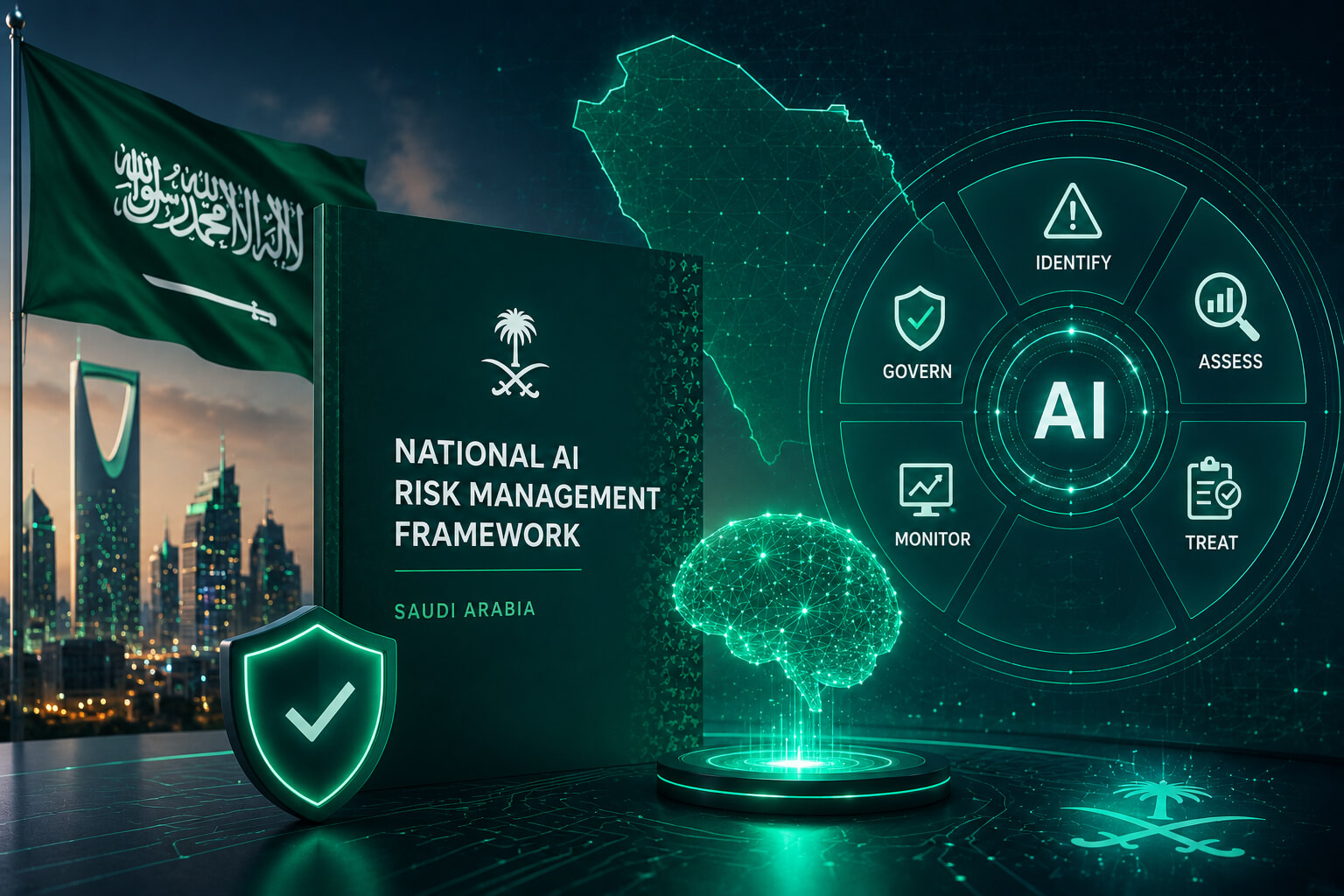
The Saudi Data and Artificial Intelligence Authority (SDAIA) has published a National Artificial Intelligence Risk Management Framework designed to help government and private entities identify, assess, treat, and monitor AI-related risks. The framework gives organizations a shared national method for handling AI systems before, during, and after deployment.
That may sound like policy language. It is. But it also says something bigger about where Saudi Arabia’s AI strategy is heading.
The Kingdom does not only want AI adoption to move fast. It wants the rules, controls, and accountability systems to move with it.
Saudi Arabia Moves AI Risk Into a National Framework
SDAIA’s new framework gives public and private organizations a common way to manage AI risk across different sectors and levels of digital maturity. It covers the full risk cycle, from defining the scope of an AI system to continuous monitoring after it is already operating.
That last part matters.
AI systems are not like traditional software that stays mostly predictable once deployed. Models can drift. Outputs can change. Decisions can be hard to explain. A tool that works safely in one environment may behave differently when data, users, or use cases shift.
SDAIA’s framework openly treats AI risk as something different from ordinary software risk. That is probably the right starting point.
The Four Phases of Saudi Arabia’s AI Risk Framework
The framework follows four connected phases.
First, organizations define the context and scope of the AI system. That means understanding where the system will be used, who it affects, what decisions it supports, and what level of risk may be involved.
Then comes risk identification and assessment. This stage looks at what could go wrong, how likely it is to happen, and how serious the impact could be.
After that, entities are expected to treat the risk. Not every problem gets the same response. Some systems may need stronger technical controls. Others may require operational changes, contractual protections, insurance, limits on use, or even full avoidance if the risk is too high.
The final phase is continuous monitoring and review. In simple terms, organizations cannot just approve an AI system once and forget about it. They need to keep watching it.
That is where AI governance often gets difficult. The launch is only the beginning.
Seven Risk Categories, One Shared Method
The framework classifies AI risks into seven main categories and is built around principles such as transparency, accountability, privacy, and integrity. SDAIA says risk levels are calculated through a matrix that connects probability with potential impact, allowing organizations to classify risks in a more consistent way.
This matters because AI regulation can easily become fragmented.
One ministry may assess risk one way. A bank may use another system. A healthcare provider may apply a stricter internal standard. A startup may have almost no formal process at all.
A national framework does not automatically fix that. But it gives everyone a common reference point.
Developers can use it while designing systems. Operators can use it when managing live AI tools. Policymakers can use it to spot regulatory gaps. That wider audience is important because AI risk does not sit in one department anymore.
Why This Matters for Saudi Arabia’s AI Push
Saudi Arabia has been building AI into its national transformation agenda for years. SDAIA is the Kingdom’s central authority for data and AI, and the new risk framework aligns with the National Strategy for Data and Artificial Intelligence.
The timing also fits the broader national push around AI in 2026. Earlier this year, Saudi Arabia designated 2026 as the Year of Artificial Intelligence, with guidelines intended to unify national efforts and promote high-impact AI initiatives across the country.
That makes this framework more than a compliance document.
It is part of the plumbing behind Saudi Arabia’s AI ambitions. Big AI programs need trust. Trust needs rules. Rules need a repeatable process.
Not exciting, maybe. But necessary.
AI Adoption Is No Longer Just About Speed
The most interesting part of the framework is what it signals.
Saudi Arabia is not slowing down on AI. But it is making clear that speed alone is not enough.
As AI spreads into predictive models, natural language processing, image and video analysis, and intelligent automation, the risk surface grows. Bias, privacy exposure, security failures, poor explainability, incorrect outputs, and uncontrolled deployment all become harder to ignore.
For businesses, this means AI projects may need stronger documentation and risk controls from the start. For government entities, it could push more consistent AI governance across departments. For developers, it means risk management can no longer be treated as something added at the end.
That is probably the real story here.
Saudi Arabia is trying to make AI governance part of the system, not a side note.
