


Key Takeaways
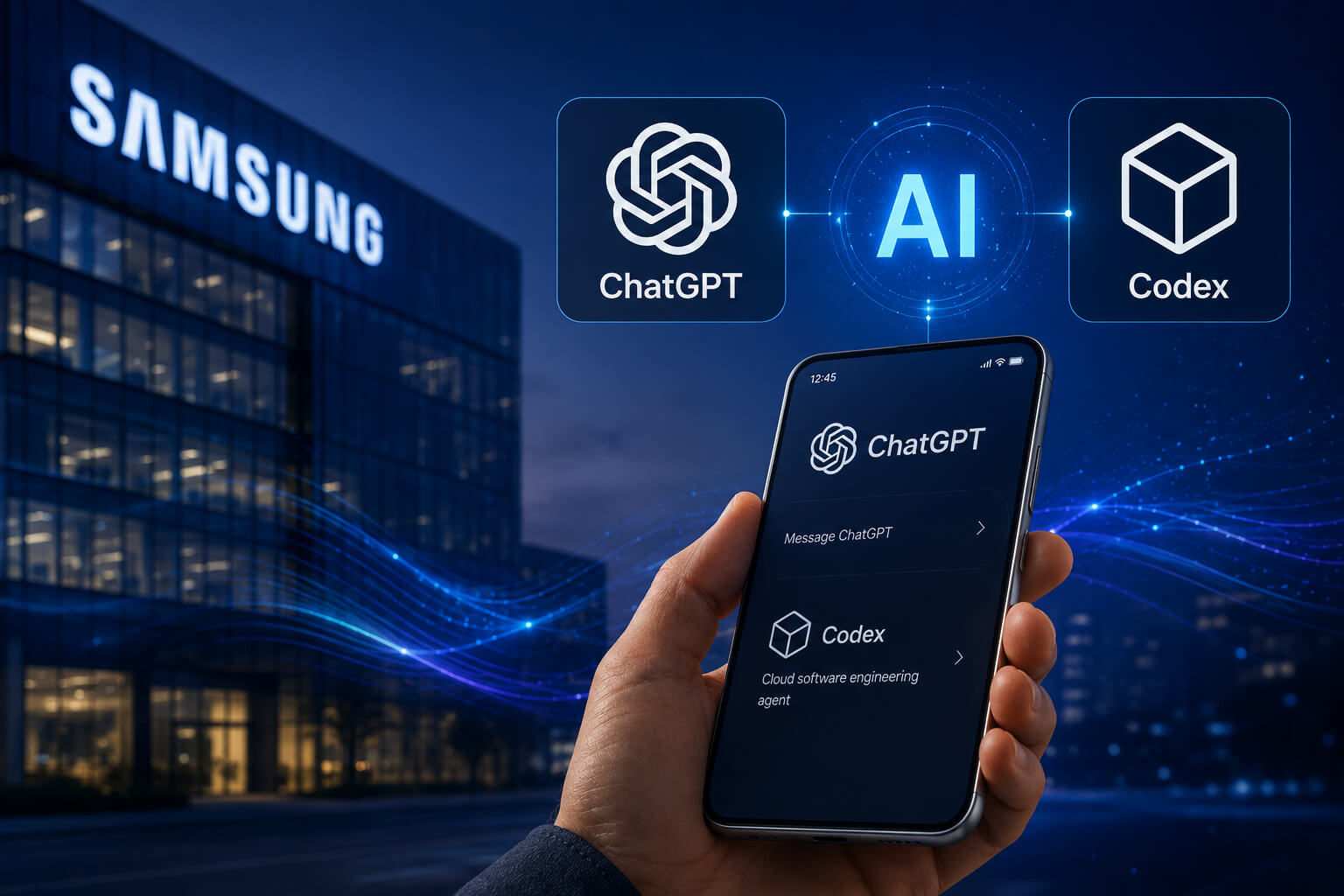
- Samsung is rolling out ChatGPT Enterprise and Codex to all Samsung Electronics employees in Korea and DX employees worldwide.
- The move follows earlier restrictions on generative AI tools caused by data security concerns.
- ChatGPT Enterprise will support tasks such as research, analysis, writing, ideation, and data interpretation.
- Codex will help developers and non-technical employees build software, automate workflows, and improve productivity.
- The deployment is one of OpenAI’s largest enterprise AI rollouts to date.
- Samsung’s decision shows how major companies are shifting from banning AI tools to adopting secure, managed enterprise AI systems.
Samsung Electronics is moving deeper into enterprise artificial intelligence with a major rollout of ChatGPT Enterprise and Codex across parts of its global workforce. The move marks a significant shift for the South Korean technology giant, which previously restricted employee access to generative AI tools because of concerns over data security and internal information leaks.
Under the new deployment, ChatGPT Enterprise and Codex will be available to all Samsung Electronics employees in Korea. The tools will also be provided to employees worldwide in Samsung’s Device eXperience division, also known as DX, which covers major consumer technology areas such as smartphones, TVs, appliances, tablets, and connected devices.
The Samsung ChatGPT rollout is being described as one of OpenAI’s largest enterprise deployments so far. It also reflects a broader trend across the tech industry: companies that once viewed generative AI mainly as a security risk are now looking for ways to adopt it through controlled, enterprise-grade systems.
Why Samsung Previously Restricted ChatGPT Use
Samsung’s cautious approach to generative AI began after concerns that employees could accidentally expose sensitive business information through public AI tools. Like many large companies, Samsung had to weigh the productivity benefits of AI against the risk of workers entering confidential code, internal documents, or proprietary data into third-party platforms.
This concern became especially important for a company involved in semiconductors, consumer electronics, software, manufacturing, and global supply chains. Any leak of internal technical data could create serious competitive and security risks.
As a result, Samsung previously limited the use of tools such as ChatGPT on company devices and internal networks. Employees were also warned not to enter personal or company-related information into generative AI services.
The new rollout suggests that Samsung is no longer treating AI adoption as an all-or-nothing decision. Rather than shutting down generative AI entirely, the company is moving in the direction of secure enterprise access with governance, access controls, and data protection.
Samsung Employees will benefit from various knowledge-based tasks with the help of the anticipated ChatGPT Enterprise. They can leverage it for information search and analysis, document drafting, idea generation, data summarization, and decision-making support.
The rollout is not limited to engineers or software teams. Samsung plans to roll out ChatGPT and Codex across technical and non-technical functions such as research and development, manufacturing, marketing, product development and corporate operations.
Samsung’s aim is not just to give employees access to an AI chatbot. The company is apparently positioning AI as a productivity platform that helps employees get tasks done faster, improve their problem-solving abilities, and innovate in multiple departments.
This is an important distinction. Many companies have started to use AI through small pilot projects or limited experiments. Samsung’s wider rollout is an example of how enterprise AI is shifting from testing phases to everyday business workflows.
Codex Expands Beyond Software Development
Codex is best known as OpenAI’s AI coding assistant, but its role is expanding beyond traditional software development. For developers, Codex can help write, review, debug, and improve code. That could be especially useful for Samsung’s software teams working on devices, apps, internal tools, and connected product ecosystems.
However, Codex is also becoming useful for non-technical teams. Employees can use it to turn ideas into internal software, build simple tools, create websites, automate repetitive workflows or prototype solutions without relying entirely on traditional development cycles.
This broader use of Codex could be important for a company like Samsung. Big companies usually have internal process bottlenecks, repetitive manual work and software needs that are unique to departments. AI coding tools can help teams get from concept to working prototype more quickly.
Why This Matters for OpenAI
Samsung’s adoption marks a major enterprise milestone for OpenAI. As one of the world’s most influential technology and manufacturing companies, Samsung’s decision to deploy ChatGPT Enterprise and Codex at scale strengthens OpenAI’s position in the corporate AI market.
The deal also strengthens the ties between Samsung and OpenAI. The two companies were already linked through AI infrastructure, with Samsung supplying the advanced memory semiconductors that are needed for next-generation AI systems.
Now, it’s moving beyond infrastructure and into workforce transformation. Samsung is not only helping power the AI industry through chips and hardware; it is also adopting AI tools internally to change how its own employees work.
Enterprise AI Is Moving From Risk to Strategy
Samsung’s decision highlights a major change in how large companies are approaching generative AI. In 2023 and 2024, many organizations responded to tools such as ChatGPT with caution, bans or tough restrictions. Their concerns were understandable: public AI tools raised questions of privacy, intellectual property, compliance and data control.
Now, the conversation is changing. Companies are looking more and more for enterprise-grade AI systems that come with security controls, user management, governance features and data protection. The goal is to realize the benefits of AI without putting the organization at unnecessary risk.
Samsung’s rollout of its own bot is a glimpse into how that balance might play out in practice. Instead of allowing unchecked use of public AI tools, it is taking a controlled approach to AI access within its corporate security setup.
Broader AI Adoption in Korea
Samsung is not the only major Korean company to adopt OpenAI tools. OpenAI has also cited growing adoption by enterprises and institutions in Korea, including by companies, universities and consumer platforms.
This suggests that Korea is a key market for enterprise AI deployment. With major technology companies, semiconductor manufacturers, telecom firms, entertainment platforms, and software businesses all exploring AI, the country could play a growing role in how generative AI is adopted at scale.
Samsung’s move may also influence other large companies that are still deciding how to handle employee AI access. If a company of Samsung’s scale and security concerns can move toward enterprise AI adoption, other global firms could follow a similar path.
What’s Next
The Samsung ChatGPT rollout may be a blueprint for how large enterprises will adopt generative AI in the post-previous restrictions. The challenge will be whether companies will be able to manage the productivity gains well with strong internal controls.
For Samsung employees, Codex and ChatGPT Enterprise could support everyday workflows. These may include research, product planning, software development, manufacturing, marketing, and corporate operations.
For OpenAI, the deployment strengthens its enterprise strategy. It also shows that large companies may use AI tools at scale when security and governance are built into the system.
Samsung’s decision also sends a strong message to the broader business community: generative AI is no longer experimental. It is, for large companies, becoming a core workplace technology.
