


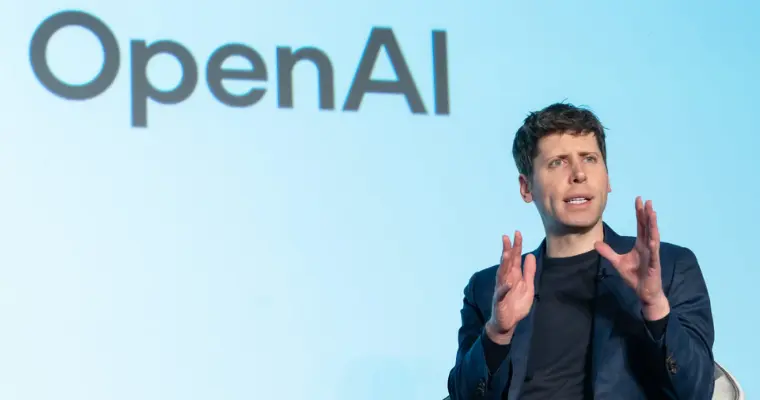
OpenAI CEO Sam Altman has acknowledged one of the biggest concerns facing the artificial intelligence industry today: companies are investing massive amounts of money into AI, but many still cannot clearly measure the return on that spending. This uncertainty contributes to the problem of enterprise AI waste.
Companies are investing heavily in AI services, but many remain unsure of when these investments will translate into higher revenues, better productivity or lower operating costs. As companies rush to implement AI tools, build out infrastructure, buy chips and roll out automation systems, a major problem is becoming harder and harder to ignore, says Altman.
The issue underscores a growing concern across the AI industry. Generative AI is attracting billions of dollars in investment and corporate adoption. But many companies are still experimenting with the technology and not necessarily deploying it in ways that have a direct impact on business outcomes.
Enterprise AI waste is becoming a problem
Altman called enterprise AI waste one of the fairest criticisms of the current AI boom. Companies see useful results from AI, but they also waste resources in many deployments.
This waste can stem from several factors, including idle computing power, poorly planned AI projects, expensive software subscriptions, and unclear internal strategies. Some companies invest in AI because they fear competitors will move ahead, rather than because they have a clear plan to improve their business.
For many companies, the challenge is no longer whether AI is powerful. Instead, they must determine whether they can deploy AI efficiently enough to justify the cost.
Companies Are Asking When AI Spending Will Pay Off
The central question for businesses is simple: when will AI investments start producing measurable returns?
Altman said companies are asking how long they need to wait before AI spending shows up in revenue and when costs will become easier to control. He believes the industry will likely improve this over the next one to two years as businesses learn how to use AI more effectively.
This reflects a wider shift in the AI market. In the early days, companies adopted AI because it was new and exciting, and they could deploy it quickly. Now, companies are moving into a more serious phase where executives want proof that AI can deliver real business value.
OpenAI’s Stargate Project Shows the Scale of AI Infrastructure Demand
Altman’s comments also connect to OpenAI’s broader infrastructure ambitions. The company’s Stargate project is designed to support the growing demand for AI compute, which has become one of the most important resources in the industry.
Training and running AI models requires a lot of computing power. As more companies use AI, the demand for data centers, chips, energy and cloud infrastructure continues to grow. OpenAI is betting that this demand will justify large-scale infrastructure investments over time.
The concern, however, is that companies could end up spending too much before they really know how much AI infrastructure they need.
Altman warns against viewing AI as a geopolitical race
Altman also warned against viewing the development of AI just as a race between countries such as the United States and China. While competition can drive innovation, he argued that AI safety, cyber security and global risk management require cooperation.
This is particularly important as AI systems become more powerful and more widely used. Areas such as biosecurity, cyber defense, and responsible deployment may require international coordination rather than pure competition.
Altman says AI could be economically competitive, but the biggest risks are global. This means governments and companies need to find ways to cooperate on safety while still encouraging innovation.
AI Adoption Isn’t Always Job-Replacing
Altman also rejected the idea that AI adoption means job losses. In his view, companies that do a good job adopting AI could actually hire more people because AI can help workers create more value.
He explained that while AI can do some things better than professionals, it doesn’t mean entire jobs are replaced. Many jobs require judgment, communication, creativity, trust, and human relationships that can’t be broken down into individual tasks.
As companies determine how to bring AI into the workplace, this human-centric perspective is gaining importance. Companies may have better success deploying AI to empower workers and increase productivity rather than replacing employees altogether.
Humans Will Be at the Center of the AI Economy
People still want human connection, human authorship,” Altman said. Even as more content is generated by AI and more tasks are automated, users still want to know who’s behind a product, service or creative work.
What this means is that the future of AI will not be a straightforward substitution of human workers with machines. Rather, the companies that will succeed most will be those able to blend the efficiencies of AI with human trust, creativity and decision-making.
Why It Matters
Sam Altman’s comments are important because they mark a turning point in the AI industry. The first phase of the AI boom was characterized by excitement, experimentation, and fear of missing out. The next phase will be characterized by accountability.
“Companies can no longer justify AI spend on the basis that they are just following the latest technology fad. They’ll need to demonstrate clear results, cut waste and build practical AI strategies that support real business goals.”
For the AI industry, this means the winners might be the companies that use AI best, not the ones that spend the most.
For more Breaking AI news, visit: https://breakingai.news
