


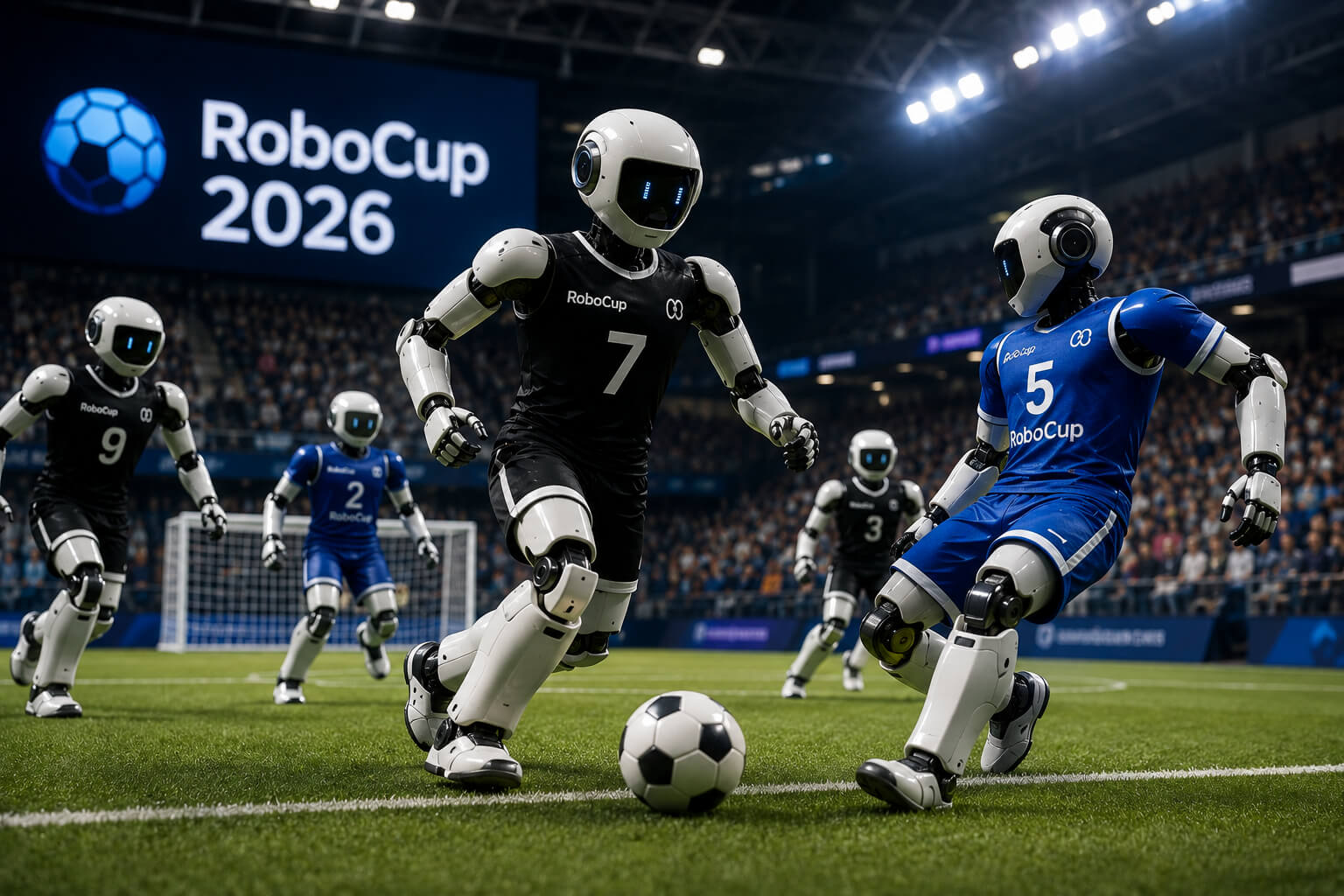
RoboCup 2026 has wrapped up in Incheon, South Korea, and the message was pretty clear. Humanoid robots are no longer just lab machines walking carefully across flat floors. They are now being pushed into messy, moving, unpredictable environments, including a football pitch.
The event, held at Songdo Convensia in Incheon, brought together researchers, engineers, developers, robotics teams, and humanoid machines from around the world. RoboCup is often described as one of the largest AI and robotics competitions globally, and this year’s edition showed why. Around 3,000 participants from 45 countries competed across different leagues, while the event reportedly drew about 15,000 visitors.
Humanoid Robots Are Learning the Game
The most watched part of RoboCup 2026 was the humanoid soccer league. Robots walked, passed, defended, adjusted their movements, and tried to score while reacting to opponents in real time.
It was not always smooth. Some robots lost balance. Some fell. A few needed help getting back on their feet. But that is also the point.
Football forces robots to deal with movement, vision, balance, teamwork, timing, and decision-making all at once. A controlled demo can hide weaknesses. A match cannot. One bad step, one late reaction, one misread opponent, and the robot is on the ground.
That makes RoboCup more than a tech show. It is a pressure test for embodied AI.
Why RoboCup Still Matters After Nearly 30 Years
RoboCup began in 1997 and has grown into a global robotics platform where AI systems are tested under real-time conditions. Its most famous long-term goal is still ambitious: to develop a fully autonomous humanoid robot football team capable of defeating the human FIFA World Cup champions by 2050.
That sounds wild. Maybe it is. But big goals have a way of forcing serious engineering.
To play football well, a robot needs to see the field, understand where the ball is, track teammates and opponents, move without falling, choose actions quickly, and cooperate with other machines. These are not small problems. They are the same kinds of problems that appear in warehouses, hospitals, factories, disaster zones, and public spaces.
A robot that can handle football is not automatically ready for the real world. Still, it is learning many of the skills the real world demands.
Tsinghua Team Defends Its Humanoid Soccer Title
In the humanoid soccer league, Tsinghua University’s THU Robotics Hephaestus team claimed the competition, defending its title after winning the previous RoboCup event in Salvador, Brazil.
That repeat win matters because RoboCup is not just about building one impressive robot. It rewards systems that can perform under competition pressure. Hardware matters. Software matters. So does recovery, coordination, and the ability to adapt when things go wrong.
And things do go wrong. Often.
That is where the useful learning happens.
The Bigger AI Story Is Not Just Soccer
The football matches are the part people remember. Tiny humanoids chasing a ball will always get attention.
But the deeper story is about autonomy.
RoboCup pushes AI out of the screen and into physical space. The robots must make decisions while moving through the world, not just process text or generate images. They have to deal with friction, impact, balance, limited sensors, shifting angles, and imperfect information.
This is where robotics becomes difficult. A chatbot can recover from a bad sentence. A humanoid robot that misjudges a step falls over in public.
That gap between digital intelligence and physical intelligence is exactly why competitions like RoboCup still feel important.
South Korea Gets a Public AI Showcase
Hosting RoboCup 2026 also gave South Korea another stage for its robotics and AI ambitions. The event placed Incheon in front of a global robotics audience and brought industry attention to humanoid systems, autonomous mobility, machine perception, and real-world AI research.
KB Financial Group served as a key sponsor, with other robotics and industry partners also backing the event.
That kind of support says something. Robotics is no longer treated as a distant research category. It is becoming part of national technology strategy, industrial planning, and public-facing innovation.
RoboCup’s 2050 Goal Still Looks Far Away
Can humanoid robots beat human World Cup champions by 2050?
Not soon. Not easily.
The robots at RoboCup 2026 showed progress, but they also showed the distance left to cover. Human players move with speed, instinct, balance, creativity, and physical intelligence that machines are still trying to approximate.
Yet the gap is shrinking in small, awkward, visible steps. A better pass here. A more stable turn there. A robot that stays upright longer than last year. That is how this kind of progress usually looks before it suddenly feels normal.
RoboCup 2026 did not prove that robots are ready to replace human athletes. It proved something more realistic and probably more important: humanoid robots are getting better at surviving real-world complexity.
And that may matter far beyond the pitch.
