


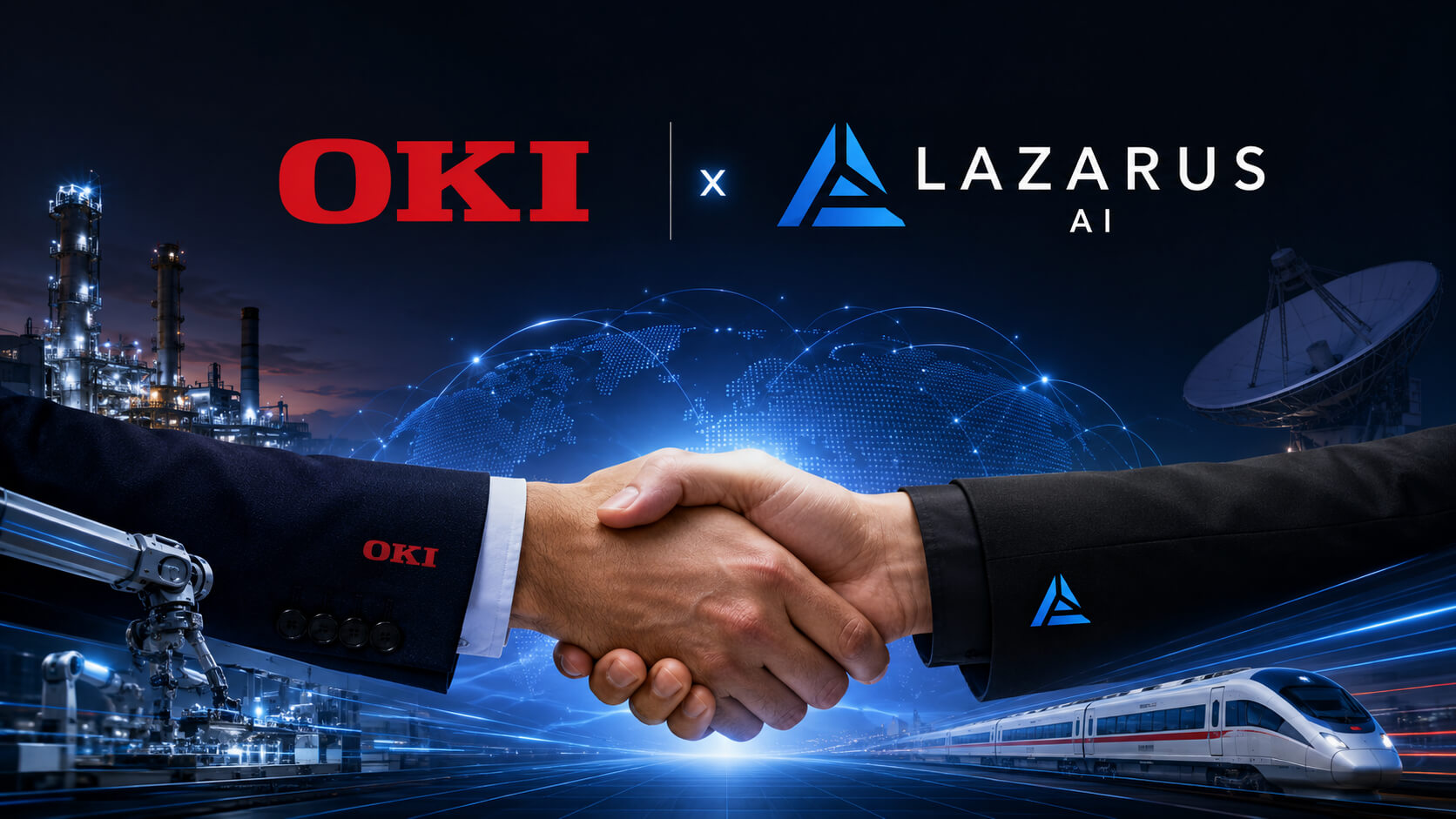
Japanese technology company OKI has signed a strategic partnership agreement with Lazarus AI, a U.S.-based company. This partnership is part of OKI’s efforts to introduce highly reliable artificial intelligence into mission-critical industries.
The agreement signed on January 1, 2026 will bring together OKI’s deep experience in public sector, defense and operational technology environments. In addition, it will combine these with Lazarus AI’s secure enterprise AI systems. The companies are looking to accelerate the use of AI in areas where accuracy, accountability, confidentiality and trust are important.
Why the OKI Lazarus AI Partnership Matters
AI adoption has accelerated exponentially in the enterprise, especially in areas that improve productivity and automate routine work. However, many organizations remain wary of deploying AI in high-risk settings such as social infrastructure, defense, regulatory functions, and core corporate decision-making.
The first big obstacle is the risk of AI hallucinations — when generative AI makes up false or unsupported info and claims it as fact. The second problem is explainability. Many AI systems have difficulty clearly identifying the sources or logic of their responses.
OKI Lazarus AI partnership is focused on solving these challenges. They use AI models and use cases that can consistently deliver in real-world, high-stakes environments.
Secure AI for Defense, Infrastructure and Business Operations
Lazarus AI is a leader in AI technology for transparency, document understanding and secure deployment. Its systems can generate information with cited sources, analyze complex documents, and operate in environments where confidentiality is critical.
According to OKI, Lazarus AI’s technologies can also be deployed in on-premises environments. This is particularly critical for organizations that handle sensitive data, and cannot rely solely on a cloud-based AI platform.
OKI’s operational experience and these capabilities will address several long-standing enterprise AI challenges:
Enhance AI accuracy for critical decision making
Provide clear evidence and sources for AI generated outputs
Support secure document analysis
Reduce workloads in complex operational environments
Assist transfer of expert knowledge from skilled personnel to AI-supported systems
Mission-Critical AI Moves Beyond Basic Automation
The partnership is indicative of a larger trend in the AI industry. Companies are no longer solely looking for tools that automate simple tasks. There is increasing demand for AI systems that can support complex decisions while maintaining reliability, traceability, and security.
“Such requirements are critical for sectors such as defense, infrastructure, finance, and government technology. AI systems used in these environments must be able to support human decision-makers without introducing unacceptable risk.
OKI and Lazarus AI plan to develop and verify AI utilization models that are robust enough for practical use in mission-critical fields. These models may support operations in critical facilities, corporate decision-making, and specialized knowledge transfer.
Lazarus AI CEO Highlights Global Growth Opportunity
Lazarus AI CEO Alex Panait said the partnership with OKI represents an important step in the company’s global go-to-market strategy. Furthermore, he highlighted OKI’s market presence, domain expertise, public-sector experience, and strong customer relationships as key strengths. These could help bring Lazarus AI’s enterprise AI technologies to more customers.
This agreement aligns with OKI’s overarching vision of utilizing cutting-edge technologies including AI. It aims to help foster a safer, more secure and sustainable society.
What’s next
OKI and Lazarus AI will create real-world AI use cases for operational environments. They will focus on building AI systems that can be trusted in industries where errors, lack of explainability or data security risks could have serious ramifications.
As AI adoption moves from experimentation to real-world deployment, such partnerships could become increasingly important. Moreover, the future of enterprise AI will likely rely on not only powerful models, but also systems that are secure, explainable, and reliable enough for mission-critical work.
