


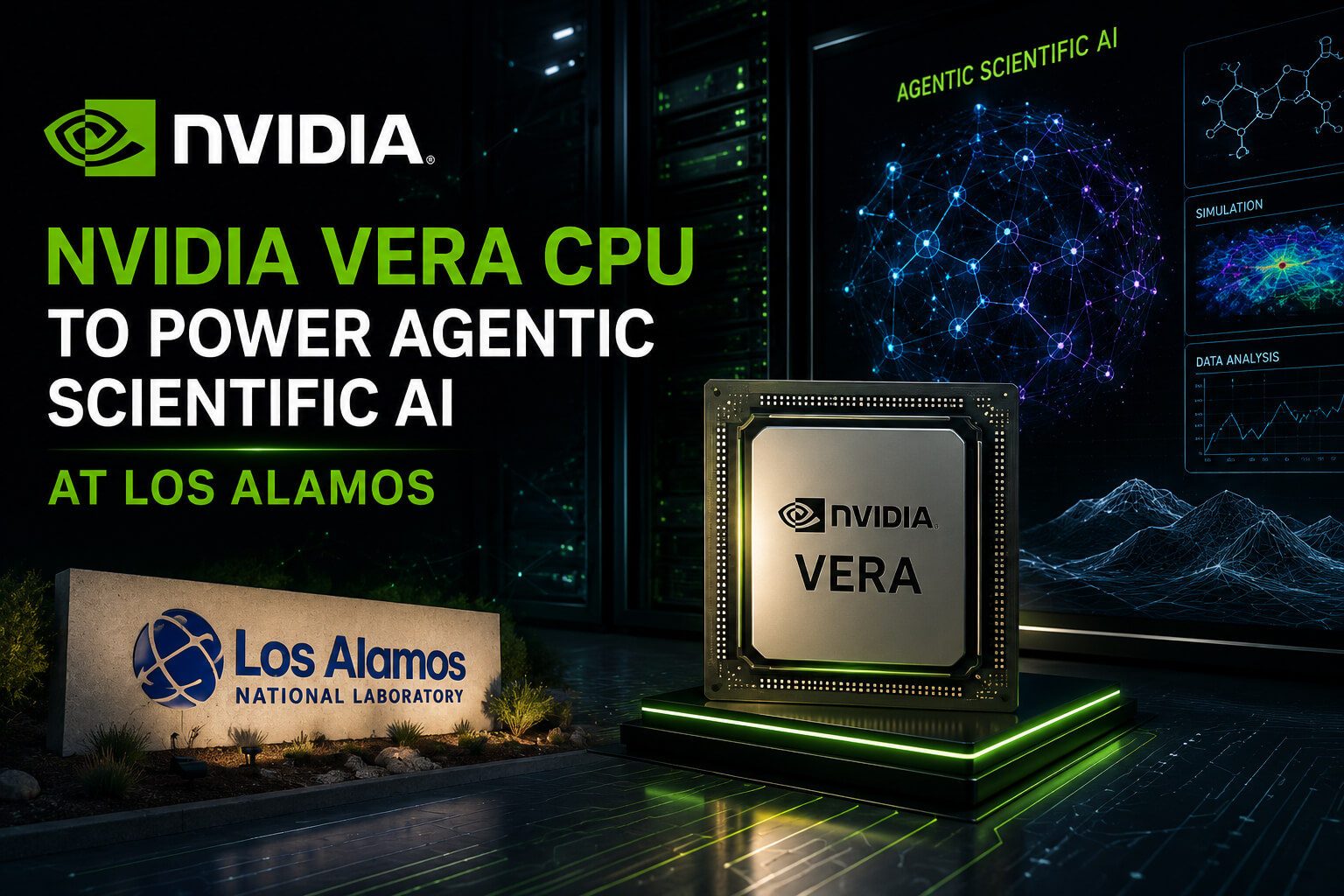
NVIDIA Vera CPU is set to play a major role in the next phase of scientific computing at Los Alamos National Laboratory, where new supercomputers will support advanced simulation, molecular design and agentic AI for research.
The systems, known as Mission, Vision and Veritas, are being developed with HPE and NVIDIA to accelerate scientific discovery. By combining NVIDIA Vera CPUs, NVIDIA Rubin GPUs and high-speed networking, the supercomputers aim to help researchers process complex workloads faster and explore new ways of using AI in science.
NVIDIA Vera CPU Expands AI Supercomputing at Los Alamos
Los Alamos National Laboratory is preparing to use NVIDIA Vera CPUs across its upcoming supercomputing systems. These machines are designed to support demanding scientific workloads, including materials simulation, molecular research, national security computing and AI-driven experimentation.
Mission, Vision and Veritas will use the HPE Cray Supercomputing GX5000 architecture with the NVIDIA Vera Rubin platform. This platform combines NVIDIA Vera CPUs, NVIDIA Rubin GPUs and NVIDIA Quantum-X800 InfiniBand networking to support large-scale AI and high-performance computing workloads.
Mission will include NVIDIA Vera Rubin GPU nodes and 2,300 standalone NVIDIA Vera CPUs using HPE Cray Supercomputing GX240 blades. Veritas will feature around 1,150 standalone NVIDIA Vera CPUs, which will complement NVIDIA Vera Rubin nodes.
Advancing Agentic AI for Scientific Research
One of the biggest goals of the new systems is to support agentic AI for science. Unlike traditional AI tools that only respond to prompts, agentic AI systems can help form hypotheses, select tools, run simulations, analyze results and refine the next research step.
This approach could change how scientists work with complex data. Instead of manually moving through every stage of research, scientists could use AI agents to assist with planning, experimentation and analysis.
Los Alamos has already shown progress in this area through URSA, or the Universal Research and Scientific Agent. URSA is a modular AI framework designed to help scientists brainstorm hypotheses, plan experiments, run simulations and interpret results.
By running these systems on advanced supercomputing infrastructure, researchers can explore faster and more automated ways to conduct scientific work.
NVIDIA Vera CPU Shows Strong Performance in Early Tests
Early testing at Los Alamos shows why NVIDIA Vera CPU is important for scientific AI workloads. According to NVIDIA, the Vera CPU delivered seven times higher performance on URSA workloads compared with CPUs in the Crossroads x86 supercomputer.
In another test using Branson, an open-source Monte Carlo heat transfer simulation tool, Vera outperformed the CPUs used in Crossroads by more than three times.
NVIDIA said Vera’s performance is supported by its custom Olympus core, LPDDR5 memory and fast on-chip fabric. A single Vera CPU also provides more memory per core and more memory per node compared with a single-socket x86 CPU.
For Los Alamos, these improvements could help reduce the time needed to complete scientific simulations and AI-driven research tasks.
Mission and Vision Supercomputers Expected in 2027
Mission is expected to become operational in 2027. It will serve as the fifth Advanced Technology System in the National Nuclear Security Administration’s Advanced Simulation and Computing program. The system will replace Crossroads for classified national security workloads.
Vision is also expected to become operational in 2027. It will support fundamental scientific research, including materials science, nuclear science, energy modeling, biomedical research and AI.
Meanwhile, Veritas will arrive alongside Mission and Vision. It will support the Laboratory Directed Research and Development program and help researchers test technologies for larger Los Alamos systems.
Building on Los Alamos and NVIDIA Collaboration
The new systems continue a long collaboration between Los Alamos and NVIDIA. Their work has included earlier platforms such as Grace and now Vera, with systems designed around real scientific workloads rather than only standard benchmarks.
The upcoming Mission, Vision and Veritas systems also build on Venado, the HPE Cray EX supercomputer installed at Los Alamos in 2024. Venado uses NVIDIA GH200 Grace Hopper Superchips and NVIDIA Grace CPU Superchips.
This continued development shows how AI infrastructure is becoming central to advanced scientific computing. As AI models become more capable, laboratories need faster CPUs, GPUs and networking systems to support simulation, reasoning and research automation.
Why NVIDIA Vera CPU Matters for Scientific AI
The NVIDIA Vera CPU is important because scientific AI requires more than raw computing power. Researchers need systems that can handle complex simulations, large datasets and AI agents that interact with scientific tools.
By supporting higher memory capacity, faster simulation performance and AI-focused workloads, Vera could help scientists move from traditional supercomputing toward more intelligent research systems.
This shift could have major implications for materials science, energy research, biomedical discovery and national security. As laboratories adopt agentic AI, supercomputers may become more than calculation engines. They could become active research partners that help scientists explore ideas faster and make better decisions.
Conclusion
NVIDIA Vera CPU is helping Los Alamos National Laboratory prepare for a new era of agentic scientific AI. With Mission, Vision and Veritas, the laboratory aims to accelerate simulation, molecular design, national research and AI-driven experimentation.
As these systems move toward operation, they highlight a growing trend in artificial intelligence: AI infrastructure is no longer only about training models. It is also becoming the foundation for scientific discovery, automated research and next-generation supercomputing.
